
Nursing practice questions with comprehensive rationales
NurseDive Free Nursing Practice Question
A nurse in an emergency department is assessing an adolescent who reports inhalation of gasoline.
Which of the following findings should the nurse expect?
A. Ataxia.
Ataxia is a neurological sign that refers to a lack of muscle coordination and can cause staggering. Inhalation of gasoline vapors can cause symptoms such as dizziness or lightheadedness, headache, facial flushing, coughing or wheezing, staggering, slurred speech, blurry vision and weakness.
B. Hypothermia.
Choice B is wrong because Hypothermia is not an answer because hypothermia refers to a dangerously low body temperature and is not a symptom of gasoline inhalation 1.
C. Hyperactive reflexes.
Choice C is wrong because Hyperactive reflexes are not an answer because hyperactive reflexes refer to overactive or overresponsive reflexes and are not a symptom of gasoline inhalation 1.
D. Pinpoint pupils.
Choice D is wrong because Pinpoint pupils are not an answer because pinpoint pupils refer to abnormally small pupils and are not a symptom of gasoline inhalation.
This question is an excerpt from Nurse Dive's nursing test bank - ATI RN Nursing Care of Children 2019 Proctored Exam. Take the full exam now
Full Explanation

Ataxia is a neurological sign that refers to a lack of muscle coordination and can cause staggering. Inhalation of gasoline vapors can cause symptoms such as dizziness or lightheadedness, headache, facial flushing, coughing or wheezing, staggering, slurred speech, blurry vision and weakness.
Choice B is wrong because Hypothermia is not an answer because hypothermia refers to a dangerously low body temperature and is not a symptom of gasoline inhalation.
Choice C is wrong because Hyperactive reflexes are not an answer because hyperactive reflexes refer to overactive or overresponsive reflexes and are not a symptom of gasoline inhalation.
Choice D is wrong because Pinpoint pupils are not an answer because pinpoint pupils refer to abnormally small pupils and are not a symptom of gasoline inhalation.
Similar Questions
A nurse is caring for a 4-year-old child who has meningitis and is receiving gentamicin.
Which of the following laboratory values should the nurse report to the provider?
A. Creatinine.4 mg/dL.
Gentamicin is an aminoglycoside antibiotic that can cause nephrotoxicity. Nephrotoxicity refers to kidney damage and can be demonstrated by rising serum creatinine levels. A creatinine level of 1.4 mg/dL is higher than the normal range and may indicate impaired kidney function 2.
B. Creatinine 0.3 mg/dL.
Choice B is wrong because Creatinine 0.3 mg/dL is not an answer because it falls within the normal range for creatinine levels.
C. BUN 12 mg/dL.
Choice C is wrong because BUN 12 mg/dL is not an answer because it falls within the normal range for BUN levels.
D. BUN 6 mg/dL.
Choice D is wrong because BUN 6 mg/dL is not an answer because it falls within the normal range for BUN levels.
Full Explanation
Choice A: Gentamicin is an aminoglycoside antibiotic that can cause nephrotoxicity. Nephrotoxicity refers to kidney damage and can be demonstrated by rising serum creatinine levels. A creatinine level of 1.4 mg/dL is higher than the normal range and may indicate impaired kidney function 2.
Choice B is wrong because Creatinine 0.3 mg/dL is not an answer because it falls within the normal range for creatinine levels.
Choice C is wrong because BUN 12 mg/dL is not an answer because it falls within the normal range for BUN levels.
Choice D is wrong because BUN 6 mg/dL is not an answer because it falls within the normal range for BUN levels.
A nurse is preparing to administer immunizations to a 3-month-old infant.
Which of the following is an appropriate action for the nurse to take to deliver atraumatic care?
A. Provide a pacifier coated with an oral sucrose solution prior to the injections.
Oral sucrose solution has been shown to have analgesic effects and can help reduce pain and discomfort in infants during procedures such as immunizations.
B. Use a 20-gauge needle for the injections.
Choice B is wrong because Use a 20-gauge needle for the injections is not an answer because a 20-gauge needle is larger than the recommended size for infant immunizations.
C. Apply eutectic mixture of local anesthetics (EMLA) cream immediately before the injections.
Choice C is wrong because Apply eutectic mixture of local anesthetics (EMLA) cream immediately before the injections is not an answer because EMLA cream needs to be applied at least 1 hour before the procedure to be effective.
D. Inject the immunizations into the deltoid muscle.
Choice D is wrong because Inject the immunizations into the deltoid muscle is not an answer because the deltoid muscle is not recommended for infants under 12 months of age.
Full Explanation

Oral sucrose solution has been shown to have analgesic effects and can help reduce pain and discomfort in infants during procedures such as immunizations.
Choice B is wrong because Use a 20-gauge needle for the injections is not an answer because a 20-gauge needle is larger than the recommended size for infant immunizations.
Choice C is wrong because Apply eutectic mixture of local anesthetics (EMLA) cream immediately before the injections is not an answer because EMLA cream needs to be applied at least 1 hour before the procedure to be effective.
Choice D is wrong because Inject the immunizations into the deltoid muscle is not an answer because the deltoid muscle is not recommended for infants under 12 months of age.
A school nurse is assessing a 7-year-old student.
The nurse should identify which of the following findings as a potential indicator of physical abuse?
A. Weight in 45th percentile.
Choice A is wrong because Weight in 45th percentile is not an answer because it falls within the normal range for weight.
B. Abrasions on the knees.
Choice B is wrong because Abrasions on the knees are not an answer because they are a common injury in children and can occur during normal play.
C. Bruising around the wrists.
Bruises in areas of the body not typically injured by accident or normal childhood activities can be a potential indicator of physical abuse.
D. Front deciduous teeth missing.
Choice D is wrong because Front deciduous teeth missing is not an answer because it is normal for children to lose their deciduous teeth.
Full Explanation
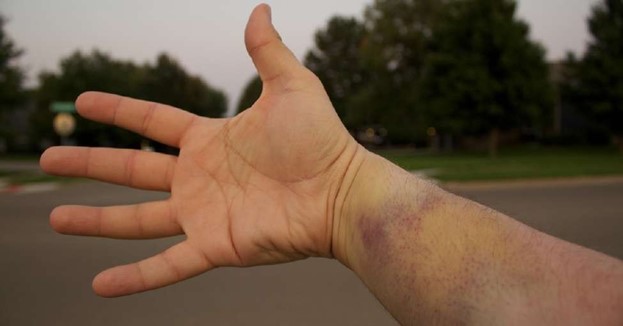
Bruises in areas of the body not typically injured by accident or normal childhood activities can be a potential indicator of physical abuse.
Choice A is wrong because Weight in 45th percentile is not an answer because it falls within the normal range for weight.
Choice B is wrong because Abrasions on the knees are not an answer because they are a common injury in children and can occur during normal play.
Choice D is wrong because Front deciduous teeth missing is not an answer because it is normal for children to lose their deciduous teeth.