Nursing practice questions with comprehensive rationales
NurseDive Free Nursing Practice Question
A nurse is assessing a 6-month-old infant at a well-child visit. Which of the following findings should the nurse expect?
A. Lateral incisors
B. Closed posterior fontanel
The posterior fontanel, located on the back of the head, usually closes by the age of 2-3 months. By 6 months of age, it is expected to be closed. By 6 months of age, infants typically do not have their lateral incisors. The primary incisors, which are the central incisors in the lower and upper jaw, usually erupt first around 6-10 months of age. At around 8 months of age, most infants are able to sit steadily without support. They can maintain an upright sitting position and may even start to reach for objects or play in a sitting position. At 6 months of age, infants are still in the developmental stage of exploring objects and refining their motor skills. They typically use a palmar grasp, where they grasp objects with their entire hand. The pincer grasp, which involves using the thumb and index finger to pick up small objects, usually develops around 9-10 months of age.
C. Sitting steadily without support
D. Uses thumb and index fingers in a pincer grasp
This question is an excerpt from Nurse Dive's nursing test bank - Paediatrics ATI Proctored Exam. Take the full exam now
Full Explanation
The posterior fontanel, located on the back of the head, usually closes by the age of 2-3 months. By 6 months of age, it is expected to be closed.
By 6 months of age, infants typically do not have their lateral incisors. The primary incisors, which are the central incisors in the lower and upper jaw, usually erupt first around 6-10 months of age.
At around 8 months of age, most infants are able to sit steadily without support. They can maintain an upright sitting position and may even start to reach for objects or play in a sitting position.
At 6 months of age, infants are still in the developmental stage of exploring objects and refining their motor skills. They typically use a palmar grasp, where they grasp objects with their entire hand. The pincer grasp, which involves using the thumb and index finger to pick up small objects, usually develops around 9-10 months of age.
Similar Questions
A nurse in a pediatric clinic is talking with the mother of a preschool-age child. The mother tells the nurse that her son is a "picky eater." Which of the following instructions should the nurse include in the teaching?
A. Emphasize the quantity, rather than the quality, of food consumed
B. Add fruit juice to the child's diet to increase vitamin intake
C. Expect that food consumption might not decrease significantly
It is important to recognize that picky eating is a common behavior among preschool-age children and may be a normal part of their development. Children at this age often exhibit preferences for certain foods and may be resistant to trying new foods or eating a wide variety of foods. It is important for parents to understand that this behavior is generally temporary and will likely improve over time. The nurse should reassure the mother that it is normal for young children to have fluctuations in their appetite and food preferences. Encouraging a positive mealtime environment and offering a variety of healthy foods is important, but pressuring or forcing the child to eat can lead to negative associations with food and mealtime. Emphasizing the quantity of food consumed over the quality is not recommended, as it may promote unhealthy eating habits. It is important to prioritize offering a balanced diet with a variety of nutrient-rich foods. Adding fruit juice to the child's diet to increase vitamin intake is not recommended as the primary strategy. Fruit juice is often high in sugar and low in fiber, and excessive consumption can contribute to poor eating habits and dental caries. It is better to focus on offering whole fruits and vegetables for their nutritional benefits. Having the child remain at the table after meals to increase food intake is not recommended either. It is important to respect the child's appetite and avoid creating negative associations with mealtime. Forcing a child to stay at the table can increase mealtime stress and may further reinforce picky eating behaviors. Overall, the nurse should provide reassurance to the mother, promote a positive mealtime environment, offer a variety of healthy foods, and allow the child to regulate their own food intake.
D. Have the child remain at the table after meals to increase food intake
Full Explanation
It is important to recognize that picky eating is a common behavior among preschool-age children and may be a normal part of their development. Children at this age often exhibit preferences for certain foods and may be resistant to trying new foods or eating a wide variety of foods. It is important for parents to understand that this behavior is generally temporary and will likely improve over time.
The nurse should reassure the mother that it is normal for young children to have fluctuations in their appetite and food preferences. Encouraging a positive mealtime environment and offering a variety of healthy foods is important, but pressuring or forcing the child to eat can lead to negative associations with food and mealtime.
Emphasizing the quantity of food consumed over the quality is not recommended, as it may promote unhealthy eating habits. It is important to prioritize offering a balanced diet with a variety of nutrient-rich foods.
Adding fruit juice to the child's diet to increase vitamin intake is not recommended as the primary strategy. Fruit juice is often high in sugar and low in fiber, and excessive consumption can contribute to poor eating habits and dental caries. It is better to focus on offering whole fruits and vegetables for their nutritional benefits.
Having the child remain at the table after meals to increase food intake is not recommended either. It is important to respect the child's appetite and avoid creating negative associations with mealtime. Forcing a child to stay at the table can increase mealtime stress and may further reinforce picky eating behaviors.
Overall, the nurse should provide reassurance to the mother, promote a positive mealtime environment, offer a variety of healthy foods, and allow the child to regulate their own food intake.
A nurse is assessing the psychosocial development of a toddler. The nurse should recognize that this stage is characterized by which of the following?
A. Imaginary playmates
Imaginary playmates are more common in the preschool years, typically around ages 3 to 5, rather than during the toddler stage.
B. Negative behaviors characterized by the need for autonomy
Toddlers are in Erikson's stage of autonomy versus shame and doubt. During this stage, they strive for independence and autonomy, often exhibiting negative behaviors such as saying "no" frequently as they assert their independence. They are often in the stage of asserting their independence, leading to behaviors like tantrums, stubbornness, and defiance.
C. Demonstrations of sexual curiosity
Sexual curiosity is more commonly seen in preschool and school-age children, not typically in toddlers.
D. Erikson's stage of initiative versus guilt
This stage applies to preschool-aged children (approximately 3 to 6 years old), where they begin to assert power and control over their environment through directing play and other social interactions.
Full Explanation
a. Imaginary playmates are more common in the preschool years, typically around ages 3 to 5, rather than during the toddler stage.
b. Toddlers are in Erikson's stage of autonomy versus shame and doubt. During this stage, they strive for independence and autonomy, often exhibiting negative behaviors such as saying "no" frequently as they assert their independence. They are often in the stage of asserting their independence, leading to behaviors like tantrums, stubbornness, and defiance.
c. Sexual curiosity is more commonly seen in preschool and school-age children, not typically in toddlers.
d. This stage applies to preschool-aged children (approximately 3 to 6 years old), where they begin to assert power and control over their environment through directing play and other social interactions.
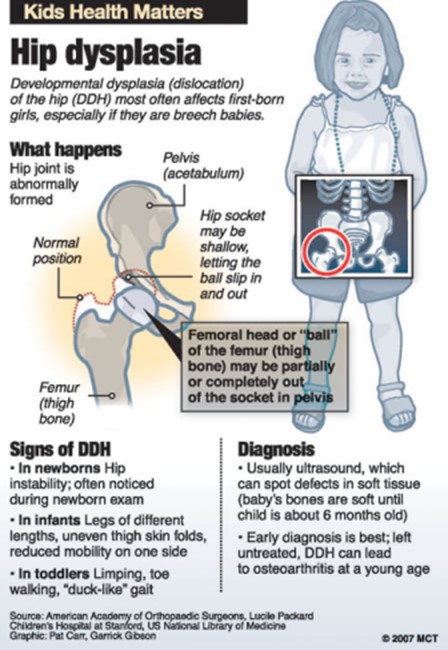
A nurse is assessing a newborn who has developmental dysplasia of the hip (DDH). Which of the following findings should the nurse expect?
A. Inwardly turned foot on the affected side
B. Absent plantar reflexes
C. Lengthened thigh on the affected side
D. Asymmetric thigh fold
DDH refers to an abnormal development or alignment of the hip joint, which can lead to instability or dislocation of the hip. An asymmetric thigh fold is a common physical finding in DDH, where there is a difference in the skin fold between the affected and unaffected sides of the thigh. This occurs due to the malposition or displacement of the femoral head within the acetabulum. While other findings may also be present in DDH, such as an inwardly turned foot on the affected side (also known as a positive Ortolani or Barlow test), absent plantar reflexes, or a lengthened thigh on the affected side, the asymmetric thigh fold is a key indicator of hip dysplasia in a newborn.
Full Explanation
DDH refers to an abnormal development or alignment of the hip joint, which can lead to instability or dislocation of the hip. An asymmetric thigh fold is a common physical finding in DDH, where there is a difference in the skin fold between the affected and unaffected sides of the thigh. This occurs due to the malposition or displacement of the femoral head within the acetabulum.
While other findings may also be present in DDH, such as an inwardly turned foot on the affected side (also known as a positive Ortolani or Barlow test), absent plantar reflexes, or a lengthened thigh on the affected side, the asymmetric thigh fold is a key indicator of hip dysplasia in a newborn.