
Nursing practice questions with comprehensive rationales
NurseDive Free Nursing Practice Question
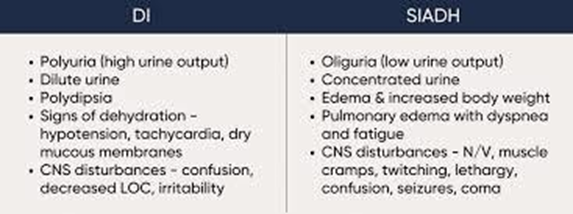
A nurse is assessing a client who had a craniotomy and has developed syndrome of inappropriate antidiuretic hormone (SIADH). Which of the following manifestations should the nurse anticipate?
A. Weight loss
SIADH leads to water retention due to excessive secretion of antidiuretic hormone (ADH), resulting in weight gain rather than weight loss.
B. Oliguria
SIADH causes the kidneys to retain water, leading to decreased urine output (oliguria) and concentrated urine.
C. Hypernatremia
SIADH typically results in dilutional hyponatremia due to water retention, not hypernatremia.
D. Increased thirst
In SIADH, the body retains water excessively, leading to decreased serum osmolality and suppression of thirst, rather than increased thirst.
This question is an excerpt from Nurse Dive's nursing test bank - Ati Med Surg Proctored Exam 8. Take the full exam now
Full Explanation
A) SIADH leads to water retention due to excessive secretion of antidiuretic hormone (ADH), resulting in weight gain rather than weight loss.
B) SIADH causes the kidneys to retain water, leading to decreased urine output (oliguria) and concentrated urine.
C) SIADH typically results in dilutional hyponatremia due to water retention, not hypernatremia.
D) In SIADH, the body retains water excessively, leading to decreased serum osmolality and suppression of thirst, rather than increased thirst.
Similar Questions
A nurse is caring for a client who has syndrome of inappropriate antidiuretic hormone (SIADH) and a sodium level of 123 mEq/L. Which of the following prescriptions should the nurse anticipate?
A. Maintain an IV of 0.45% sodium chloride.
Infusing hypotonic fluids such as 0.45% sodium chloride can exacerbate hyponatremia in a client with SIADH by further diluting serum sodium levels.
B. Administer desmopressin acetate 0.2 mg orally.
Desmopressin acetate is a synthetic form of ADH and would exacerbate the symptoms of SIADH by increasing water reabsorption and further diluting serum sodium levels.
C. Provide a diet containing 2 g of sodium per day.
Increasing dietary sodium intake would not be appropriate for a client with SIADH, as it would contribute to further fluid retention and exacerbate hyponatremia.
D. Restrict fluid intake to 1,000 mL per day.
Fluid restriction is a key component of managing SIADH to prevent further water retention and dilutional hyponatremia. Restricting fluid intake helps to normalize serum sodium levels by allowing excess water to be excreted.
Full Explanation
A. Infusing hypotonic fluids such as 0.45% sodium chloride can exacerbate hyponatremia in a client with SIADH by further diluting serum sodium levels.
B. Desmopressin acetate is a synthetic form of ADH and would exacerbate the symptoms of SIADH by increasing water reabsorption and further diluting serum sodium levels.
C. Increasing dietary sodium intake would not be appropriate for a client with SIADH, as it would contribute to further fluid retention and exacerbate hyponatremia.
D. Fluid restriction is a key component of managing SIADH to prevent further water retention and dilutional hyponatremia. Restricting fluid intake helps to normalize serum sodium levels by allowing excess water to be excreted.
A nurse is assisting with the care of a client who has metabolic alkalosis. Which of the following actions should the nurse take?
A. Place the client on seizure precautions.
Placing the client on seizure precautions is important as metabolic alkalosis can cause neurological symptoms, such as confusion and increased risk for seizures due to electrolyte imbalances (e.g., low calcium levels). Therefore, seizure precautions are warranted.
B. Have the client breath into a paper bag.
Breathing into a paper bag is used in respiratory alkalosis to increase CO2 levels, but it is not appropriate in metabolic alkalosis, where the issue is not primarily related to CO2 imbalance.
C. Encourage the client to breath slowly,
Encouraging the client to breathe slowly is generally more appropriate for respiratory alkalosis, not metabolic alkalosis. Slow breathing would not directly address the underlying issue of metabolic alkalosis.
D. Plan to administer sodium bicarbonate to the client
Administering sodium bicarbonate would worsen metabolic alkalosis, as it would further increase the alkalotic state. Sodium bicarbonate is used in metabolic acidosis, not alkalosis.
Full Explanation
A. Placing the client on seizure precautions is important as metabolic alkalosis can cause neurological symptoms, such as confusion and increased risk for seizures due to electrolyte imbalances (e.g., low calcium levels). Therefore, seizure precautions are warranted.
B. Breathing into a paper bag is used in respiratory alkalosis to increase CO2 levels, but it is not appropriate in metabolic alkalosis, where the issue is not primarily related to CO2 imbalance.
C. Encouraging the client to breathe slowly is generally more appropriate for respiratory alkalosis, not metabolic alkalosis. Slow breathing would not directly address the underlying issue of metabolic alkalosis.
D. Administering sodium bicarbonate would worsen metabolic alkalosis, as it would further increase the alkalotic state. Sodium bicarbonate is used in metabolic acidosis, not alkalosis.
A nurse is reviewing the medication record for a client who has chronic kidney disease. Which of the following medications should the nurse identify as having the potential to cause nephrotoxicity?
A. Ondansetron
Ondansetron is an antiemetic commonly used to prevent nausea and vomiting, and it is not typically associated with nephrotoxicity.
B. Diphenhydramine
Diphenhydramine is an antihistamine used for allergy symptoms and as a sleep aid. It is not known to cause nephrotoxicity.
C. Vancomycin
Vancomycin is an antibiotic that can cause nephrotoxicity, especially when administered in high doses or in individuals with impaired renal function. Monitoring renal function is crucial when using vancomycin.
D. Omeprazole
Omeprazole is a proton pump inhibitor used to reduce gastric acid secretion and treat conditions such as gastroesophageal reflux disease (GERD) and peptic ulcers. It is not associated with nephrotoxicity.
Full Explanation
A. Ondansetron is an antiemetic commonly used to prevent nausea and vomiting, and it is not typically associated with nephrotoxicity.
B. Diphenhydramine is an antihistamine used for allergy symptoms and as a sleep aid. It is not known to cause nephrotoxicity.
C. Vancomycin is an antibiotic that can cause nephrotoxicity, especially when administered in high doses or in individuals with impaired renal function. Monitoring renal function is crucial when using vancomycin.
D. Omeprazole is a proton pump inhibitor used to reduce gastric acid secretion and treat conditions such as gastroesophageal reflux disease (GERD) and peptic ulcers. It is not associated with nephrotoxicity.