Nursing practice questions with comprehensive rationales
NurseDive Free Nursing Practice Question
A nurse is assisting the provider with a lumbar puncture for a client who has manifestations of meningitis.
Into which of the following positions should the nurse assist the client?
A. Head flexed to the chest and her knees pulled up to the abdomen
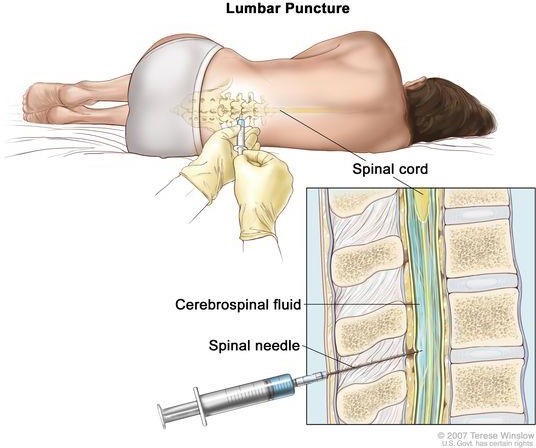
The appropriate position for a lumbar puncture is typically the fetal or sitting position. Option A describes a position where the client's head is flexed to the chest, and the knees are pulled up to the abdomen. This position helps open up the intervertebral spaces, facilitating access to the lumbar region for the lumbar puncture.
B. Arms raised above her head with her legs elevated on pillows
With the arms raised above the head and legs elevated on pillows, is not the appropriate position for a lumbar puncture. This position does not facilitate access to the lumbar region and may cause discomfort for the client.
C. Prone with her arms at her side and her legs extended
The prone position (lying face down) with arms at the side and legs extended is not suitable for a lumbar puncture, as it does not provide the necessary spinal curvature for the procedure. When assisting with a lumbar puncture, the client should be positioned in the prone position with the head turned to the side and the knees flexed slightly toward the chest. This position helps to open up the spaces between the vertebrae, making it easier for the provider to access the lumbar region.
D. Trendelenburg with her body in Sims' position
Trendelenburg position involves the client being tilted with the head lower than the feet. Sims' position is a lateral position often used for rectal examinations but is not appropriate for lumbar punctures.
This question is an excerpt from Nurse Dive's nursing test bank - ATI PN Comprehensive Predictor 2023 Proctored Exam 4. Take the full exam now
Full Explanation
Similar Questions
A nurse is receiving change-of-shift report on four clients.
Which of the following clients should the nurse plan to see first?
A. A client who has cirrhosis and severe pruritus
Pruritus (severe itching) can be distressing for the client, but it is not an immediate life-threatening condition that requires immediate intervention.
B. A client who had a laparoscopic appendectomy 8 hr. ago and is awaiting discharge
This client has already undergone surgery and is in the postoperative period. While they may require routine assessments and care, they are stable and can wait for the nurse's attention.
C. A client who has a femur fracture and reports numbness of the toes
When prioritizing care, the nurse should consider the urgency and potential complications associated with each client's condition. Based on the given information, the nurse should plan to see the client who has a femur fracture and reports numbness of the toes first. The client with a femur fracture and numbness of the toes is experiencing a potential neurovascular compromise. Numbness can indicate impaired circulation or nerve damage, which requires immediate assessment and intervention to prevent further complications.
D. A client who had a renal biopsy 3 hr. ago and has pink-tinged urine
Pink-tinged urine following a renal biopsy can be expected due to blood in the urine. While the nurse should monitor the client's condition closely, it is not an immediate concern unless there is excessive bleeding or signs of complications.
Full Explanation
When prioritizing care, the nurse should consider the urgency and potential complications associated with each client's condition. Based on the given information, the nurse should plan to see the client who has a femur fracture and reports numbness of the toes first.
The client with a femur fracture and numbness of the toes is experiencing a potential neurovascular compromise. Numbness can indicate impaired circulation or nerve damage, which requires immediate assessment and intervention to prevent further complications.
The other clients also require attention, but their conditions are not as urgent as a potential neurovascular compromise. Here's a brief explanation of the other options:
Option A, A client who has cirrhosis and severe pruritus is incorrect: Pruritus (severe itching) can be distressing for the client, but it is not an immediate life-threatening condition that requires immediate intervention.
Option B, A client who had a laparoscopic appendectomy 8 hr ago and is awaiting discharge is incorrect: This client has already undergone surgery and is in the postoperative period. While they may require routine assessments and care, they are stable and can wait for the nurse's attention.
Option D A client who had a renal biopsy 3 hr ago and has pink-tinged urine is incorrect: Pink-tinged urine following a renal biopsy can be expected due to blood in the urine. While the nurse should monitor the client's condition closely, it is not an immediate concern unless there is excessive bleeding or signs of complications.
A nurse in a provider's office is collecting data from a client who has psoriasis.
Which of the following statements by the client should the nurse report to the provider?
A. I limit my time spent out in the sunlight
Sunlight exposure can actually be beneficial for clients with psoriasis, as ultraviolet (UV) light can help reduce the growth of skin cells and alleviate symptoms. If the client is limiting their sunlight exposure, they might be missing out on a potential therapeutic benefit. However, it is important to balance sun exposure and avoid overexposure to prevent skin damage.
B. I do not use fabric softener when I wash my clothing.
Avoiding fabric softener can be a proactive measure to prevent skin irritation, which is beneficial for someone with psoriasis.
C. I try not to look at the scales on my body.
This could indicate emotional distress or body image concerns, but it doesn’t necessarily need to be reported unless the client shows signs of depression or anxiety affecting their daily life.
D. I remove old medication on my skin before applying a new dose.
This is correct practice to ensure the effectiveness of the medication.
E. None
None
F. None
None
Full Explanation
A. Sunlight exposure can actually be beneficial for clients with psoriasis, as ultraviolet (UV) light can help reduce the growth of skin cells and alleviate symptoms. If the client is limiting their sunlight exposure, they might be missing out on a potential therapeutic benefit. However, it is important to balance sun exposure and avoid overexposure to prevent skin damage.
B. Avoiding fabric softener can be a proactive measure to prevent skin irritation, which is beneficial for someone with psoriasis.
C. This could indicate emotional distress or body image concerns, but it doesn’t necessarily need to be reported unless the client shows signs of depression or anxiety affecting their daily life.
D. This is correct practice to ensure the effectiveness of the medication.

A nurse is caring for a client who is postoperative following a subtotal thyroidectomy.
The nurse should place the client in which of the following positions?
A. Dorsal recumbent
Is a supine position with the knees flexed and the feet flat on the bed. This position is not typically used postoperatively for a subtotal thyroidectomy.
B. Supine
Is a position where the client lies flat on their back with their face up. While this position may be used for some postoperative clients, it is not the best choice for a client who has undergone a thyroidectomy due to the risk of swelling and respiratory discomfort.
C. Semi-Fowler's
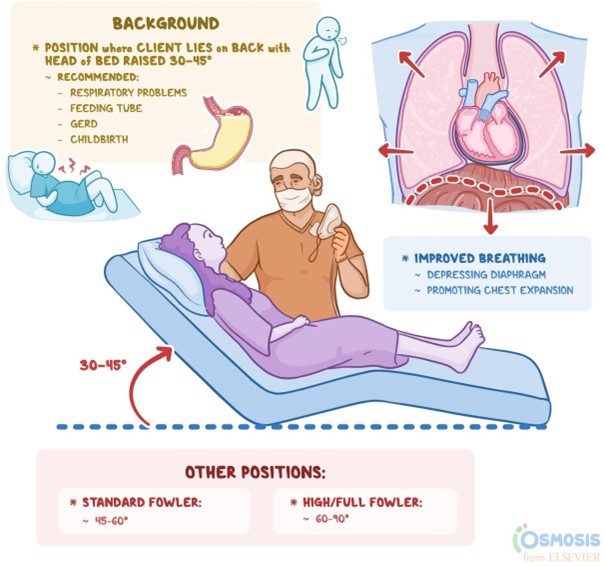
The Semi-Fowler's position is a sitting position with the head of the bed elevated at an angle between 30 to 45 degrees. This position helps to reduce swelling and promote comfort and respiratory function after a thyroidectomy. The elevation of the head and upper body helps to prevent pressure on the surgical site, reduces the risk of swelling, and facilitates breathing.
D. Left lateral
Is a side-lying position on the left side. This position may be used for clients undergoing certain surgical procedures or for certain medical conditions, but it is not specifically indicated for a client who has had a subtotal thyroidectomy.
Full Explanation
The Semi-Fowler's position is a sitting position with the head of the bed elevated at an angle between 30 to 45 degrees. This position helps to reduce swelling and promote comfort and respiratory function after a thyroidectomy. The elevation of the head and upper body helps to prevent pressure on the surgical site, reduces the risk of swelling, and facilitates breathing.
Dorsal recumbent in (option A) is incorrect because it, is a supine position with the knees flexed and the feet flat on the bed. This position is not typically used postoperatively for a subtotal thyroidectomy.
Supine in (option B) is incorrect because it, is a position where the client lies flat on their back with their face up. While this position may be used for some postoperative clients, it is not the best choice for a client who has undergone a thyroidectomy due to the risk of swelling and respiratory discomfort.
Left latera in (option D) is incorrect because it, is a side-lying position on the left side. This position may be used for clients undergoing certain surgical procedures or for certain medical conditions, but it is not specifically indicated for a client who has had a subtotal thyroidectomy.