Nursing practice questions with comprehensive rationales
NurseDive Free Nursing Practice Question
A nurse is caring for a child who has asthma and a prescription for montelukast granules. Which of the following instructions should the nurse provide the client's parent on administering the medication?
A. Administer the granules mixed with 20 oz of water.
Administering the granules mixed with 20 oz of water is not necessary. Montelukast granules can be administered directly into the mouth or mixed with a small amount of soft food (e.g., applesauce) if necessary. The specific instructions for administration should be provided by the healthcare provider or included in the product labeling.
B. Administer the medication 2 hr before exercise.
If you’re using it to prevent breathing problems related to exercise, take a single dose at least 2 hours before exercising. However, another dose cannot be taken within 24 hours.
C. Give the medication in the morning daily
Montelukast is a leukotriene receptor antagonist commonly used for the maintenance treatment of asthma in children and adults. The usual recommended dose is once daily in the evening, depending on the specific instructions from the healthcare provider.
D. Give the medication at the onset of wheezing
Administering the medication at the onset of wheezing is not the recommended approach. Montelukast is a daily maintenance medication for asthma and should be taken regularly as prescribed, regardless of wheezing symptoms. It is not intended to be used for immediate relief of wheezing or acute asthma symptoms. Short-acting bronchodilators are typically used for quick relief of wheezing or acute asthma symptoms.
This question is an excerpt from Nurse Dive's nursing test bank - ATI NUR 229 Pharmacology Test #1 OEK Proctored Exam. Take the full exam now
Full Explanation
A. Administering the granules mixed with 20 oz of water is not necessary. Montelukast granules can be administered directly into the mouth or mixed with a small amount of soft food (e.g., applesauce) if necessary. The specific instructions for administration should be provided by the healthcare provider or included in the product labeling.
B. If you’re using it to prevent breathing problems related to exercise, take a single dose at least 2 hours before exercising. However, another dose cannot be taken within 24 hours.
C. Montelukast is a leukotriene receptor antagonist commonly used for the maintenance treatment of asthma in children and adults. The usual recommended dose is once daily in the evening, depending on the specific instructions from the healthcare provider.
D. Administering the medication at the onset of wheezing is not the recommended approach. Montelukast is a daily maintenance medication for asthma and should be taken regularly as prescribed, regardless of wheezing symptoms. It is not intended to be used for immediate relief of wheezing or acute asthma symptoms. Short-acting bronchodilators are typically used for quick relief of wheezing or acute asthma symptoms.
Similar Questions
A nurse is providing discharge teaching to the parent of a child who is prescribed diphenhydramine 25 mg elixir every 4 hr as needed. The amount available is diphenhydramine elixir 12.5 mg/5 mL. How many mL should the nurse administer per dose?
(Round the answer to the nearest tenth. Use a leading zero if it applies. Do not use a trailing zero.)
Full Explanation
To determine the mL of diphenhydramine elixir to administer per dose, we need to calculate the dose based on the prescribed amount and the concentration of the elixir.
Given:
Prescribed dose: 25 mg Concentration of elixir: 12.5 mg/5 mL
We can set up a proportion to find the equivalent mL for the prescribed dose: 25 mg / x mL = 12.5 mg / 5 mL
Cross-multiplying and solving for x, we get:
25 mg * 5 mL = 12.5 mg * x mL 125 mg = 12.5 mg * x mL
125 mg / 12.5 mg = x mL 10 mL = x mL
Therefore, the nurse should administer 10 mL of diphenhydramine elixir per dose.
A nurse is caring for a client who has poison ivy and is prescribed diphenhydramine. Which of the following instructions should the nurse give regarding the adverse effect of dry mouth associated with diphenhydramine?
A. "Administer the medication with food."
"Administer the medication with food": While taking diphenhydramine with food may help reduce the risk of stomach upset, it does not directly address the dry mouth side effect.
B. "Discontinue the medication and notify your provider.”
"Discontinue the medication and notify your provider": Discontinuing the medication without consulting the healthcare provider is not recommended unless specifically instructed to do so. Dry mouth is a common side effect of diphenhydramine and can be managed with supportive measures.
C. "Place a humidifier at your bedside every evening.”
"Place a humidifier at your bedside every evening": While using a humidifier can help add moisture to the air and potentially alleviate dryness in the environment, it is not a specific instruction for managing dry mouth caused by diphenhydramine.
D. “Chew on sugarless gum or suck on hard, sour candies."
Dry mouth is a common side effect of diphenhydramine, which is an antihistamine medication commonly used to relieve symptoms of allergies, including itching and rash. Chewing on sugarless gum or sucking on hard, sour candies can help stimulate saliva production and alleviate the discomfort of dry mouth.
Full Explanation
Dry mouth is a common side effect of diphenhydramine, which is an antihistamine medication commonly used to relieve symptoms of allergies, including itching and rash. Chewing on sugarless gum or sucking on hard, sour candies can help stimulate saliva production and alleviate the discomfort of dry mouth.

A. "Administer the medication with food": While taking diphenhydramine with food may help reduce the risk of stomach upset, it does not directly address the dry mouth side effect.
B. "Discontinue the medication and notify your provider": Discontinuing the medication without consulting the healthcare provider is not recommended unless specifically instructed to do so. Dry mouth is a common side effect of diphenhydramine and can be managed with supportive measures.
C. "Place a humidifier at your bedside every evening": While using a humidifier can help add moisture to the air and potentially alleviate dryness in the environment, it is not a specific instruction for managing dry mouth caused by diphenhydramine.
A nurse is teaching a client who has asthma about how to use an albuterol inhaler. Which of the following actions by the client indicates an understanding of the teaching?
A. The client waits 10 min between inhalations.
Waiting 10 minutes between inhalations: Albuterol inhalers are typically used as a quick-relief medication for acute symptoms, and waiting 10 minutes between inhalations may not provide immediate relief when needed. The specific instructions on the frequency of inhalations should be provided by the healthcare provider.
B. The client takes a quick inhalation while releasing the medication from the inhaler.
Taking a quick inhalation while releasing the medication from the inhaler: It is important to take a slow and deep inhalation while releasing the medication to ensure that the medication reaches the lungs effectively. Taking a quick inhalation may result in less effective delivery of the medication.
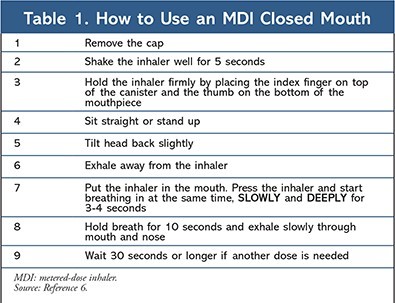
C. The client holds his breath for 10 seconds after inhaling the medication.
When using an albuterol inhaler, it is important for the client to take a slow and deep inhalation while releasing the medication from the inhaler. After inhaling the medication, holding the breath for about 10 seconds allows the medication to reach deep into the airways and maximize its effectiveness.
D. The client exhales as the medication is released from the inhaler.
Exhaling as the medication is released from the inhaler: It is important to exhale fully before using the inhaler to ensure that the medication is inhaled deeply into the lungs. Exhaling while releasing the medication can interfere with the proper inhalation technique.
Full Explanation
When using an albuterol inhaler, it is important for the client to take a slow and deep inhalation while releasing the medication from the inhaler. After inhaling the medication, holding the breath for about 10 seconds allows the medication to reach deep into the airways and maximize its effectiveness.
The other actions mentioned are not correct:
A. Waiting 10 minutes between inhalations: Albuterol inhalers are typically used as a quick-relief medication for acute symptoms, and waiting 10 minutes between inhalations may not provide immediate relief when needed. The specific instructions on the frequency of inhalations should be provided by the healthcare provider.
B. Taking a quick inhalation while releasing the medication from the inhaler: It is important to take a slow and deep inhalation while releasing the medication to ensure that the medication reaches the lungs effectively. Taking a quick inhalation may result in less effective delivery of the medication.
D. Exhaling as the medication is released from the inhaler: It is important to exhale fully before using the inhaler to ensure that the medication is inhaled deeply into the lungs. Exhaling while releasing the medication can interfere with the proper inhalation technique.