
Nursing practice questions with comprehensive rationales
NurseDive Free Nursing Practice Question
A nurse is caring for a client 4 hr following evacuation of a subdural hematoma. Which of the following assessments is the nurse's priority?
A. Respiratory status
Choice A: Respiratory Status Reason: After the evacuation of a subdural hematoma, monitoring the respiratory status is crucial. This is because changes in respiratory patterns can indicate increased intracranial pressure (ICP) or brainstem compression, which are life-threatening conditions. Ensuring that the airway is clear and that the patient is breathing adequately is the top priority. Normal respiratory rate for adults is 12-20 breaths per minute.
B. Temperature
Choice B: Temperature Reason: While monitoring temperature is important to detect infections or other complications, it is not the immediate priority in the acute postoperative period following a subdural hematoma evacuation. Fever can indicate infection, but it is less likely to cause immediate life-threatening complications compared to respiratory issues.
C. Intracranial pressure
Choice C: Intracranial pressure Intracranial pressure (ICP) is crucial to monitor, but it is often assessed through indirect signs such as changes in respiratory status, level of consciousness, and pupil response. Direct measurement of ICP might not be feasible in all settings, making respiratory status a more practical and immediate indicator.
D. Serum electrolytes
Choice D: Serum Electrolytes Reason: Serum electrolytes are important to monitor for overall metabolic stability and to detect imbalances that could affect neurological function. Normal ranges for key electrolytes are: Sodium (135-145 mEq/L), Potassium (3.5-4.5 mEq/L), and Chloride (80-100 mEq/L). However, these are not the immediate priority in the acute phase following surgery compared to respiratory status.
This question is an excerpt from Nurse Dive's nursing test bank - ATI Med Surg Custom N235 Final Summer 2023 Proctored Exam. Take the full exam now
Full Explanation
The correct answer is a. Respiratory status.
Choice A: Respiratory Status
Reason: After the evacuation of a subdural hematoma, monitoring the respiratory status is crucial. This is because changes in respiratory patterns can indicate increased intracranial pressure (ICP) or brainstem compression, which are life-threatening conditions. Ensuring that the airway is clear and that the patient is breathing adequately is the top priority. Normal respiratory rate for adults is 12-20 breaths per minute.
Choice B: Temperature
Reason: While monitoring temperature is important to detect infections or other complications, it is not the immediate priority in the acute postoperative period following a subdural hematoma evacuation. Fever can indicate infection, but it is less likely to cause immediate life-threatening complications compared to respiratory issues.
Choice C: Intracranial Pressure
Reason: Monitoring intracranial pressure (ICP) is very important in patients with brain injuries. Normal ICP ranges from 5-15 mmHg. However, changes in respiratory status can be an early indicator of increased ICP. Therefore, while ICP monitoring is critical, ensuring the patient’s respiratory status is stable takes precedence.
Choice D: Serum Electrolytes
Reason: Serum electrolytes are important to monitor for overall metabolic stability and to detect imbalances that could affect neurological function. Normal ranges for key electrolytes are: Sodium (135-145 mEq/L), Potassium (3.5-4.5 mEq/L), and Chloride (80-100 mEq/L). However, these are not the immediate priority in the acute phase following surgery compared to respiratory status.
Similar Questions
A nurse is admitting a client who has sustained severe burn injuries in a grease fire. The nurse shades in a diagram indicating the burned surface areas. Using the Rule of Nines, the nurse should estimate that the client has burned what percentage of body surface area? (Round the answer to the nearest tenth. Use a leading zero if it applies. Do not use a trailing zero.)
Full Explanation
To estimate the percentage of body surface area burned using the Rule of Nines, follow these guidelines:
- Head and Neck: 9%
- Each Arm: 9% (right arm) + 9% (left arm) = 18%
- Front of Torso: 18%
- Back of Torso: 18%
- Each Leg: 18% (right leg) + 18% (left leg) = 36%
- Genital Area: 1%
Now, add up the percentages of the burned areas:
9% (head and neck) + 18% (each arm) + 18% (front of torso) + 18% (back of torso) + 36% (each leg) + 1% (genital area) = 100%
So, the nurse should estimate that the client has burned 100% of their body surface area.
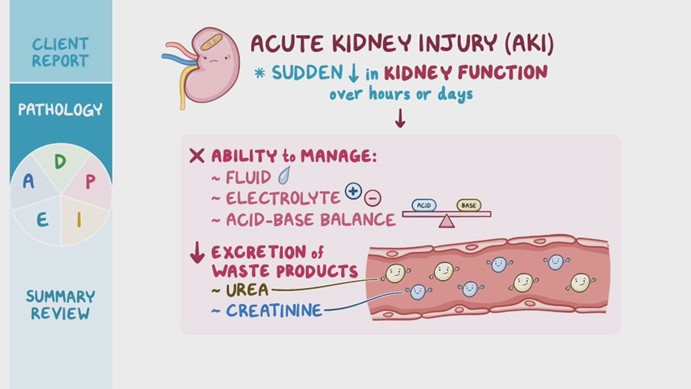
A nurse is caring for a client who has acute kidney injury (AKI). Which of the following arterial blood gas values would the nurse expect this client to have?
A. pH 7.49, HCO3 24, PaCO2 30
Reason: This choice is incorrect because it indicates respiratory alkalosis, not AKI. Respiratory alkalosis is a condition in which the lungs eliminate too much carbon dioxide (CO2) from the blood, resulting in a low level of CO2 (PaCO2) and a high level of pH. A normal PaCO2 range is 35 to 45 mm Hg, and a normal pH range is 7.35 to 7.45, so a value of 30 mm Hg and 7.49 indicate respiratory alkalosis.
B. pH 7.26, HCO3 24, PaCO2 46
Reason: This choice is incorrect because it indicates respiratory acidosis, not AKI. Respiratory acidosis is a condition in which the lungs cannot eliminate enough CO2 from the blood, resulting in a high level of CO2 (PaCO2) and a low level of pH. A value of 46 mm Hg and 7.26 indicate respiratory acidosis.
C. pH 7.26, HCO3 14, PaCO2 30
Reason: This choice is correct because it indicates metabolic acidosis, which is a common complication of AKI. Metabolic acidosis is a condition in which the body produces too much acid or loses too much base, resulting in a low level of bicarbonate (HCO3) and a low level of pH. A normal HCO3 range is 22 to 26 mEq/L, so a value of 14 mEq/L indicates metabolic acidosis. The low PaCO2 value (30 mm Hg) is due to the respiratory compensation mechanism that tries to restore the acid-base balance by increasing the ventilation and eliminating more CO2.
D. pH 7.49, HCO3 30, PaCO2 40
Reason: This choice is incorrect because it indicates metabolic alkalosis, not AKI. Metabolic alkalosis is a condition in which the body loses too much acid or gains too much base, resulting in a high level of bicarbonate (HCO3) and a high level of pH. A value of 30 mEq/L and 7.49 indicate metabolic alkalosis.
Full Explanation
Choice A Reason: This choice is incorrect because it indicates respiratory alkalosis, not AKI. Respiratory alkalosis is a condition in which the lungs eliminate too much carbon dioxide (CO2) from the blood, resulting in a low level of CO2 (PaCO2) and a high level of pH. A normal PaCO2 range is 35 to 45 mm Hg, and a normal pH range is 7.35 to 7.45, so a value of 30 mm Hg and 7.49 indicate respiratory alkalosis.
Choice B Reason: This choice is incorrect because it indicates respiratory acidosis, not AKI. Respiratory acidosis is a condition in which the lungs cannot eliminate enough CO2 from the blood, resulting in a high level of CO2 (PaCO2) and a low level of pH. A value of 46 mm Hg and 7.26 indicate respiratory acidosis.
Choice C Reason: This choice is correct because it indicates metabolic acidosis, which is a common complication of AKI. Metabolic acidosis is a condition in which the body produces too much acid or loses too much base, resulting in a low level of bicarbonate (HCO3) and a low level of pH. A normal HCO3 range is 22 to 26 mEq/L, so a value of 14 mEq/L indicates metabolic acidosis. The low PaCO2 value (30 mm Hg) is due to the respiratory compensation mechanism that tries to restore the acid-base balance by increasing the ventilation and eliminating more CO2.
Choice D Reason: This choice is incorrect because it indicates metabolic alkalosis, not AKI. Metabolic alkalosis is a condition in which the body loses too much acid or gains too much base, resulting in a high level of bicarbonate (HCO3) and a high level of pH. A value of 30 mEq/L and 7.49 indicate metabolic alkalosis.
A nurse in an emergency room is caring for a client who sustained partial-thickness burns to both lower legs, chest, face, and both forearms. Which of the following is the priority action the nurse should take?
A. Administer intravenous pain medication.
Reason: This choice is incorrect because administering intravenous pain medication is not the priority action for a client who has sustained partial-thickness burns. Pain medication may be indicated for pain relief and comfort, but it does not address the potential life-threatening complications of burns such as shock, infection, or respiratory distress.
B. Draw blood for a complete blood cell (CBC) count.
Reason: This choice is incorrect because drawing blood for a CBC count is not the priority action for a client who has sustained partial-thickness burns. A CBC count may be useful to monitor the hematological status and detect any signs of infection or anemia, but it does not address the immediate needs of the client.
C. Insert an indwelling urinary catheter.
Reason: This choice is incorrect because inserting an indwelling urinary catheter is not the priority action for a client who has sustained partial-thickness burns. A urinary catheter may be necessary to measure the urine output and assess the renal function and fluid balance, but it does not address the most urgent problem of the client.
D. Inspect the mouth for signs of inhalation injuries.
Reason: This choice is correct because inspecting the mouth for signs of inhalation injuries is the priority action for a client who has sustained partial-thickness burns. Inhalation injuries are caused by inhaling hot air, smoke, or toxic gases that damage the airway and lungs. They can cause airway obstruction, bronchospasm, pulmonary edema, or respiratory failure. Therefore, the nurse should inspect the mouth for signs such as soot, singed nasal hairs, burns on the lips or tongue, hoarseness, stridor, or wheezes. The nurse should also monitor the oxygen saturation and arterial blood gases to assess the oxygenation and ventilation status of the client.
Full Explanation
Choice A Reason: This choice is incorrect because administering intravenous pain medication is not the priority action for a client who has sustained partial-thickness burns. Pain medication may be indicated for pain relief and comfort, but it does not address the potential life-threatening complications of burns such as shock, infection, or respiratory distress.
Choice B Reason: This choice is incorrect because drawing blood for a CBC count is not the priority action for a client who has sustained partial-thickness burns. A CBC count may be useful to monitor the hematological status and detect any signs of infection or anemia, but it does not address the immediate needs of the client
Choice C Reason: This choice is incorrect because inserting an indwelling urinary catheter is not the priority action for a client who has sustained partial-thickness burns. A urinary catheter may be necessary to measure the urine output and assess the renal function and fluid balance, but it does not address the most urgent problem of the client.
Choice D Reason: This choice is correct because inspecting the mouth for signs of inhalation injuries is the priority action for a client who has sustained partial-thickness burns. Inhalation injuries are caused by inhaling hot air, smoke, or toxic gases that damage the airway and lungs. They can cause airway obstruction, bronchospasm, pulmonary edema, or respiratory failure. Therefore, the nurse should inspect the mouth for signs such as soot, singed nasal hairs, burns on the lips or tongue, hoarseness, stridor, or wheezes. The nurse should also monitor the oxygen saturation and arterial blood gases to assess the oxygenation and ventilation status of the client.