
Nursing practice questions with comprehensive rationales
NurseDive Free Nursing Practice Question
A nurse is caring for a client.
Complete the following sentence by using the list of options.
After notifying the provider, the nurse should first
This question is an excerpt from Nurse Dive's nursing test bank - ATI Comprehensive Predictor 2023 Exit Proctored Exam A. Take the full exam now
Full Explanation
The nurse should first administer oxygen at 2 L/min via nasal cannula because the client has signs of hypoxemia (low oxygen saturation) and respiratory distress (increased respiratory rate) that may worsen the chest pain and myocardial ischemia. Oxygen therapy can help improve oxygen delivery to the heart muscle and reduce the workload of the heart.
The nurse should then administer sublingual nitroglycerin as prescribed because nitroglycerin is a vasodilator that can help relieve chest pain by dilating the coronary arteries and improving blood flow to the heart. Nitroglycerin can also lower blood pressure and reduce cardiac preload and afterload, which can decrease myocardial oxygen demand.
Other choices:
• Prepare the client for cardiac catheterization: This may be a later intervention if the chest pain persists or if the client has a confirmed myocardial infarction, but it is not the first priority for the nurse. Cardiac catheterization is an invasive procedure that involves inserting a catheter into a large artery and advancing it to the coronary arteries to visualize any blockages or stenosis. The procedure may also involve angioplasty or stent placement to restore blood flow to the affected area.
• Request a prescription for an increase in statin: This may be a long-term intervention to lower the client’s LDL cholesterol and prevent further plaque formation in the coronary arteries, but it is not an immediate intervention for chest pain. Statins are lipid-lowering drugs that can reduce the risk of cardiovascular events in clients with CAD, but they do not have a direct effect on chest pain or myocardial ischemia.
• Check a STAT cardiac troponin: This may be a diagnostic test to confirm or rule out a myocardial infarction, but it is not an intervention for chest pain. Cardiac troponin is a protein that is released into the bloodstream when there is damage to the heart muscle. Elevated levels of cardiac troponin indicate a myocardial infarction or other cardiac injury.
• Request a prescription for a beta-blocker: This may be an adjunctive therapy to reduce chest pain and prevent complications, but it is not the first-line intervention for chest pain. Beta-blockers are drugs that block the effects of adrenaline on the heart and blood vessels, which can lower heart rate, blood pressure, and myocardial oxygen demand. Beta-blockers can also prevent arrhythmias and reduce mortality in clients with CAD.
Similar Questions
A nurse is reviewing the medical records of four clients.
The nurse should identify that which of the following client findings requires follow-up care?
A. A client who received a Mantoux test 48 hr ago and has an induration.
An induration after a Mantoux test indicates a positive reaction, but it does not necessarily require immediate follow-up unless the induration is significant and the client has risk factors for tuberculosis.
B. A client who is scheduled for a colonoscopy and is taking sodium phosphate.
Sodium phosphate is commonly used as a bowel preparation for colonoscopy. This does not typically require follow-up unless the client experiences adverse effects such as dehydration or electrolyte imbalance.
C. A client who is taking bumetanide and has a potassium level of 3.6 mEq/L.
A potassium level of 3.6 mEq/L is within the normal range (3.5-5.0 mEq/L). Therefore, this finding does not require follow-up.
D. A client who is taking warfarin and has an INR of 1.8.
An INR of 1.8 for a client taking warfarin is below the therapeutic range for most indications (typically 2.0-3.0). This requires follow-up to adjust the warfarin dosage to achieve the desired anticoagulation effect.
Full Explanation
The correct answer is choice d. A client who is taking warfarin and has an INR of 1.8.
Choice A rationale:
An induration after a Mantoux test indicates a positive reaction, but it does not necessarily require immediate follow-up unless the induration is significant and the client has risk factors for tuberculosis.
Choice B rationale:
Sodium phosphate is commonly used as a bowel preparation for colonoscopy. This does not typically require follow-up unless the client experiences adverse effects such as dehydration or electrolyte imbalance.
Choice C rationale:
A potassium level of 3.6 mEq/L is within the normal range (3.5-5.0 mEq/L). Therefore, this finding does not require follow-up.
Choice D rationale:
An INR of 1.8 for a client taking warfarin is below the therapeutic range for most indications (typically 2.0-3.0). This requires follow-up to adjust the warfarin dosage to achieve the desired anticoagulation effect.
A nurse is caring for a client who has end-stage kidney disease.
The client’s adult child asks the nurse about becoming a living kidney donor for their parent.
Which of the following conditions in the child’s medical history should the nurse identify as a contraindication to the procedure?
A. Osteoarthritis.
is not a contraindication to living kidney donation. Osteoarthritis is a degenerative joint disease that does not affect the kidneys or the cardiovascular system.
B. Primary glaucoma.
primary glaucoma, is not a contraindication to living kidney donation. Primary glaucoma is a condition that causes increased pressure in the eye and can lead to vision loss if untreated. It does not affect the kidneys or the cardiovascular system. A potential donor with primary glaucoma can donate a kidney if they have normal kidney function and no other medical problems.
C. Hypertension.
hypertension. Hypertension is a contraindication to living kidney donation because it can increase the risk of kidney disease and cardiovascular complications in the donor. Hypertension can also affect the quality and survival of the donated kidney in the recipient. Therefore, a potential donor with uncontrolled or poorly controlled hypertension should not undergo nephrectomy.
D. Amputation.
is not a contraindication to living kidney donation. Amputation is the surgical removal of a limb or part of a limb due to injury, infection, or disease. It does not affect the kidneys or the cardiovascular system. A potential donor with amputation can donate a kidney if they have normal kidney function and no other medical problems. Normal ranges for blood pressure are less than 120/80 mmHg for systolic and diastolic pressure, respectively. Normal ranges for kidney function are eGFR above 60 mL/min/1.73 m2 and albuminuria below 30 mg/g.
Full Explanation
Answer and explanation.
The correct answer is choice C, hypertension. Hypertension is a contraindication to living kidney donation because it can increase the risk of kidney disease and cardiovascular complications in the donor. Hypertension can also affect the quality and survival of the donated kidney in the recipient.
Therefore, a potential donor with uncontrolled or poorly controlled hypertension should not undergo nephrectomy.
Choice A, osteoarthritis, is not a contraindication to living kidney donation.
Osteoarthritis is a degenerative joint disease that does not affect the kidneys or the cardiovascular system.
It may cause pain and stiffness in the joints, but it can be managed with medications and physical therapy. A potential donor with osteoarthritis can donate a kidney if they have normal kidney function and no other medical problems.
Choice B, primary glaucoma, is not a contraindication to living kidney donation.
Primary glaucoma is a condition that causes increased pressure in the eye and can lead to vision loss if untreated.
It does not affect the kidneys or the cardiovascular system. A potential donor with primary glaucoma can donate a kidney if they have normal kidney function and no other medical problems.
Choice D, amputation, is not a contraindication to living kidney donation.
Amputation is the surgical removal of a limb or part of a limb due to injury, infection, or disease.
It does not affect the kidneys or the cardiovascular system. A potential donor with amputation can donate a kidney if they have normal kidney function and no other medical problems.
Normal ranges for blood pressure are less than 120/80 mmHg for systolic and diastolic pressure, respectively.
Normal ranges for kidney function are eGFR above 60 mL/min/1.73 m2 and albuminuria below 30 mg/g.
A nurse is assessing a client immediately following a cardiac catheterization.
The nurse should notify the provider for which of the following findings?
A. Heart rate 90/min.
because heart rate 90/min is within the normal range for adults and does not indicate a complication.
B. Hematoma over the insertion site.
A hematoma is a collection of blood outside a blood vessel that can cause swelling, pain, and bruising. It can indicate bleeding from the artery where the catheter was inserted, which can be a serious complication of cardiac catheterization. The nurse should notify the provider immediately if a hematoma is observed.
C. Bounding pulses in the affected extremity.
because bounding pulses in the affected extremity are expected after cardiac catheterization, as they indicate good blood flow to the area.
D. Report of discomfort at the insertion site continue.
because report of discomfort at the insertion site is common and usually mild after cardiac catheterization.
Full Explanation
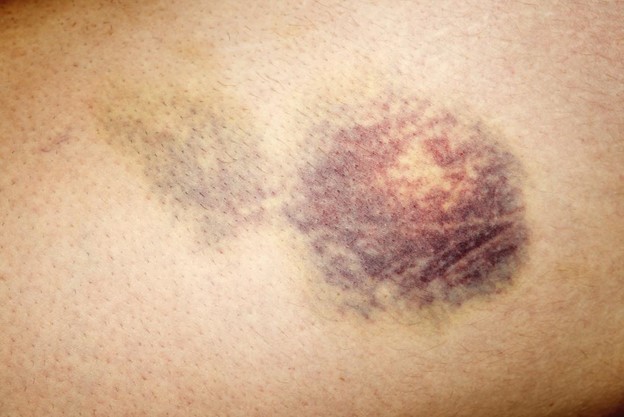
A hematoma is a collection of blood outside a blood vessel that can cause swelling, pain, and bruising. It can indicate bleeding from the artery where the catheter was inserted, which can be a serious complication of cardiac catheterization.
The nurse should notify the provider immediately if a hematoma is observed.
Choice A is wrong because heart rate 90/min is within the normal range for adults and does not indicate a complication.
Choice C is wrong because bounding pulses in the affected extremity are expected after cardiac catheterization, as they indicate good blood flow to the area.
Choice D is wrong because report of discomfort at the insertion site is common and usually mild after cardiac catheterization.
The nurse can provide pain relief as needed, but does not need to notify the provider unless the pain is severe or persistent.
Normal ranges for heart rate are 60-100 beats per minute for adults. Normal ranges for blood pressure are 120/80 mmHg or lower for systolic pressure and 80 mmHg or lower for diastolic pressure. Normal ranges for oxygen saturation are 95-100% for adults.