
Nursing practice questions with comprehensive rationales
NurseDive Free Nursing Practice Question
A nurse is caring for a client in the emergency department.
Click to highlight the findings that indicate that the client's condition is improving. To deselect a finding, click on the finding again.
1400:
Client admitted to the medical-surgical unit at 1200 today. Alert and orientated x4, heart and lung sounds clear. Client urinating 100 mL/hour.
Client is tolerating soft diet and oral fluids. Bowel sounds are hyperactive in all 4 quadrants.
Bilateral pedal pulses 2+, Blood glucose 310 mg/dl. (74 to 106 mg/dL) 1400:
Temperature 36.8° C (98.2° F)
Pulse rate 84/min Respiratory rate 16/min
Blood pressure 106/76 mm Hg Oxygen saturation 96% on room air
A. Alert and orientated x4
None
B. Heart and lung sounds clear
None
C. Blood glucose 310 mg/dl. (74 to 106 mg/dL)
None
D. Client is tolerating soft diet and oral fluids
None
E. Bilateral pedal pulses 2+
None
F. Temperature 36.8° C (98.2° F)
None
G. Pulse rate 84/min
None
H. Respiratory rate 16/min
None
I. Blood pressure 106/76 mm Hg
None
J. Oxygen saturation 96% on room air
None
This question is an excerpt from Nurse Dive's nursing test bank - Ati Rn Adult Med Surg 2023 Proctored Exam. Take the full exam now
Full Explanation
Rationale:
The client's condition shows signs of improvement as indicated by several findings. The blood glucose level has decreased from 468 mg/dL to 310 mg/dL, which, although still above the normal range, is a significant improvement. The pulse rate has normalized from 110/min to 84/min, and the blood pressure has improved from 96/65 mm Hg to 106/76 mm Hg, indicating better cardiovascular stability. The increase in bilateral pedal pulses from 1+ to 2+ suggests improved circulation.
Similar Questions
A nurse is preparing to receive a client from surgery following a transverse colon resection with colostomy placement. The nurse should expect to assess the stoma at which of the following locations? (You will find hot spots to select in the artwork below. Select only the hot spot that corresponds to your answer.)
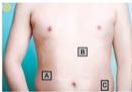
A. A
None
B. B
A transverse colon colostomy is typically placed in the upper abdomen, either in the middle or toward the right side of the body. In the above scenario the best location will be B which is located along the path of the transverse colon. Point A would be suitable for an ileostomy while point B will be suitable for a sigmoid colostomy.
C. C
None
Full Explanation
A transverse colon colostomy is typically placed in the upper abdomen, either in the middle or toward the right side of the body. In the above scenario the best location will be B which is located along the path of the transverse colon. Point A would be suitable for an ileostomy while point B will be suitable for a sigmoid colostomy.
A nurse is admitting a client who reports tightness in their chest that radiates to left arm.
Click to highlight the findings below that would indicate that the client has a potential problem. To deselect a finding, click on the finding again.
Nurses' Notes
1000:
Client reports tightness in chest that radiates to left arm. States pain as 7 on a scale of 0 to 10. Started to feel nauseous after breakfast. Client states, "I had scrambled eggs and bacon like I do every morning." Client is diaphoretic and short of breath. Heart rate irregular and tachycardic. Alert and oriented to person, place, and time. Lungs clear to auscultation in all lobes. Bowel sounds are present in all 4 quadrants. +1 pedal pulses. Skin is cool to touch. Capillary refill less than 2 seconds.
A. Client reports tightness in chest that radiates to left arm. States pain as 7 on a scale of 0 to 10. Started to feel nauseous after breakfast.
B. Client is diaphoretic and short of breath. Heart rate irregular and tachycardic.
C. +1 pedal pulses.
D. Skin is cool to touch
Full Explanation
The symptoms of chest tightness radiating to the left arm, along with nausea, diaphoresis (sweating), shortness of breath, and an irregular, tachycardic (fast) heart rate are classic signs of a myocardial infarction. The faint pulses in myocardial infarction, can be caused by a reduced blood flow to the heart muscle due to a blockage of a coronary artery. The reduced blood flow result in a cool skin.
A nurse is admitting a client who reports tightness in their chest that radiates to left arm.
Complete the following sentence by using the lists of options.
The nurse should first address the client's
Full Explanation
The client's pain level should be addressed first based on the principle of prioritizing interventions according to the client's immediate needs and potential severity of the condition. Chest pain, especially when radiating to the left arm, is a concerning symptom that can indicate myocardial ischemia or infarction. It is essential to promptly assess and manage the client's pain to provide relief and potentially mitigate further cardiac damage. In this scenario, the client rates the pain as 7 out of 10, indicating moderate to severe discomfort, which warrants immediate attention.
After addressing the client's pain level, the nurse should focus on the client's ECG results. The ECG findings of tachycardia with ST segment elevation and T wave changes are indicative of myocardial ischemia or infarction. These changes suggest ongoing myocardial damage and require further evaluation and intervention. The ECG results provide crucial information about the client's cardiac status and guide subsequent treatment decisions, such as initiating interventions to restore myocardial perfusion or preparing for invasive procedures like cardiac catheterization.