
Nursing practice questions with comprehensive rationales
NurseDive Free Nursing Practice Question
A nurse is caring for a client who has a chest tube. The client asks why the fluid in the water-seal chamber rises and falls.
Which of the following statements should the nurse make?
A. "This indicates a possible air leak.".
Choice A is not correct because tidaling does not indicate an air leak.
B. "This means your lung is fully re-expanded.".
Choice B is not correct because tidaling does not necessarily mean that the lung is fully re-expanded.
C. "Your breathing pattern causes this.".
The fluctuation of fluid in the water-seal chamber of a chest tube is known as tidaling and is caused by the changes in pressure within the chest during respiration.
D. "Suction pressure that is too high causes this.".
Choice D is not correct because suction pressure does not cause tidaling.
This question is an excerpt from Nurse Dive's nursing test bank - ATI Adult Medical Surgical 2019 Proctored Exam. Take the full exam now
Full Explanation
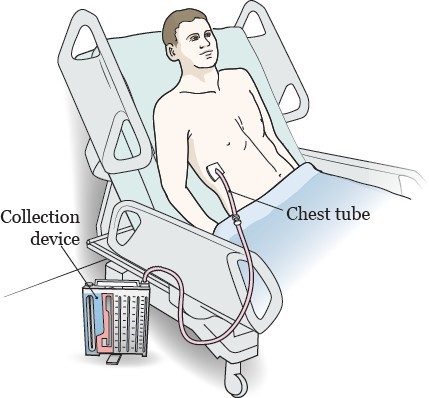
The fluctuation of fluid in the water-seal chamber of a chest tube is known as tidaling and is caused by the changes in pressure within the chest during respiration.
Choice A is not correct because tidaling does not indicate an air leak.
Choice B is not correct because tidaling does not necessarily mean that the lung is fully re-expanded.
Choice D is not correct because suction pressure does not cause tidaling.
Similar Questions
A nurse is preparing to administer naloxone 10 mcg/kg via IV bolus to a client who weighs 220 lb. The amount available is 0.4 mg/mL. How many mL should the nurse administer? (round off to the nearest tenth)
A. 2.5 mL.
Let’s break down the problem step by step: Step 1: Convert the client’s weight from pounds (lb) to kilograms (kg). We know that 1 kg = 2.2 lbs. So, we have: 220 lb ÷ 2.2 = 100 kg Step 2: Calculate the total amount of naloxone needed. The doctor ordered 10 mcg/kg, and the client weighs 100 kg. So, we have: 10 mcg/kg × 100 kg = 1000 mcg Step 3: Convert micrograms (mcg) to milligrams (mg). We know that 1 mg = 1000 mcg. So, we have: 1000 mcg ÷ 1000 = 1 mg Step 4: Calculate the volume of naloxone solution needed. The available naloxone solution is 0.4 mg/mL. So, we have: 1 mg ÷ 0.4 = 2.5 mL So, the nurse should administer 2.5 mL of naloxone. Since we are asked to round off to the nearest tenth, the final answer remains 2.5 mL.
B. 25 mL.
None
C. 2.05 mL.
None
D. 2.25 mL.
None
Full Explanation
Let’s break down the problem step by step:
Step 1: Convert the client’s weight from pounds (lb) to kilograms (kg). We know that 1 kg = 2.2 lbs. So, we have: 220 lb ÷ 2.2 = 100 kg
Step 2: Calculate the total amount of naloxone needed. The doctor ordered 10 mcg/kg, and the client weighs 100 kg. So, we have: 10 mcg/kg × 100 kg = 1000 mcg
Step 3: Convert micrograms (mcg) to milligrams (mg). We know that 1 mg = 1000 mcg. So, we have: 1000 mcg ÷ 1000 = 1 mg
Step 4: Calculate the volume of naloxone solution needed. The available naloxone solution is 0.4 mg/mL. So, we have: 1 mg ÷ 0.4 = 2.5 mL
So, the nurse should administer 2.5 mL of naloxone. Since we are asked to round off to the nearest tenth, the final answer remains 2.5 mL.
A nurse is providing teaching to a client who is receiving opioids for pain management.
Which of the following information should the nurse include in the teaching?
A. "Itching indicates you are having an allergic reaction to the medication.".
Choice A is not correct because itching can be a side effect of opioids and does not necessarily indicate an allergic reaction.
B. "Monitor urinary output for retention.".
“Monitor urinary output for retention.” Urinary retention is a common side effect of opioid use and should be monitored.
C. "Restrict fluid intake if you experience constipation.".
Choice C is not correct because restricting fluid intake can worsen constipation.
D. "Avoid taking antiemetics with the medication.".
Choice D is not correct because antiemetics may be prescribed to manage nausea and vomiting, which are common side effects of opioids.
Full Explanation
“Monitor urinary output for retention.” Urinary retention is a common side effect of opioid use and should be monitored.
Choice A is not correct because itching can be a side effect of opioids and does not necessarily indicate an allergic reaction.
Choice C is not correct because restricting fluid intake can worsen constipation.
Choice D is not correct because antiemetics may be prescribed to manage nausea and vomiting, which are common side effects of opioids.
A nurse is preparing to administer piperacillin 3.375 g by intermittent IV bolus every 6 hr.
Available in piperacillin 3.375 g in dextrose 5% in water (DsW) 100 mL to infuse over 30 min.
The nurse should set the IV pump to deliver how many mL/hr?
A. 33 mL/hr.
Step 1: 100 mL ÷ 30 min Step 2: (100 mL ÷ 30 min) × 60 min/hr Step 3: 3.33 mL/min × 60 min/hr Answer: 200 mL/hr
B. 100 mL/hr.
Step 1: 100 mL ÷ 30 min Step 2: (100 mL ÷ 30 min) × 60 min/hr Step 3: 3.33 mL/min × 60 min/hr Answer: 200 mL/hr
C. 200 mL/hr.
Step 1: 100 mL ÷ 30 min Step 2: (100 mL ÷ 30 min) × 60 min/hr Step 3: 3.33 mL/min × 60 min/hr Answer: 200 mL/hr
D. 400 mL/hr.
Step 1: 100 mL ÷ 30 min Step 2: (100 mL ÷ 30 min) × 60 min/hr Step 3: 3.33 mL/min × 60 min/hr Answer: 200 mL/hr
Full Explanation
Step 1: 100 mL ÷ 30 min
Step 2: (100 mL ÷ 30 min) × 60 min/hr
Step 3: 3.33 mL/min × 60 min/hr
Answer: 200 mL/hr