Nursing practice questions with comprehensive rationales
NurseDive Free Nursing Practice Question
A nurse is caring for a client who has Addison's disease and is at risk for Addisonian crisis. Which of the following actions should the nurse take?
A. Administer oral corticosteroids.
Administering corticosteroids is crucial during an Addisonian crisis but typically involves intravenous corticosteroids (not oral) during the crisis to quickly restore hormone levels. Oral corticosteroids are part of regular maintenance therapy but not an immediate intervention in the crisis.
B. Weigh the client daily.
Weighing the client daily is important to monitor for potential fluid loss, dehydration, or weight changes related to Addison's disease and Addisonian crisis. Clients with Addison’s disease may experience fluid and electrolyte imbalances, so daily weight tracking helps detect early signs of fluid shifts, which are critical in crisis prevention and management.
C. Provide a low-carbohydrate diet.
A low-carbohydrate diet is not recommended for clients with Addison’s disease, as they may need a balanced diet with sufficient carbohydrates to prevent hypoglycemia.
D. Restrict fluid intake
Fluid intake should not be restricted; rather, maintaining adequate hydration is vital. Clients in Addisonian crisis are often at risk for dehydration due to fluid losses and low aldosterone levels, making fluid replacement essential.
This question is an excerpt from Nurse Dive's nursing test bank - Ati Med Surg Proctored Exam 8. Take the full exam now
Full Explanation
A. Administering corticosteroids is crucial during an Addisonian crisis but typically involves intravenous corticosteroids (not oral) during the crisis to quickly restore hormone levels. Oral corticosteroids are part of regular maintenance therapy but not an immediate intervention in the crisis.
B. Weighing the client daily is important to monitor for potential fluid loss, dehydration, or weight changes related to Addison's disease and Addisonian crisis. Clients with Addison’s disease may experience fluid and electrolyte imbalances, so daily weight tracking helps detect early signs of fluid shifts, which are critical in crisis prevention and management.
C. A low-carbohydrate diet is not recommended for clients with Addison’s disease, as they may need a balanced diet with sufficient carbohydrates to prevent hypoglycemia.
D. Fluid intake should not be restricted; rather, maintaining adequate hydration is vital. Clients in Addisonian crisis are often at risk for dehydration due to fluid losses and low aldosterone levels, making fluid replacement essential.
Similar Questions
A nurse is reviewing the medical records of four clients who have an acid-base imbalance. The nurse should recognize that which of the following clients is at risk for metabolic acidosis?
A. A client who has salicylate intoxication
Salicylate intoxication can lead to metabolic acidosis due to the accumulation of salicylic acid, which increases metabolic rate and production of organic acids.
B. A client who is taking a thiazide diuretic
Thiazide diuretics can lead to metabolic alkalosis due to the loss of hydrogen and chloride ions.
C. A client who is vomiting
Vomiting can lead to metabolic alkalosis due to the loss of gastric acid.
D. A client who has diarrhea
Diarrhea can lead to metabolic acidosis due to the loss of bicarbonate-rich fluids.
Full Explanation
A. Salicylate intoxication can lead to metabolic acidosis due to the accumulation of salicylic acid, which increases metabolic rate and production of organic acids.
B. Thiazide diuretics can lead to metabolic alkalosis due to the loss of hydrogen and chloride ions.
C. Vomiting can lead to metabolic alkalosis due to the loss of gastric acid.
D. Diarrhea can lead to metabolic acidosis due to the loss of bicarbonate-rich fluids.
A nurse is caring for a client who has end-stage kidney disease (ESKD) and reports having shortness of breath and swelling in his lower extremities. Upon assessment, the nurse notes the client has crackles in his lungs and an elevated blood pressure. The nurse should suspect which of the following based on the client's manifestations?
A. Hyponatremia
Hyponatremia is characterized by low sodium levels in the blood and is not typically associated with crackles in the lungs or elevated blood pressure.
B. Hyperkalemia
While hyperkalemia is a concern in end-stage kidney disease, it is not typically associated with crackles in the lungs or elevated blood pressure.
C. Hypovolemia
Hypovolemia, or low blood volume, is not consistent with the client's reported symptoms of swelling in the lower extremities and crackles in the lungs.
D. Hypervolemia
Hypervolemia, or fluid overload, is common in end-stage kidney disease and can manifest with symptoms such as shortness of breath, lower extremity edema, crackles in the lungs (due to pulmonary congestion), and elevated blood pressure.
Full Explanation
A. Hyponatremia is characterized by low sodium levels in the blood and is not typically associated with crackles in the lungs or elevated blood pressure.
B. While hyperkalemia is a concern in end-stage kidney disease, it is not typically associated with crackles in the lungs or elevated blood pressure.
C. Hypovolemia, or low blood volume, is not consistent with the client's reported symptoms of swelling in the lower extremities and crackles in the lungs.
D. Hypervolemia, or fluid overload, is common in end-stage kidney disease and can manifest with symptoms such as shortness of breath, lower extremity edema, crackles in the lungs (due to pulmonary congestion), and elevated blood pressure.
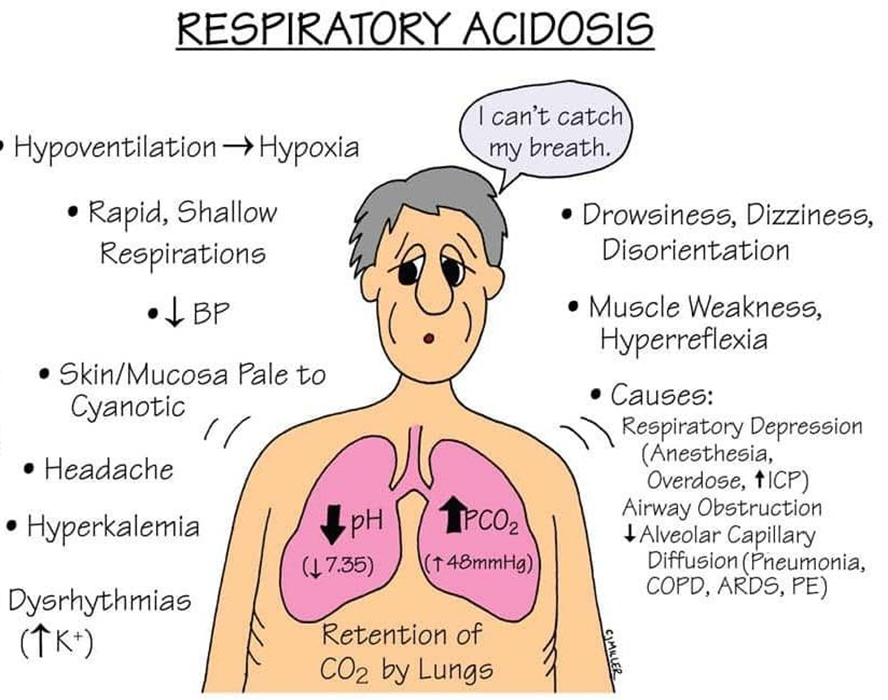
A nurse is assessing a client who has respiratory acidosis. Which of the following findings should the nurse expect?
A. Dry skin
Dry skin is not a typical manifestation of respiratory acidosis.
B. Abdominal pain
Abdominal pain is not a typical manifestation of respiratory acidosis.
C. Lethargy
Lethargy and altered mental status are common manifestations of respiratory acidosis due to the effects of hypercapnia (elevated PaCO2) on the central nervous system.
D. Numbness of fingers
Numbness of fingers is not a typical manifestation of respiratory acidosis.
Full Explanation
A. Dry skin is not a typical manifestation of respiratory acidosis.
B. Abdominal pain is not a typical manifestation of respiratory acidosis.
C. Lethargy and altered mental status are common manifestations of respiratory acidosis due to the effects of hypercapnia (elevated PaCO2) on the central nervous system.
D. Numbness of fingers is not a typical manifestation of respiratory acidosis.