
Nursing practice questions with comprehensive rationales
NurseDive Free Nursing Practice Question
A nurse is caring for a client who has end-stage kidney disease (ESKD) and reports having shortness of breath and swelling in his lower extremities. Upon assessment, the nurse notes the client has crackles in his lungs and an elevated blood pressure. The nurse should suspect which of the following based on the client's manifestations?
A. Hyponatremia
Hyponatremia is characterized by low sodium levels in the blood and is not typically associated with crackles in the lungs or elevated blood pressure.
B. Hyperkalemia
While hyperkalemia is a concern in end-stage kidney disease, it is not typically associated with crackles in the lungs or elevated blood pressure.
C. Hypovolemia
Hypovolemia, or low blood volume, is not consistent with the client's reported symptoms of swelling in the lower extremities and crackles in the lungs.
D. Hypervolemia
Hypervolemia, or fluid overload, is common in end-stage kidney disease and can manifest with symptoms such as shortness of breath, lower extremity edema, crackles in the lungs (due to pulmonary congestion), and elevated blood pressure.
This question is an excerpt from Nurse Dive's nursing test bank - Ati Med Surg Proctored Exam 8. Take the full exam now
Full Explanation
A. Hyponatremia is characterized by low sodium levels in the blood and is not typically associated with crackles in the lungs or elevated blood pressure.
B. While hyperkalemia is a concern in end-stage kidney disease, it is not typically associated with crackles in the lungs or elevated blood pressure.
C. Hypovolemia, or low blood volume, is not consistent with the client's reported symptoms of swelling in the lower extremities and crackles in the lungs.
D. Hypervolemia, or fluid overload, is common in end-stage kidney disease and can manifest with symptoms such as shortness of breath, lower extremity edema, crackles in the lungs (due to pulmonary congestion), and elevated blood pressure.
Similar Questions
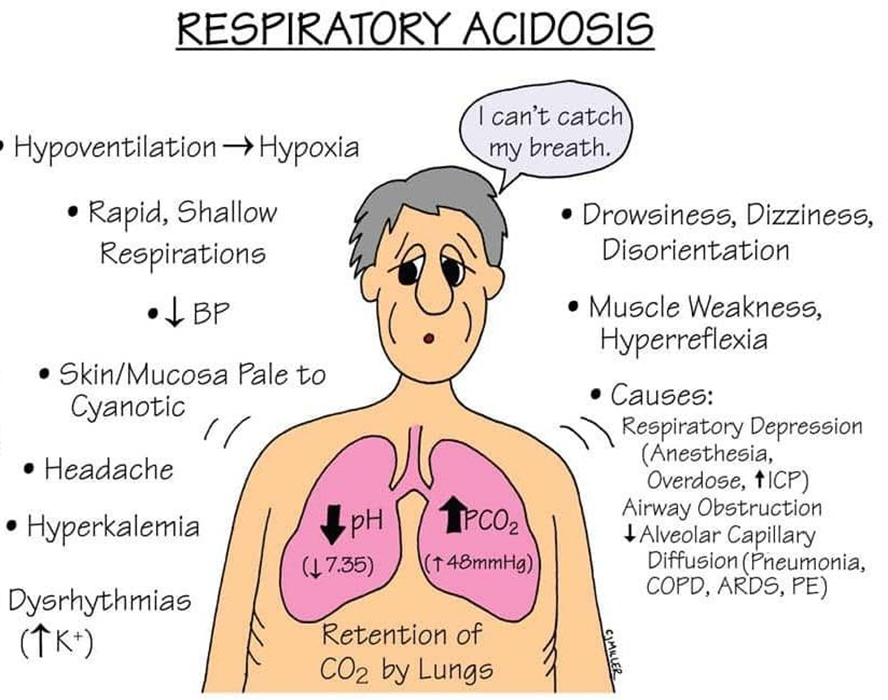
A nurse is assessing a client who has respiratory acidosis. Which of the following findings should the nurse expect?
A. Dry skin
Dry skin is not a typical manifestation of respiratory acidosis.
B. Abdominal pain
Abdominal pain is not a typical manifestation of respiratory acidosis.
C. Lethargy
Lethargy and altered mental status are common manifestations of respiratory acidosis due to the effects of hypercapnia (elevated PaCO2) on the central nervous system.
D. Numbness of fingers
Numbness of fingers is not a typical manifestation of respiratory acidosis.
Full Explanation
A. Dry skin is not a typical manifestation of respiratory acidosis.
B. Abdominal pain is not a typical manifestation of respiratory acidosis.
C. Lethargy and altered mental status are common manifestations of respiratory acidosis due to the effects of hypercapnia (elevated PaCO2) on the central nervous system.
D. Numbness of fingers is not a typical manifestation of respiratory acidosis.
A nurse is teaching a client who has urolithiasis (renal calculi). The nurse should explain that which of the following conditions can increase the risk for renal calculi?
A. Obesity
While obesity can contribute to certain health conditions, it is not a direct risk factor for the formation of renal calculi.
B. Protein in the urine
Proteinuria may indicate kidney dysfunction, but it is not a direct risk factor for the formation of renal calculi.
C. Iron deficiency
Iron deficiency is not directly associated with an increased risk of renal calculi formation.
D. Dehydration
Dehydration can lead to concentrated urine, which increases the risk of crystal formation and subsequently the formation of renal calculi.
Full Explanation
A. While obesity can contribute to certain health conditions, it is not a direct risk factor for the formation of renal calculi.
B. Proteinuria may indicate kidney dysfunction, but it is not a direct risk factor for the formation of renal calculi.
C. Iron deficiency is not directly associated with an increased risk of renal calculi formation.
D. Dehydration can lead to concentrated urine, which increases the risk of crystal formation and subsequently the formation of renal calculi.
A nurse is discussing kidney transplant with a client who has end-stage renal disease (ESRD).
Which of the following should the nurse identify as a contraindication for this treatment?
A. Pacemaker
Having a pacemaker is not a contraindication for kidney transplant unless there are significant underlying cardiac issues that would increase the risks associated with surgery.
B. Alcohol use disorder
Chronic alcohol abuse can lead to multiple organ damage and increased surgical risks, making it a contraindication for kidney transplant.
C. Breast cancer survivor for 8 years
Being a breast cancer survivor is not a contraindication for kidney transplant unless there are active cancer or metastases that would affect surgical outcomes.
D. 65 years of age
Age alone is not a contraindication for kidney transplant. The decision for transplant candidacy is based on overall health status and comorbidities rather than age alone.
Full Explanation
A. Having a pacemaker is not a contraindication for kidney transplant unless there are significant underlying cardiac issues that would increase the risks associated with surgery.
B. Chronic alcohol abuse can lead to multiple organ damage and increased surgical risks, making it a contraindication for kidney transplant.
C. Being a breast cancer survivor is not a contraindication for kidney transplant unless there are active cancer or metastases that would affect surgical outcomes.
D. Age alone is not a contraindication for kidney transplant. The decision for transplant candidacy is based on overall health status and comorbidities rather than age alone.