
Nursing practice questions with comprehensive rationales
NurseDive Free Nursing Practice Question
A nurse is caring for a client who has been placed in halo traction to immobilize his cervical spine.
Which of the following actions should the nurse take?
A. Apply a pelvic girdle.
Choice A is not correct because a pelvic girdle is not used with halo traction.
B. Place the client in a supine position.
Choice B is not correct because placing the client in a supine position can increase pressure on the cervical spine.
C. Elevate the head of the bed.
Elevating the head of the bed can help to reduce pressure on the cervical spine and promote comfort for the client.
D. Elevate the foot of the bed.
Choice D is not correct because elevating the foot of the bed would not provide any benefit for a client in halo traction.
This question is an excerpt from Nurse Dive's nursing test bank - ATI Custom- Wn23 NS122 Proctored Exam. Take the full exam now
Full Explanation
Elevating the head of the bed can help to reduce pressure on the cervical spine and promote comfort for the client.
Choice A is not correct because a pelvic girdle is not used with halo traction.
Choice B is not correct because placing the client in a supine position can increase pressure on the cervical spine.
Choice D is not correct because elevating the foot of the bed would not provide any benefit for a client in halo traction.
Similar Questions
The nurse is working with a group of caregivers of school-aged children discussing fractures.
The nurse explains that if the fragments of the fractured bone are separated, the fracture is said to be:
A. Spiral.
Choice A, Spiral, is incorrect because it refers to a specific type of complete fracture that occurs when a long bone is twisted with force.
B. Incomplete.
Choice B, Incomplete, is incorrect because it refers to a type of fracture where the bone is only partially broken.
C. Complete.
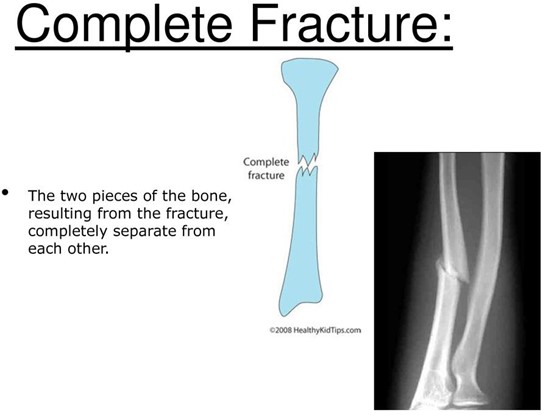
A complete fracture is when the bone breaks into two or more separate pieces. This is in contrast to an incomplete fracture, where the bone is only partially broken. A spiral fracture is a type of complete fracture that occurs when a long bone is twisted with force. A greenstick fracture is a type of incomplete fracture that occurs when a bone bends and cracks but does not break completely.
D. Greenstick.
Choice D, Greenstick, is incorrect because it refers to a specific type of incomplete fracture that occurs when a bone bends and cracks but does not break completely.
Full Explanation
A complete fracture is when the bone breaks into two or more separate pieces.
This is in contrast to an incomplete fracture, where the bone is only partially broken.
A spiral fracture is a type of complete fracture that occurs when a long bone is twisted with force.
A greenstick fracture is a type of incomplete fracture that occurs when a bone bends and cracks but does not break completely.
Choice A, Spiral, is incorrect because it refers to a specific type of complete fracture that occurs when a long bone is twisted with force.
Choice B, Incomplete, is incorrect because it refers to a type of fracture where the bone is only partially broken.
Choice D, Greenstick, is incorrect because it refers to a specific type of incomplete fracture that occurs when a bone bends and cracks but does not break completely.
A nurse is counseling a client diagnosed with bulimia nervosa about the symptom of tooth enamel deterioration.
Which explanation for this complication of bulimia nervosa should the nurse provide?
A. Food is rapidly ingested without proper mastication.
Choice A, Food is rapidly ingested without proper mastication, is incorrect because it does not directly relate to tooth enamel deterioration.
B. The emesis produced during purging is acidic and corrodes the tooth enamel.
When people with bulimia nervosa frequently engage in self-induced vomiting, the gastric acids in their vomit can damage the tooth enamel. This is called dental erosion and can create “bulimia teeth”.
C. Poor dental and oral hygiene leads to dental caries.
Choice C, Poor dental and oral hygiene leads to dental caries, is incorrect because it refers to a different dental issue.
D. Purging causes the depletion of dietary calcium.
Choice D, Purging causes the depletion of dietary calcium, is incorrect because it does not directly relate to tooth enamel deterioration.
Full Explanation
When people with bulimia nervosa frequently engage in self-induced vomiting, the gastric acids in their vomit can damage the tooth enamel.
This is called dental erosion and can create “bulimia teeth”.
Choice A, Food is rapidly ingested without proper mastication, is incorrect because it does not directly relate to tooth enamel deterioration.
Choice C, Poor dental and oral hygiene leads to dental caries, is incorrect because it refers to a different dental issue.
Choice D, Purging causes the depletion of dietary calcium, is incorrect because it does not directly relate to tooth enamel deterioration.
A nurse is assisting with teaching a class about the long-term effects of childhood obesity.
The nurse should include which of the following conditions is a potential complication of childhood obesity?
A. Diabetes mellitus.
Childhood obesity is a serious medical condition that can lead to health problems that were once considered adult problems, such as diabetes, high blood pressure, and high cholesterol.
B. Hypotension.
Choice B, Hypotension, is incorrect because it refers to low blood pressure, which is not a common complication of childhood obesity.
C. Rheumatoid arthritis.
Choice C, Rheumatoid arthritis, is incorrect because it is an autoimmune disorder that is not directly related to childhood obesity.
D. Attention-deficit/hyperactivity disorder.
Choice D, Attention-deficit/hyperactivity disorder (ADHD), is incorrect because it is a neurodevelopmental disorder that is not directly related to childhood obesity.
Full Explanation
Childhood obesity is a serious medical condition that can lead to health problems that were once considered adult problems, such as diabetes, high blood pressure, and high cholesterol.
Choice B, Hypotension, is incorrect because it refers to low blood pressure, which is not a common complication of childhood obesity.
Choice C, Rheumatoid arthritis, is incorrect because it is an autoimmune disorder that is not directly related to childhood obesity.
Choice D, Attention-deficit/hyperactivity disorder (ADHD), is incorrect because it is a neurodevelopmental disorder that is not directly related to childhood obesity.