
Nursing practice questions with comprehensive rationales
NurseDive Free Nursing Practice Question
A nurse is caring for a client who has COPD.
Nurses' Notes
Vital Signs
Medication
Home health nurse admission note:
Client discharged from healthcare facility yesterday following a 4-day stay for exacerbation of COPD. Lives alone; alert and oriented to person, place, and time. Lung fields with scattered rhonchi throughout, cough productive for thick white sputum, dyspnea with minimal exertion.
Clubbing is noted on fingers, chest is barrel-shaped. Supplemental oxygen at 2L/min via nasal cannula.
Home Health Nurse Note 3 days following discharge from health care facility: Client sleeping in recliner with nasal canula on their lap; awakens easily and is oriented to person but disoriented to place and time.
Lung sounds with scattered rhonchi, cough productive for thick, yellow secretions. 2+pitting edema bilateral in ankles and feet.
Re-oriented client. Client states "I don't remember if I did that breathing machine thing you told me about."
Instructed client on oxygen use, safety, and nebulizer treatments. Elevated lower extremities.
Select the 5 findings that require follow-up.
A. Disorientation
B. Barrel-shaped chest
C. Yellow sputum
D. Nebulizer use
E. Ankle edema SaO2 92% Clubbing of fingers
F. Lives alone
This question is an excerpt from Nurse Dive's nursing test bank - ATI SP 250 Exam 3 Med Surg Proctored Exam. Take the full exam now
Full Explanation
- Disorientation may indicate hypoxia, infection, or medication side effects. - Yellow sputum may indicate a bacterial infection that requires antibiotics. - Nebulizer use may indicate that the client is not using it correctly or regularly as prescribed, which can affect their lung function and oxygenation. - Ankle edema may indicate fluid overload or heart failure, which can worsen COPD symptoms and increase the risk of complications.
- Living alone may pose safety risks for the client, especially if they are disoriented or have difficulty managing their oxygen and nebulizer treatments. The nurse should assess the client's support system and refer them to community resources if needed.
Similar Questions
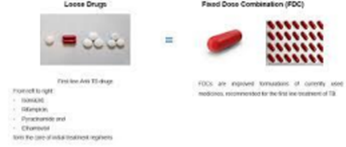
A nurse is teaching a client who has tuberculosis and is to start combination drug therapy. Which of the following medications should the w plan to administer? (Select all that apply.)
A. Rifampin
B. Acyclovir
C. Montelukast
D. Isoniazid
E. Pyrazinamide
Full Explanation
This is because these medications are antimycobacterial agents that inhibit the growth and replication of Mycobacterium tuberculosis, the bacterium that causes tuberculosis. Acyclovir is an antiviral medication that is used to treat herpes simplex virus infections, and montelukast is a leukotriene receptor antagonist that is used to prevent asthma attacks.
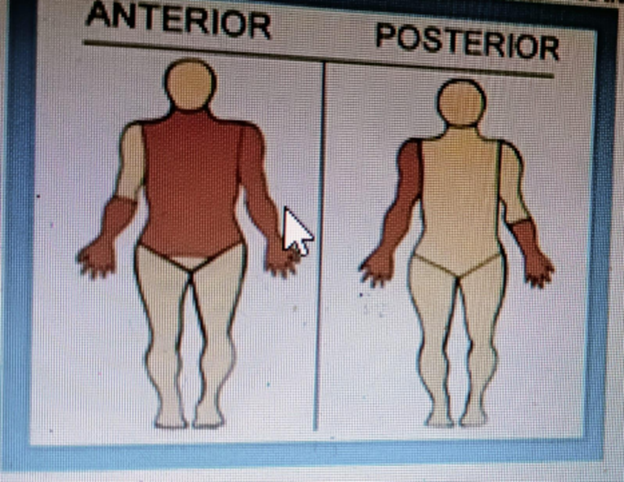
A nurse is admitting a client who has sustained severe burn injuries in a grease fire. The nurse shades in a diagram indicating the burned surface areas. Using the Rule of Nines, the nurse should estimate that the client has burned what percentage of body surface area? (Round the answer to the nearest tenth. Use a leading zero if it applies. Do not use a trailing zero.)
Full Explanation
The anterior chest wall and abdomen accounts for 18%, the left upper limb 9 % (4.5% anteriorly and 4.5% posteriorly), and the right upper limb 4.5% (2.25% anteriorly and 2.25% posteriorly).
(18+9+4.5) =31.5%
A nurse in a community health clinic is caring for a client who has a history of HIV. For each of the following assessment findings for the client, identify if the finding is consistent with HIV stage I or HIV stage III (AIDS). Each finding may support more than one disease process.
A. CD4 cell count 200 cells/mm3 (600-1500 cells/mm3)
B. Weight changes
C. Chest x-ray showing bilateral white infiltrates consistent with pneumonia
D. Skin condition
E. Latest CD4 cell count