Nursing practice questions with comprehensive rationales
NurseDive Free Nursing Practice Question
A nurse is caring for a client who has immunosuppression and a continuous IV infusion.
Which of the following actions should the nurse take?
A. Assess the client's IV site every 8 hr.
Incorrect. The nurse should assess the client's IV site every hour to prevent infection and phlebitis.
B. Check the client's WBC count every 48 hr.
Incorrect. The nurse should check the client's WBC count every day to monitor for signs of infection or bone marrow suppression.
C. Monitor the client's mouth every 8 hr.
Correct. The nurse should monitor the client's mouth every 8 hr for signs of oral candidiasis, which is a common fungal infection in immunosuppressed clients.
D. Change the client's IV tubing every 48 hr.
Incorrect. The nurse should change the client's IV tubing every 24 hr to reduce the risk of bacterial contamination.
This question is an excerpt from Nurse Dive's nursing test bank - RN Comprehensive Online Practice 2019 B with NGN Proctored Exam. Take the full exam now
Full Explanation
- A. Incorrect. The nurse should assess the client's IV site every hour to prevent infection and phlebitis.
- B. Incorrect. The nurse should check the client's WBC count every day to monitor for signs of infection or bone marrow suppression.
- C. Correct. The nurse should monitor the client's mouth every 8 hr for signs of oral candidiasis, which is a common fungal infection in immunosuppressed clients.\
- D. Incorrect. The nurse should change the client's IV tubing every 24 hr to reduce the risk of bacterial contamination.
Similar Questions
A home health nurse is evaluating a school-age child who has cystic fibrosis. The nurse should initiate a request for a high-frequency chest compression vest in response to which of the following parent statements?
A. "My child doesn't like to sit still for nebulizer treatments."
Incorrect. The nurse should educate the parent on the importance of nebulizer treatments to deliver medications that thin and loosen mucus in the airways.
B. "I think that my child has been running a fever over the last couple of days."
Incorrect. The nurse should advise the parent to contact the provider if the child has a fever, which could indicate an infection or inflammation in the lungs.
C. "My child has only a small amount of mucus after percussion therapy."
Correct. The nurse should initiate a request for a high-frequency chest compression vest, which is a device that vibrates the chest wall and helps mobilize mucus from the lungs.
D. "I am concerned about my child's future participation in team sports."
Incorrect. The nurse should encourage the parent to support the child's participation in team sports, which can improve lung function and social skills.
Full Explanation
- A. Incorrect. The nurse should educate the parent on the importance of nebulizer treatments to deliver medications that thin and loosen mucus in the airways.
- B. Incorrect. The nurse should advise the parent to contact the provider if the child has a fever, which could indicate an infection or inflammation in the lungs.
- C. Correct. The nurse should initiate a request for a high-frequency chest compression vest, which is a device that vibrates the chest wall and helps mobilize mucus from the lungs.
- D. Incorrect. The nurse should encourage the parent to support the child's participation in team sports, which can improve lung function and social skills.
A nurse is providing phone advice for a client who is pregnant.
Complete the following sentence by using the copy pasting from the list of options.
The client is at risk for experiencingelectrolyte imbalancedue to the
Full Explanation
Electrolyte imbalance in pregnant clients is often associated with conditions that lead to dehydration and nutritional deficiencies. In this scenario, the key indicators are persistent nausea and significant weight loss.
- Persistent nausea can lead to reduced food and fluid intake. This condition, especially if prolonged, can cause dehydration and electrolyte imbalances due to the loss of essential minerals and nutrients that are not being replenished due to inadequate dietary intake.
- Significant weight loss, particularly the amount described in the scenario (6.8 kg or 15 lb), is a clear sign of inadequate nutritional intake and can further exacerbate the risk of electrolyte imbalance. It indicates that the body is not receiving enough nutrients, which is crucial for maintaining electrolyte balance.
The other options, while related to diet and fluid intake, are more specific to the client's eating habits and do not directly point to the primary cause of potential electrolyte imbalance in the context of this scenario. Therefore, the most comprehensive and medically relevant choice is (A) Persistent nausea and significant weight loss.
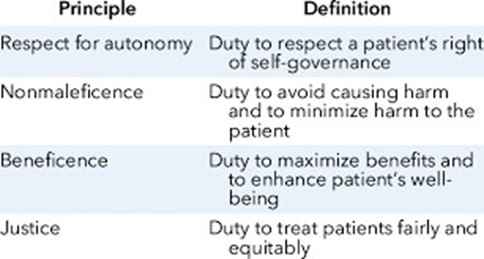
A nurse manager is reviewing clients' rights with the nurses on the unit. The nurse manager should tell the nurses that informed consent promotes which of the following ethical principles?
A. Autonomy
Autonomy is the ethical principle that respects the right of clients to make their own decisions and choices regarding their health care. Informed consent is a process that ensures that clients are fully informed of the benefits, risks, alternatives, and consequences of a proposed treatment or procedure, and that they voluntarily agree to it.
B. Nonmaleficence
Nonmaleficence is the ethical principle that obliges health care providers to do no harm to clients, either intentionally or unintentionally. Informed consent does not directly promote this principle, although it may help to prevent harm by disclosing potential risks and complications.
C. Justice
Justice is the ethical principle that requires fair and equal treatment of all clients, regardless of their personal characteristics, preferences, or values. Informed consent does not directly promote this principle, although it may help to ensure that clients are not coerced or manipulated into accepting a treatment or procedure that they do not want or need.
D. Fidelity
Fidelity is the ethical principle that requires health care providers to be faithful and loyal to their clients, and to honor their commitments and promises. Informed consent does not directly promote this principle, although it may help to establish trust and rapport between clients and providers.
Full Explanation
- A. Autonomy is the ethical principle that respects the right of clients to make their own decisions and choices regarding their health care. Informed consent is a process that ensures that clients are fully informed of the benefits, risks, alternatives, and consequences of a proposed treatment or procedure, and that they voluntarily agree to it.
- B. Nonmaleficence is the ethical principle that obliges health care providers to do no harm to clients, either intentionally or unintentionally. Informed consent does not directly promote this principle, although it may help to prevent harm by disclosing potential risks and complications.
- C. Justice is the ethical principle that requires fair and equal treatment of all clients, regardless of their personal characteristics, preferences, or values. Informed consent does not directly promote this principle, although it may help to ensure that clients are not coerced or manipulated into accepting a treatment or procedure that they do not want or need.
- D. Fidelity is the ethical principle that requires health care providers to be faithful and loyal to their clients, and to honor their commitments and promises. Informed consent does not directly promote this principle, although it may help to establish trust and rapport between clients and providers.