
Nursing practice questions with comprehensive rationales
NurseDive Free Nursing Practice Question
A nurse is caring for a client who has respiratory alkalosis and is hyperventilating Which of the following actions should the nurse take?
A. Have the client place their head between their knees.
Having the client place their head between their knees is a measure used to alleviate symptoms associated with hyperventilation but does not directly address the underlying respiratory alkalosis.
B. Have the client breath into a paper bag.
Having the client breathe into a paper bag helps retain carbon dioxide, which can help reverse respiratory alkalosis by increasing PaCO2 levels and subsequently decreasing pH.
C. Plan to administer sodium bicarbonate to the client
Administering sodium bicarbonate would worsen alkalosis by further increasing the pH and bicarbonate levels.
D. Plan to administer insulin to the client
Administering insulin is not indicated for respiratory alkalosis and hyperventilation.
This question is an excerpt from Nurse Dive's nursing test bank - Ati Med Surg Proctored Exam 8. Take the full exam now
Full Explanation
A. Having the client place their head between their knees is a measure used to alleviate symptoms associated with hyperventilation but does not directly address the underlying respiratory alkalosis.
B. Having the client breathe into a paper bag helps retain carbon dioxide, which can help reverse respiratory alkalosis by increasing PaCO2 levels and subsequently decreasing pH.
C. Administering sodium bicarbonate would worsen alkalosis by further increasing the pH and bicarbonate levels.
D. Administering insulin is not indicated for respiratory alkalosis and hyperventilation.
Similar Questions
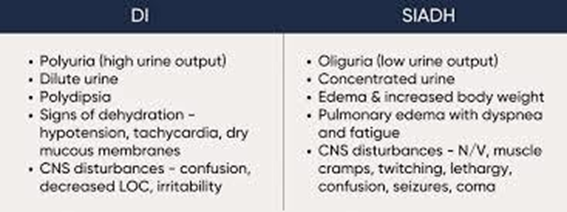
A nurse is assessing a client who has diabetes insipidus. Which of the following findings should the nurse expect?
A. Hyperglycemia
Hyperglycemia is associated with diabetes mellitus, not diabetes insipidus. Diabetes insipidus is characterized by excessive thirst and urination due to inadequate secretion of antidiuretic hormone (ADH), not hyperglycemia.
B. Dehydration
Dehydration is a hallmark finding in diabetes insipidus due to excessive urination and fluid loss. Clients with diabetes insipidus may exhibit signs of dehydration, such as dry mucous membranes, decreased skin turgor, and hypotension.
C. Bradycardia
Bradycardia is not typically associated with diabetes insipidus.
D. Polyphagia
Polyphagia, or excessive hunger, is a symptom of diabetes mellitus, not diabetes insipidus.
Full Explanation
A. Hyperglycemia is associated with diabetes mellitus, not diabetes insipidus. Diabetes insipidus is characterized by excessive thirst and urination due to inadequate secretion of antidiuretic hormone (ADH), not hyperglycemia.
B. Dehydration is a hallmark finding in diabetes insipidus due to excessive urination and fluid loss. Clients with diabetes insipidus may exhibit signs of dehydration, such as dry mucous membranes, decreased skin turgor, and hypotension.
C. Bradycardia is not typically associated with diabetes insipidus.
D. Polyphagia, or excessive hunger, is a symptom of diabetes mellitus, not diabetes insipidus.
A nurse is reviewing the arterial blood gas values for a client. The pH is 7.32, PaCO, 48 mm Hg and the HCO, is 23 mEq/L. The nurse should recognize that these findings indicate of which of the following acid base balances?
A. Metabolic acidosis
Metabolic acidosis is characterized by a low pH and low bicarbonate levels (HCO3).
B. Metabolic alkalosis
Metabolic alkalosis is characterized by a high pH and high bicarbonate levels (HCO3).
C. Respiratory alkalosis
Respiratory alkalosis is characterized by a high pH and low PaCO2 levels.
D. Respiratory acidosis
The pH is below the normal range (7.35-7.45), indicating acidosis. The PaCO2 is elevated, indicating respiratory acidosis, as an increase in PaCO2 leads to an increase in carbonic acid and a decrease in pH.
Full Explanation
A. Metabolic acidosis is characterized by a low pH and low bicarbonate levels (HCO3).
B. Metabolic alkalosis is characterized by a high pH and high bicarbonate levels (HCO3).
C. Respiratory alkalosis is characterized by a high pH and low PaCO2 levels.
D. The pH is below the normal range (7.35-7.45), indicating acidosis. The PaCO2 is elevated, indicating respiratory acidosis, as an increase in PaCO2 leads to an increase in carbonic acid and a decrease in pH.
A nurse is providing dietary teaching to client who has calcium oxalate kidney stones. Which of the following statements indicates an understanding of the teaching?
A. "I can have almonds as a snack"
Almonds are high in oxalates, which can contribute to the formation of calcium oxalate kidney stones. Therefore, almonds should be avoided or consumed in moderation by individuals with this condition.
B. "I may eat a sweet potato for dinner.
Sweet potatoes contain moderate levels of oxalates, which may increase the risk of calcium oxalate kidney stones if consumed in large amounts. It is advisable for individuals with this condition to limit their intake of sweet potatoes.
C. "I may eat a banana with my breakfast"
Bananas are low in oxalates, making them a suitable choice for individuals with calcium oxalate kidney stones. Including bananas in the diet can help reduce the risk of stone formation.
D. “I can use soy milk with my cereal"
Soy milk may contain moderate to high levels of oxalates, depending on processing methods. It is recommended to choose low-oxalate alternatives for individuals prone to calcium oxalate kidney stones.
Full Explanation
A. Almonds are high in oxalates, which can contribute to the formation of calcium oxalate kidney stones. Therefore, almonds should be avoided or consumed in moderation by individuals with this condition.
B. Sweet potatoes contain moderate levels of oxalates, which may increase the risk of calcium oxalate kidney stones if consumed in large amounts. It is advisable for individuals with this condition to limit their intake of sweet potatoes.
C. Bananas are low in oxalates, making them a suitable choice for individuals with calcium oxalate kidney stones. Including bananas in the diet can help reduce the risk of stone formation.
D. Soy milk may contain moderate to high levels of oxalates, depending on processing methods. It is recommended to choose low-oxalate alternatives for individuals prone to calcium oxalate kidney stones.