
Nursing practice questions with comprehensive rationales
NurseDive Free Nursing Practice Question
A nurse is caring for a client who is 2 days postoperative following bowel resection and reports sudden, severe abdominal pain.
Which of the following actions should the nurse take first?
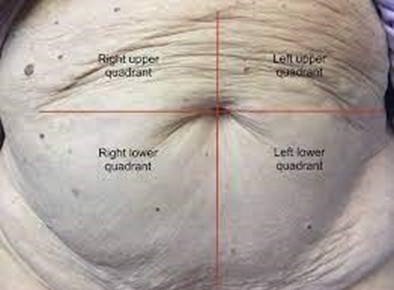
A. Expose the client's abdomen to look for changes in appearance.
After postoperative surgery, chances of infections are very high also discharges, color changes, etc. So it is important to expose the client’s abdomen to look for changes in appearance.
B. Determine areas of resonance across the abdomen using a systematic approach.
Choice B is not the answer because determining areas of resonance across the abdomen using a systematic approach is not the first action that should be taken 1.
C. Use the diaphragm of a stethoscope to listen for bowel sounds.
Choice C is not the answer because using the diaphragm of a stethoscope to listen for bowel sounds is not the first action that should be taken 1.
D. Perform abdominal palpation by pressing gently with the finger pads.
Choice D is not the answer because performing abdominal palpation by pressing gently with the finger pads is not the first action that should be taken 1.
This question is an excerpt from Nurse Dive's nursing test bank - ATI RN Fundamentals 2019 with NGN Proctored Exam. Take the full exam now
Full Explanation
After postoperative surgery, chances of infections are very high also discharges, color changes, etc.
So it is important to expose the client’s abdomen to look for changes in appearance.
Choice B is not the answer because determining areas of resonance across the abdomen using a systematic approach is not the first action that should be taken 1.
Choice C is not the answer because using the diaphragm of a stethoscope to listen for bowel sounds is not the first action that should be taken 1.
Choice D is not the answer because performing abdominal palpation by pressing gently with the finger pads is not the first action that should be taken 1.
Similar Questions
A nurse is planning care for a client who is scheduled for an intravenous pyelogram.
Which of the following actions is appropriate for the nurse to include?
A. Assist the client with a bowel cleansing.
This is appropriate and necessary prior to the procedure. Bowel prep may include laxatives or enemas the evening before and possibly the morning of the procedure.
B. Monitor the client for pain in the suprapubic region.
While pain in the suprapubic region (lower abdomen) is not a common side effect of an IVP, the nurse should be aware of this possibility and assess the client for any discomfort. However, monitoring for pain is not a specific action to include in preparation for the procedure.
C. Ensure the client is free of metal objects.
This is important for MRI, not IVP. IVP uses X-ray, so metal doesn't pose the same risk.
D. Administer 240 mL (8 oz) of oral contrast before the procedure.
Oral contrast is not typically used in an IVP. The contrast material for this procedure is administered intravenously.
Full Explanation
A. This is appropriate and necessary prior to the procedure. Bowel prep may include laxatives or enemas the evening before and possibly the morning of the procedure.
A nurse is conducting Weber's test on a client.
Which of the following is an appropriate action for the nurse to take?
A. Deliver a series of high-pitched sounds at random intervals.
Choice A is wrong because delivering a series of high-pitched sounds at random intervals is not part of Weber’s test.
B. Hold an activated tuning fork against the client's mastoid process.
Choice B is wrong because holding an activated tuning fork against the client’s mastoid process is part of Rinne’s test, not Weber’s test.
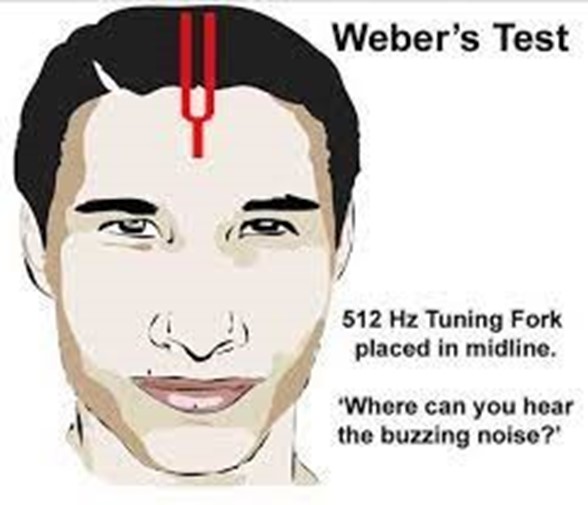
C. Place an activated tuning fork in the middle of the client's forehead.
The Weber test is a screening test for hearing performed with a tuning fork that can detect unilateral conductive hearing loss and unilateral sensorineural hearing loss. To perform Weber’s test, strike the fork against your knee or elbow, then place the base of the fork in the midline, high on the patient’s forehead.
D. Whisper a series of words softly into one ear.
Choice D is wrong because whispering a series of words softly into one ear is not part of Weber’s test.
Full Explanation
The Weber test is a screening test for hearing performed with a tuning fork that can detect unilateral conductive hearing loss and unilateral sensorineural hearing loss.
To perform Weber’s test, strike the fork against your knee or elbow, then place the base of the fork in the midline, high on the patient’s forehead.
Choice A is wrong because delivering a series of high-pitched sounds at random intervals is not part of Weber’s test.
Choice B is wrong because holding an activated tuning fork against the client’s mastoid process is part of Rinne’s test, not Weber’s test.
Choice D is wrong because whispering a series of words softly into one ear is not part of Weber’s test.
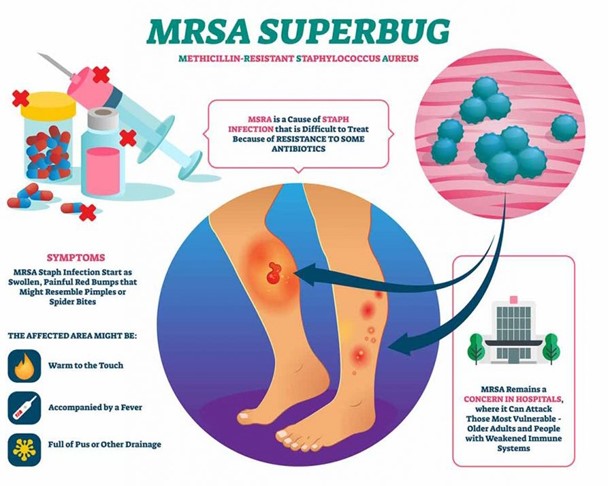
A nurse is teaching a newly licensed nurse about the care of a client who has a methicillin-resistant Staphylococcus aureus (MRSA) infection.
Which of the following statements by the newly licensed nurse indicates an understanding of the teaching?
A. "I will wear an N95 respirator mask when caring for the client.".
Choice A is wrong because an N95 respirator mask is not necessary when caring for a client with an MRSA infection.
B. "I will place the client in a private room.".
A client with MRSA infection should be placed in a private room to prevent the spread of infection.
C. "I will remove my gown before my gloves after providing client care.".
Choice C is wrong because the proper sequence for removing personal protective equipment is to remove gloves first, then the gown.
D. "I will tell the client's visitors to wear a mask when they are within 3 feet of the client.".
Choice D is wrong because visitors do not need to wear a mask when they are within 3 feet of the client with an MRSA infection.
Full Explanation
A client with MRSA infection should be placed in a private room to prevent the spread of infection.
Choice A is wrong because an N95 respirator mask is not necessary when caring for a client with an MRSA infection.
Choice C is wrong because the proper sequence for removing personal protective equipment is to remove gloves first, then the gown.
Choice D is wrong because visitors do not need to wear a mask when they are within 3 feet of the client with an MRSA infection.