
Nursing practice questions with comprehensive rationales
NurseDive Free Nursing Practice Question
A nurse is caring for a client who is experiencing shaking chills during the immediate postpartum period. Which of the following actions should the nurse take?
A. Determine the client's temperature.
While monitoring vital signs is important, shaking chills are not always indicative of fever or infection, especially during the immediate postpartum period. Assessing temperature can be done after addressing the client's comfort.
B. Place the client on seizure precautions.
Shaking chills are distinct from seizure activity. Unless there are additional neurological symptoms (e.g., loss of consciousness, tonic-clonic movements), seizure precautions are unnecessary.
C. Notify the charge nurse.
This is unnecessary unless the shaking is prolonged, severe, or accompanied by other signs of distress or complications, such as fever or infection.
D. Cover the client with warm blankets.
Covering the client with warm blankets helps provide comfort and regulate body temperature during this temporary chill phase, which is commonly seen after childbirth. This is a non-invasive, immediate intervention that supports the client's well-being. Shaking chills in the immediate postpartum period are often a physiological response due to sudden shifts in body temperature, blood volume, and hormones. This is typically a transient and non-pathological condition.
This question is an excerpt from Nurse Dive's nursing test bank - ATI PN Maternity Proctored Exam. Take the full exam now
Full Explanation
The correct answer is D. Cover the client with warm blankets.
Choice A rationale:
Shaking chills are not always associated with fever, especially during the immediate postpartum period. While determining the client's temperature can rule out infection, this action does not provide immediate relief or comfort. The chills are often physiological due to hormonal and vascular changes.
Choice B rationale:
Seizure precautions are unnecessary unless additional symptoms, such as loss of consciousness or convulsions, are observed. Shaking chills are typically not indicative of a neurological event but rather a normal postpartum response.
Choice C rationale:
Notifying the charge nurse is unnecessary unless the shaking is accompanied by other abnormal findings, such as fever or prolonged chills. The immediate priority is to ensure client comfort.
Choice D rationale:
Providing warm blankets addresses the primary issue of discomfort caused by postpartum chills. This is a standard intervention to stabilize the client's body temperature and promote comfort. The action is immediate, non-invasive, and effective.
Similar Questions
A nurse is assisting with the care of a client who is at 32 weeks of gestation and in labor. The client asks the nurse, "Will my baby be okay?”. Which of the following responses should the nurse make?
A. "We have a neonatal unit here equipped to handle emergencies.".
While it’s true that the presence of a neonatal unit equipped to handle emergencies is reassuring, this response does not address the client’s immediate emotional needs or fears. It’s important for the nurse to recognize and validate the client’s feelings rather than focusing solely on the facilities available.
B. "You must be feeling very scared.".
This choice demonstrates empathy and understanding. It allows the client to express their feelings and concerns, which is a crucial aspect of providing emotional support during labor. By acknowledging the client’s potential fear, the nurse opens the door for further communication and support. “You must be feeling very scared.” This response is an example of therapeutic communication, where the nurse acknowledges the client’s feelings and provides emotional support without making assumptions or giving false reassurances.
C. "Everyone worries about their baby while they are in labor.".
This response minimizes the client’s individual feelings by suggesting that everyone has the same worries. It can make the client feel that their concerns are not unique or taken seriously, which is not conducive to establishing trust or providing individualized care.
D. "You are far enough along that your baby will be just fine.".
This choice provides false reassurance. At 32 weeks of gestation, while the prognosis for the baby is generally good, there are still risks associated with preterm birth. It’s important not to make definitive statements about outcomes that cannot be guaranteed.
Full Explanation
The correct answer is choice B: “You must be feeling very scared.” This response is an example of therapeutic communication, where the nurse acknowledges the client’s feelings and provides emotional support without making assumptions or giving false reassurances.
Choice A rationale: While it’s true that the presence of a neonatal unit equipped to handle emergencies is reassuring, this response does not address the client’s immediate emotional needs or fears. It’s important for the nurse to recognize and validate the client’s feelings rather than focusing solely on the facilities available.
Choice B rationale: This choice demonstrates empathy and understanding. It allows the client to express their feelings and concerns, which is a crucial aspect of providing emotional support during labor. By acknowledging the client’s potential fear, the nurse opens the door for further communication and support.
Choice C rationale: This response minimizes the client’s individual feelings by suggesting that everyone has the same worries. It can make the client feel that their concerns are not unique or taken seriously, which is not conducive to establishing trust or providing individualized care.
Choice D rationale: This choice provides false reassurance. At 32 weeks of gestation, while the prognosis for the baby is generally good, there are still risks associated with preterm birth. It’s important not to make definitive statements about outcomes that cannot be guaranteed.
A nurse is assisting with the monitoring of a client who is in the first stage of labor, with an external fetal monitor in place and IV fluids infusing. Which of the following factors will cause variable decelerations in the fetal heart rate?
A. Fetal head compression.
Fetal head compression is unlikely to cause variable decelerations in the fetal heart rate. During contractions and labor, the fetal head may experience pressure, but this usually leads to early decelerations, not variable decelerations. Early decelerations are considered benign and are caused by the head's pressure stimulating the vagus nerve, resulting in a temporary decrease in heart rate.
B. Umbilical cord compression.
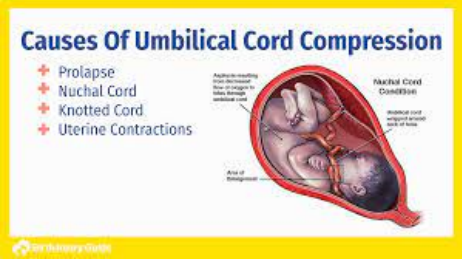
Umbilical cord compression is a known cause of variable decelerations in the fetal heart rate. When the umbilical cord is compressed, it can temporarily disrupt blood flow and oxygen supply to the fetus, leading to decelerations. Variable decelerations often appear as abrupt, sharp drops in the fetal heart rate and are typically characterized by their unpredictable nature.
C. Maternal opioid administration.
Maternal opioid administration is not a direct cause of variable decelerations in the fetal heart rate. While opioids can cross the placenta and may affect the fetus, they are more likely to cause other issues, such as respiratory depression in the newborn, rather than variable decelerations.
D. Uteroplacental insufficiency.
Uteroplacental insufficiency is not the primary factor causing variable decelerations. Uteroplacental insufficiency refers to an inadequate blood flow and oxygen delivery to the placenta, which can lead to late decelerations in the fetal heart rate, not variable decelerations.
Full Explanation
Choice A rationale:
Fetal head compression is unlikely to cause variable decelerations in the fetal heart rate. During contractions and labor, the fetal head may experience pressure, but this usually leads to early decelerations, not variable decelerations. Early decelerations are considered benign and are caused by the head's pressure stimulating the vagus nerve, resulting in a temporary decrease in heart rate.
Choice B rationale:
Umbilical cord compression is a known cause of variable decelerations in the fetal heart rate. When the umbilical cord is compressed, it can temporarily disrupt blood flow and oxygen supply to the fetus, leading to decelerations. Variable decelerations often appear as abrupt, sharp drops in the fetal heart rate and are typically characterized by their unpredictable
nature.
Choice C rationale:
Maternal opioid administration is not a direct cause of variable decelerations in the fetal heart rate. While opioids can cross the placenta and may affect the fetus, they are more likely to cause other issues, such as respiratory depression in the newborn, rather than variable decelerations.
Choice D rationale:
Uteroplacental insufficiency is not the primary factor causing variable decelerations. Uteroplacental insufficiency refers to an inadequate blood flow and oxygen delivery to the placenta, which can lead to late decelerations in the fetal heart rate, not variable decelerations.
A nurse is assisting with the monitoring of a client who is in the first stage of labor, with an external fetal monitor in place and IV fluids infusing. Which of the following factors will cause variable decelerations in the fetal heart rate?
A. Fetal head compression.
Fetal head compression is unlikely to cause variable decelerations in the fetal heart rate. During contractions and labor, the fetal head may experience pressure, but this usually leads to early decelerations, not variable decelerations. Early decelerations are considered benign and are caused by the head's pressure stimulating the vagus nerve, resulting in a temporary decrease in heart rate.
B. Umbilical cord compression.
Umbilical cord compression is a known cause of variable decelerations in the fetal heart rate. When the umbilical cord is compressed, it can temporarily disrupt blood flow and oxygen supply to the fetus, leading to decelerations. Variable decelerations often appear as abrupt, sharp drops in the fetal heart rate and are typically characterized by their unpredictable nature.
C. Maternal opioid administration.
Maternal opioid administration is not a direct cause of variable decelerations in the fetal heart rate. While opioids can cross the placenta and may affect the fetus, they are more likely to cause other issues, such as respiratory depression in the newborn, rather than variable decelerations.
D. Uteroplacental insufficiency.
Uteroplacental insufficiency is not the primary factor causing variable decelerations. Uteroplacental insufficiency refers to an inadequate blood flow and oxygen delivery to the placenta, which can lead to late decelerations in the fetal heart rate, not variable decelerations.
Full Explanation
Choice A rationale:
Fetal head compression is unlikely to cause variable decelerations in the fetal heart rate. During contractions and labor, the fetal head may experience pressure, but this usually leads to early decelerations, not variable decelerations. Early decelerations are considered benign and are caused by the head's pressure stimulating the vagus nerve, resulting in a temporary decrease in heart rate.
Choice B rationale:
nature.
Choice C rationale:
Maternal opioid administration is not a direct cause of variable decelerations in the fetal heart rate. While opioids can cross the placenta and may affect the fetus, they are more likely to cause other issues, such as respiratory depression in the newborn, rather than variable decelerations.
Choice D rationale:
Uteroplacental insufficiency is not the primary factor causing variable decelerations. Uteroplacental insufficiency refers to an inadequate blood flow and oxygen delivery to the placenta, which c