
Nursing practice questions with comprehensive rationales
NurseDive Free Nursing Practice Question
A nurse is caring for a client who is receiving mechanical ventilation when the low pressure alarm sounds on the ventilator. Which of the following actions should the nurse take?
A. Increase the client's ventilator flow rate.
Increasing the ventilator flow rate may not address the cause of the low-pressure alarm and could potentially worsen the situation.
B. Empty water from the client's ventilator tubing.
Emptying water from the ventilator tubing is not typically necessary when the low-pressure alarm sounds.
C. Evaluate the client for a cuff leak.
Evaluating the client for a cuff leak is essential because a leak in the endotracheal tube cuff can cause the low-pressure alarm to sound.
D. Suction the client's airway.
Suctioning the client's airway is not indicated unless there are signs of airway obstruction or secretions.
This question is an excerpt from Nurse Dive's nursing test bank - Ati Rn Adult Med Surg 2023 Proctored Exam. Take the full exam now
Full Explanation
A) Increasing the ventilator flow rate may not address the cause of the low-pressure alarm and could potentially worsen the situation.
B) Emptying water from the ventilator tubing is not typically necessary when the low-pressure alarm sounds.
C) Evaluating the client for a cuff leak is essential because a leak in the endotracheal tube cuff can cause the low-pressure alarm to sound.
D) Suctioning the client's airway is not indicated unless there are signs of airway obstruction or secretions.
Similar Questions
A nurse is providing discharge teaching to a client who reports that they cannot afford their prescribed medication. Which of the following statements should the nurse make?
A. "I can arrange for a social worker to talk with you before you leave."
This response offers a solution by involving a social worker who can assist the client in exploring financial assistance programs or alternative medication options.
B. "Contact your pharmacy to inquire about a different medication."
While contacting the pharmacy may be helpful, it does not guarantee a solution to the client's financial constraints.
C. "I can contact the occupational therapist to schedule a home visit."
Involving the occupational therapist for a home visit is not directly related to addressing the client's inability to afford medication.
D. "You should ask your provider to prescribe a cheaper medication."
Instructing the client to ask their provider to prescribe a cheaper medication puts the responsibility solely on the client and may not address the underlying issue effectively.
Full Explanation
A) This response offers a solution by involving a social worker who can assist the client in exploring financial assistance programs or alternative medication options.
B) While contacting the pharmacy may be helpful, it does not guarantee a solution to the client's financial constraints.
C) Involving the occupational therapist for a home visit is not directly related to addressing the client's inability to afford medication.
D) Instructing the client to ask their provider to prescribe a cheaper medication puts the responsibility solely on the client and may not address the underlying issue effectively.
A nurse is caring for a client in the emergency department.
Click to highlight the findings that indicate that the client's condition is improving. To deselect a finding, click on the finding again.
1400:
Client admitted to the medical-surgical unit at 1200 today. Alert and orientated x4, heart and lung sounds clear. Client urinating 100 mL/hour.
Client is tolerating soft diet and oral fluids. Bowel sounds are hyperactive in all 4 quadrants.
Bilateral pedal pulses 2+, Blood glucose 310 mg/dl. (74 to 106 mg/dL) 1400:
Temperature 36.8° C (98.2° F)
Pulse rate 84/min Respiratory rate 16/min
Blood pressure 106/76 mm Hg Oxygen saturation 96% on room air
A. Alert and orientated x4
None
B. Heart and lung sounds clear
None
C. Blood glucose 310 mg/dl. (74 to 106 mg/dL)
None
D. Client is tolerating soft diet and oral fluids
None
E. Bilateral pedal pulses 2+
None
F. Temperature 36.8° C (98.2° F)
None
G. Pulse rate 84/min
None
H. Respiratory rate 16/min
None
I. Blood pressure 106/76 mm Hg
None
J. Oxygen saturation 96% on room air
None
Full Explanation
Rationale:
The client's condition shows signs of improvement as indicated by several findings. The blood glucose level has decreased from 468 mg/dL to 310 mg/dL, which, although still above the normal range, is a significant improvement. The pulse rate has normalized from 110/min to 84/min, and the blood pressure has improved from 96/65 mm Hg to 106/76 mm Hg, indicating better cardiovascular stability. The increase in bilateral pedal pulses from 1+ to 2+ suggests improved circulation.
A nurse is preparing to receive a client from surgery following a transverse colon resection with colostomy placement. The nurse should expect to assess the stoma at which of the following locations? (You will find hot spots to select in the artwork below. Select only the hot spot that corresponds to your answer.)
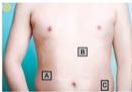
A. A
None
B. B
A transverse colon colostomy is typically placed in the upper abdomen, either in the middle or toward the right side of the body. In the above scenario the best location will be B which is located along the path of the transverse colon. Point A would be suitable for an ileostomy while point B will be suitable for a sigmoid colostomy.
C. C
None
Full Explanation
A transverse colon colostomy is typically placed in the upper abdomen, either in the middle or toward the right side of the body. In the above scenario the best location will be B which is located along the path of the transverse colon. Point A would be suitable for an ileostomy while point B will be suitable for a sigmoid colostomy.