
Nursing practice questions with comprehensive rationales
NurseDive Free Nursing Practice Question
A nurse is caring for a client who is restrained to each extremity. Which of the following assessments should the nurse perform first?
A. Elimination needs
Elimination needs are important but not the first priority in this situation.
B. Comfort level
Comfort level is also important but not the first priority in this situation.
C. Skin integrity
Skin integrity is important but not the first priority in this situation.
D. Peripheral pulses.
When a client is restrained to each extremity, it is important for the nurse to assess the client’s peripheral pulses first to ensure that circulation is not compromised.
This question is an excerpt from Nurse Dive's nursing test bank - ATI RN Fundamentals 2019 with NGN Proctored Exam. Take the full exam now
Full Explanation
When a client is restrained to each extremity, it is important for the nurse to assess the client’s peripheral pulses first to ensure that circulation is not compromised.
Choice A, Elimination needs, is important but not the first priority in this situation.
Choice B, Comfort level, is also important but not the first priority in this situation.
Choice C, Skin integrity, is important but not the first priority in this situation.
Similar Questions
A nurse is preparing to administer IV fluids to a client.
The nurse notes sparks when plugging in the IV pump.
Which of the following actions should the nurse take first?
A. Notify the biomedical department to fix the pump.
While notifying the biomedical department to fix the pump is important,it is not the immediate priority in this situation.The first step is to ensure patient and staff safety by removing the potential electrical hazard. Delaying the removal of the sparking pump could lead to electrical shock,fire,or other serious consequences. Biomedical staff can be notified after the immediate safety risk has been addressed.
B. Obtain a replacement pump.
Obtaining a replacement pump is necessary to continue the client's IV therapy,but it is not the first action the nurse should take. The priority is to eliminate the electrical hazard posed by the sparking pump. Once the faulty pump is unplugged and safety is ensured,the nurse can then proceed to obtain a replacement pump.
C. Label the pump with a defective equipment sticker.
Labeling the pump with a defective equipment sticker is important to prevent others from using it,but it does not address the immediate safety risk. The priority is to disconnect the pump from the power source to eliminate the risk of electrical shock or fire. Labeling can be done after the pump has been unplugged and the situation has been assessed.
D. Unplug the pump.
Unplugging the pump is the correct first action because it immediately removes the electrical hazard,preventing potential harm to the patient,staff,or equipment. This action prioritizes safety and mitigates the risk of electrical shock,burns,fire,or other serious consequences. It is essential to act quickly and decisively in such situations to ensure a safe environment for everyone involved.
Full Explanation
The correct answer is d. Unplug the pump.
Rationale for Choice A:
- While notifying the biomedical department to fix the pump is important, it is not the immediate priority in this situation. The first step is to ensure patient and staff safety by removing the potential electrical hazard.
- Delaying the removal of the sparking pump could lead to electrical shock, fire, or other serious consequences.
- Biomedical staff can be notified after the immediate safety risk has been addressed.
Rationale for Choice B:
- Obtaining a replacement pump is necessary to continue the client's IV therapy, but it is not the first action the nurse should take.
- The priority is to eliminate the electrical hazard posed by the sparking pump.
- Once the faulty pump is unplugged and safety is ensured, the nurse can then proceed to obtain a replacement pump.
Rationale for Choice C:
- Labeling the pump with a defective equipment sticker is important to prevent others from using it, but it does not address the immediate safety risk.
- The priority is to disconnect the pump from the power source to eliminate the risk of electrical shock or fire.
- Labeling can be done after the pump has been unplugged and the situation has been assessed.
Rationale for Choice D:
- Unplugging the pump is the correct first action because it immediately removes the electrical hazard, preventing potential harm to the patient, staff, or equipment.
- This action prioritizes safety and mitigates the risk of electrical shock, burns, fire, or other serious consequences.
- It is essential to act quickly and decisively in such situations to ensure a safe environment for everyone involved.
A nurse is caring for a client who is scheduled to have his alanine aminotransferase (ALT) level checked.
The client asks the nurse to explain the laboratory test.
Which of the following is an appropriate response by the nurse?
A. "This test will indicate if you are at risk for developing blood clots."
Choice A, “This test will indicate if you are at risk for developing blood clots,” is not correct as an ALT test does not provide information about blood clot risk.
B. "This test will determine if your heart is performing properly."
Choice B, “This test will determine if your heart is performing properly,” is not correct as an ALT test does not provide information about heart function.
C. "This test will provide information about the function of your liver."
“This test will provide information about the function of your liver.” An alanine aminotransferase (ALT) test measures the level of ALT in the blood, which is an enzyme found primarily in the liver. Elevated levels of ALT can indicate liver damage or disease.
D. "This test is used to check how your kidneys are working.".
Choice D, “This test is used to check how your kidneys are working,” is not correct as an ALT test does not provide information about kidney function.
Full Explanation
“This test will provide information about the function of your liver.” An alanine aminotransferase (ALT) test measures the level of ALT in the blood, which is an enzyme found primarily in the liver.
Elevated levels of ALT can indicate liver damage or disease.
Choice A, “This test will indicate if you are at risk for developing blood clots,” is not correct as an ALT test does not provide information about blood clot risk.
Choice B, “This test will determine if your heart is performing properly,” is not correct as an ALT test does not provide information about heart function.
Choice D, “This test is used to check how your kidneys are working,” is not correct as an ALT test does not provide information about kidney function.
A nurse working on a medical-surgical unit is making client assignments for an upcoming shift.
Which of the following tasks should the nurse assign to an assistive personnel?
A. Showing a client how to use an incentive spirometer prior to surgery.
Choice A is wrong because showing a client how to use an incentive spirometer prior to surgery requires more specialized knowledge and training.
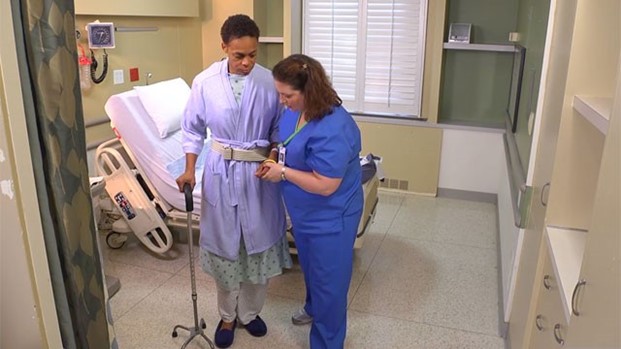
B. Assisting with ambulation for a client who has a pulmonary infection.
Assisting with ambulation for a client who has a pulmonary infection. Assistive personnel can perform basic nursing care functions such as assisting patients with mobility.
C. Irrigating a client's infected surgical wound.
Choice C is wrong because irrigating a client’s infected surgical wound is a more complex medical procedure that should be performed by a licensed nurse.
D. Inserting a glycerin suppository for a client who is constipated.
Choice D is wrong because inserting a glycerin suppository for a client who is constipated is also a more complex medical procedure that should be performed by a licensed nurse.
Full Explanation
Assisting with ambulation for a client who has a pulmonary infection.
Assistive personnel can perform basic nursing care functions such as assisting patients with mobility.
Choice A is wrong because showing a client how to use an incentive spirometer prior to surgery requires more specialized knowledge and training.
Choice C is wrong because irrigating a client’s infected surgical wound is a more complex medical procedure that should be performed by a licensed nurse.
Choice D is wrong because inserting a glycerin suppository for a client who is constipated is also a more complex medical procedure that should be performed by a licensed nurse.