
Nursing practice questions with comprehensive rationales
NurseDive Free Nursing Practice Question
A nurse is caring for a client who is scheduled for a mastectomy. The client tells the nurse,
"I'm not sure I want to have a mastectomy." Which of the following statements should the nurse make?
A. "You should get a second opinion regarding the procedure."
Telling the client to get a second opinion may imply that the nurse does not trust the surgeon ordoubts the necessity of the procedure.
B. "You will be cancer-free if you have the procedure."
Telling the client that they will be cancer-free if they have the procedure may be false or misleading, as there may be residual cancer cells or recurrence after surgery.
C. "I can give you a list of other people who had the same procedure."
Giving the client a list of other people who had the same procedure may violate confidentiality and may not be helpful or relevant to the client's situation.
D. I can give you additional information about the procedure."
A mastectomy is a surgical removal of one or both breasts, usually done to treat breast cancer. The nurse should respect the client's autonomy and provide factual information about the procedure, its benefits and risks, and possible alternatives . The nurse should also assess the client's readiness to learn, address any concerns or fears, and offer emotional support .
This question is an excerpt from Nurse Dive's nursing test bank - ATI RN adult medical surgical 2019 with NGN - Proctored Exam 3. Take the full exam now
Full Explanation
A mastectomy is a surgical removal of one or both breasts, usually done to treat breast cancer. The nurse should respect the client's autonomy and provide factual information about the procedure, its benefits and risks, and possible alternatives . The nurse should also assess the client's readiness to learn, address any concerns or fears, and offer emotional support . Telling the client to get a second opinion may imply that the nurse does not trust the surgeon or doubts the necessity of the procedure.
Telling the client that they will be cancer-free if they have the procedure may be false or misleading, as there may be residual cancer cells or recurrence after surgery. Giving the client a list of other people who had the same procedure may violate confidentiality and may not be helpful or relevant to the client's situation.
Similar Questions
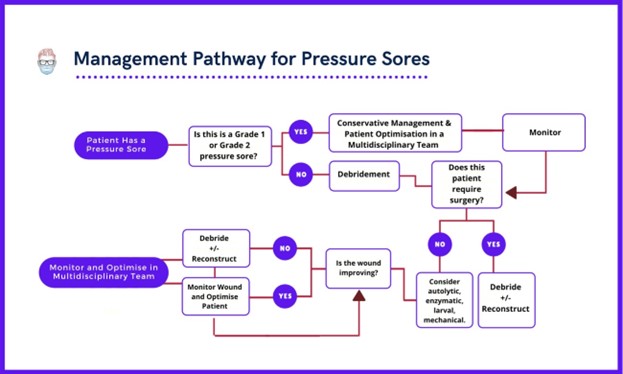
A nurse is assessing a client who has a pressure ulcer. Which of the following findings should the nurse expect as an indication the wound is healing?
A. Wound tissue firm to palpation
Wound tissue that is firm to palpation may indicate edema, inflammation, or infection .
B. Dry brown eschar
Dry browneschar is dead tissue that covers the wound and prevents healing
C. Light yellow exudate
Light yellow exudate is a sign of wound infection or necrosis .
D. Dark red granulation tissue
A pressure ulcer is a localized injury to the skin and underlying tissue caused by prolonged pressure, shear, friction, or moisture. Granulation tissue is new connective tissue and blood vessels that form on the surface of awound during healing . It is usually dark red or pink in color and moist in appearance.
Full Explanation
A pressure ulcer is a localized injury to the skin and underlying tissue caused by prolonged pressure, shear, friction, or moisture.
Granulation tissue is new connective tissue and blood vessels that form on the surface of a wound during healing . It is usually dark red or pink in color and moist in appearance . Wound tissue that is firm to palpation may indicate edema, inflammation, or infection . Dry brown eschar is dead tissue that covers the wound and prevents healing . Light yellow exudate is a sign of wound infection or necrosis .
A nurse is caring for a client following a bronchoscopy. Which of the following actions should the nurse take first?
A. Check the client's gag reflex.
The nurse should assess the client's gag reflex before allowing oral intake to prevent aspiration. The client's throat may be numb after a bronchoscopy, which is a procedure that uses a thin tube with a camera and light to examine the lungs and airways . The other actions are important but not the priority.
B. Inform the client they might experience a low-grade fever.
C. Provide the client with sips of water.
D. Instruct the client to report bleeding.
Full Explanation
The nurse should assess the client's gag reflex before allowing oral intake to prevent aspiration. The client's throat may be numb after a bronchoscopy, which is a procedure that uses a thin tube with a camera and light to examine the lungs and airways . The other actions are important but not the priority.
A nurse is providing discharge teaching to a client who has an ileostomy. Which of the following client statements indicates an understanding of the teaching?
A. "I will empty my bag when it is full."
The client should empty their bag several times a day, not when it is full, to prevent leakage and skin irritation.
B. "I will take a laxative when I'm constipated."
The client should avoid laxatives, which can cause dehydration and electrolyte imbalance.
C. "I will expect my stools to be loose."
An ileostomy is a surgical opening in the abdomen that connects the end of the small intestine (ileum) to a pouch or bag on the outside of the body. The ileostomy bypasses the large intestine (colon) and rectum, which normally absorb water and form solid stools. Therefore, the client should expect their stools to be loose and watery. The client should empty their bag several times a day, not when it is full, to prevent leakage and skin irritation. The client should avoid laxatives, which can cause dehydration and electrolyte imbalance. The client should also avoid high-fiber foods, which can cause blockage or irritation of the ileostomy.
D. "I will eat a high-fiber diet."
The client should also avoid high-fiber foods, which can cause blockage or irritation of the ileostomy.
Full Explanation
An ileostomy is a surgical opening in the abdomen that connects the end of the small intestine (ileum) to a pouch or bag on the outside of the body. The ileostomy bypasses the large intestine (colon) and rectum, which normally absorb water and form solid stools. Therefore, the client should expect their stools to be loose and watery. The client should empty their bag several times a day, not when it is full, to prevent leakage and skin irritation. The client should avoid laxatives, which can cause dehydration and electrolyte imbalance. The client should also avoid high-fiber foods, which can cause blockage or irritation of the ileostomy.