
Nursing practice questions with comprehensive rationales
NurseDive Free Nursing Practice Question
A nurse is caring for a client who reports spontaneous rupture of membranes. The nurse observes fetal bradycardia on the FHR tracing and notices that the umbilical cord is protruding.
After calling for assistance and notifying the provider, which of the following actions should the nurse take next?
A. Cover the umbilical cord with a sterile saline saturated towel.
Choice A) is not correct because while it is important to cover the cord with a sterile saline saturated towel if it has prolapsed externally 1, it is not the next action after calling for assistance and notifying the provider.
B. Perform a vaginal examination by applying upward pressure on the presenting part.
If a prolapsed cord is identified, the nurse should perform a vaginal examination and ensure the presenting part is pushed upwards to relieve pressure on the cord.
C. Administer oxygen via non-rebreather mask at 8 L/min.
Choice C) is not correct because administering oxygen via non-rebreather mask at 8 L/min is not mentioned as an immediate intervention for a prolapsed cord .
D. Initiate an infusion of IV fluids for the client.
Choice D) is not correct because initiating an infusion of IV fluids for the client is not mentioned as an immediate intervention for a prolapsed cord .
This question is an excerpt from Nurse Dive's nursing test bank - ATI RN Maternal Newborn 2019 with NGN Proctored Exam. Take the full exam now
Full Explanation
If a prolapsed cord is identified, the nurse should perform a vaginal examination and ensure the presenting part is pushed upwards to relieve pressure on the cord.
Choice A) is not correct because while it is important to cover the cord with a sterile saline saturated towel if it has prolapsed externally 1, it is not the next action after calling for assistance and notifying the provider.
Choice C) is not correct because administering oxygen via non-rebreather mask at 8 L/min is not mentioned as an immediate intervention for a prolapsed cord .
Choice D) is not correct because initiating an infusion of IV fluids for the client is not mentioned as an immediate intervention for a prolapsed cord .
Similar Questions
A nurse is caring for a client who is in labor and just received epidural anesthesia. The client's blood pressure is 90/50 mm Hg.
Which of the following actions should the nurse take?
A. Initiate an amnioinfusion for the client.
Choice A) is not correct because initiating an amnioinfusion is not mentioned as an immediate intervention for low blood pressure after epidural anesthesia .
B. Turn the client onto their side.
It’s normal for blood pressure to fall a little when a client receives an epidural. If necessary, fluids and medicine can be given through a drip to keep blood pressure normal.
C. Monitor the client's blood pressure every 15 min.
Choice C) is not correct because monitoring the client’s blood pressure every 15 min is not mentioned as an immediate intervention for low blood pressure after epidural anesthesia .
D. Administer naloxone to the client.
Choice D) is not correct because administering naloxone to the client is not mentioned as an immediate intervention for low blood pressure after epidural anesthesia .
Full Explanation
It’s normal for blood pressure to fall a little when a client receives an epidural.
If necessary, fluids and medicine can be given through a drip to keep blood pressure normal.
Choice A) is not correct because initiating an amnioinfusion is not mentioned as an immediate intervention for low blood pressure after epidural anesthesia .
Choice C) is not correct because monitoring the client’s blood pressure every 15 min is not mentioned as an immediate intervention for low blood pressure after epidural anesthesia .
Choice D) is not correct because administering naloxone to the client is not mentioned as an immediate intervention for low blood pressure after epidural anesthesia .
A nurse is planning care immediately following birth for a newborn who has a myelomeningocele that is leaking cerebrospinal fluid.
Which of the following actions should the nurse include in the plan of care?
A. Prepare for surgical closure after 72 hr.
Preparing for surgical closure after 72 hours is incorrect. Surgical closure is typically performed within the first 24 to 48 hours to prevent infection and further damage to the neural tissue.
B. Administer broad-spectrum antibiotics.
Administering broad-spectrum antibiotics is crucial to prevent infection, especially since the cerebrospinal fluid is leaking, which increases the risk of meningitis and other infections.
C. Cleanse the site with povidone-iodine.
Cleansing the site with povidone-iodine is not recommended because it can be irritating and potentially harmful to the exposed neural tissue.
D. Monitor the rectal temperature every 4 hr.
Monitoring the rectal temperature every 4 hours is not appropriate as it can increase the risk of infection and trauma to the site. Axillary temperature monitoring is preferred.
Full Explanation
The correct answer is. Administering broad-spectrum antibiotics.
Cleansing the site with povidone-iodine is not recommended because it can be irritating and potentially harmful to the exposed neural tissue.
Monitoring the rectal temperature every 4 hours is not appropriate as it can increase the risk of infection and trauma to the site. Axillary temperature monitoring is preferred.
Preparing for surgical closure after 72 hours is incorrect. Surgical closure is typically performed within the first 24 to 48 hours to prevent infection and further damage to the neural tissue.
Administering broad-spectrum antibiotics is crucial to prevent infection, especially since the cerebrospinal fluid is leaking, which increases the risk of meningitis and other infections.
A nurse is planning care for a client following a chorionic villus sampling.
The nurse should recognize that the client is at risk for developing which of the following complications?
A. Anemia
Choice A is incorrect because anemia is not a known complication of CVS.
B. Infection
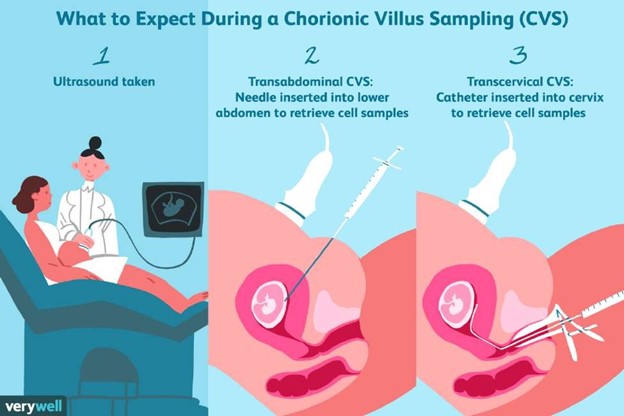
Chorionic villus sampling (CVS) is a prenatal test that involves taking a sample of tissue from the placenta to test for chromosomal abnormalities and certain other genetic problems. As with all types of surgical procedures, infections can happen during or after CVS.
C. Late decelerations
Choice C is incorrect because late decelerations are a type of fetal heart rate patern that can occur during labor and are not related to CVS.
D. Placental insufficiency.
Choice D is incorrect because placental insufficiency is a condition where the placenta is unable to provide enough oxygen and nutrients to the fetus and is not a known complication of CVS.
Full Explanation
Chorionic villus sampling (CVS) is a prenatal test that involves taking a sample of tissue from the placenta to test for chromosomal abnormalities and certain other genetic problems.
As with all types of surgical procedures, infections can happen during or after CVS2.
Choice A is incorrect because anemia is not a known complication of CVS.
Choice C is incorrect because late decelerations are a type of fetal heart rate patern that can occur during labor and are not related to CVS.
Choice D is incorrect because placental insufficiency is a condition where the placenta is unable to provide enough oxygen and nutrients to the fetus and is not a known complication of CVS.