
Nursing practice questions with comprehensive rationales
NurseDive Free Nursing Practice Question
A nurse is collecting data from a 3-month-old infant who is 6 hr postoperative following a cleft palate repair.
Which of the following pain rating tools should the nurse use?
A. FACES Scale
The FACES Scale, also known as the Wong-Baker FACES Pain Rating Scale, is a tool commonly used for children who can understand and self-report their pain. It consists of a series of faces with different expressions representing varying degrees of pain.
B. FLACC Scale
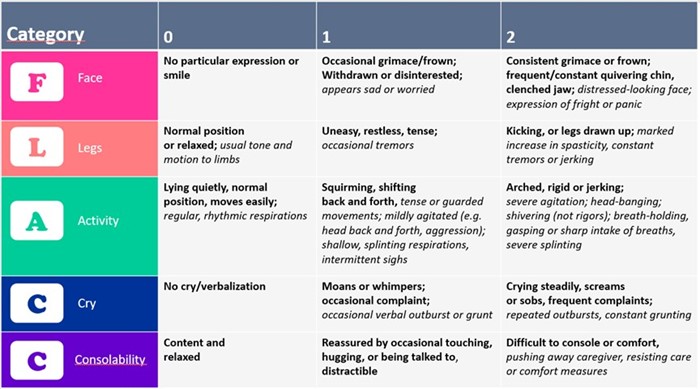
The FLACC (Face, Legs, Activity, Cry, Consolability) Scale is a pain assessment tool commonly used for infants and young children who are unable to self-report their pain. It assesses five categories of behavior: facial expression, leg movement, activity level, cry, and consolability. Each category is scored from 0 to 2 or 0 to 3, depending on the specific scale used. The scores are then totaled to provide an overall pain assessment.
C. Color tool
The Color tool is not a recognized pain rating tool. It may refer to an assessment of skin color, which can be used to assess oxygenation or circulation but not specifically for pain.
D. Numeric scale
The Numeric scale is a pain rating tool that involves asking the individual to rate their pain on a scale from 0 to 10, with 0 being no pain and 10 being the worst pain imaginable. However, this scale may not be suitable for a 3-month-old infant who is unable to comprehend numbers or communicate effectively.
This question is an excerpt from Nurse Dive's nursing test bank - VATI PN Comprehensive Predictor 2020 Proctored Exam. Take the full exam now
Full Explanation
b. FLACC Scale.
Explanation: The FLACC (Face, Legs, Activity, Cry, Consolability) Scale is a pain assessment tool commonly used for infants and young children who are unable to self-report their pain. It assesses five categories of behavior: facial expression, leg movement, activity level, cry, and consolability. Each category is scored from 0 to 2 or 0 to 3, depending on the specific scale used. The scores are then totaled to provide an overall pain assessment.
The FACES Scale, also known as the Wong-Baker FACES Pain Rating Scale, is a tool commonly used for children who can understand and self-report their pain. It consists of a series of faces with different expressions representing varying degrees of pain.
The Color tool is not a recognized pain rating tool. It may refer to an assessment of skin color, which can be used to assess oxygenation or circulation but not specifically for pain.
The Numeric scale is a pain rating tool that involves asking the individual to rate their pain on a scale from 0 to 10, with 0 being no pain and 10 being the worst pain imaginable. However, this scale may not be suitable for a 3-month-old infant who is unable to comprehend numbers or communicate effectively.
Similar Questions
A nurse is collecting data from a client who has a long-leg cast on his left leg and reports severe pain. Which of the following findings should the nurse identify as an indication that the client might have compartment syndrome? (Select all that apply.)
A. Pallor in the exposed portion of the left foot.
Option a is a correct answer because pallor (paleness) in the exposed portion of the left foot may indicate compromised blood flow due to increased pressure within the compartment.
B. Inability to move the left foot.
Option b is a correct answer because the inability to move the left foot suggests impaired nerve function, which can be a sign of compartment syndrome.
C. Increased warmth of the exposed portion of the left foot.
Option c is not a correct answer. Increased warmth is not typically associated with compartment syndrome; instead, it may suggest inflammation or infection.
D. Ecchymosis in the exposed portion of the left foot.
Option d is not a correct answer. Ecchymosis (bruising) is not typically associated with compartment syndrome, as it is more commonly observed in cases of injury or trauma.
E. e. Paresthesia in the left foot
Option e is a correct answer because paresthesia (abnormal sensations like tingling or numbness) in the left foot can indicate nerve compression and is a potential symptom of compartment syndrome.
Full Explanation
Compartment syndrome is a condition characterized by increased pressure within a closed anatomical space, such as a compartment in the leg. This increased pressure can compromise blood flow and nerve function. When assessing a client with a long-leg cast who reports severe pain, the nurse should be vigilant for signs and symptoms of compartment syndrome.
Option a is a correct answer because pallor (paleness) in the exposed portion of the left foot may indicate compromised blood flow due to increased pressure within the compartment.
Option b is a correct answer because the inability to move the left foot suggests impaired nerve function,
which can be a sign of compartment syndrome.
Option c is not a correct answer. Increased warmth is not typically associated with compartment syndrome; instead, it may suggest inflammation or infection.
Option d is not a correct answer. Ecchymosis (bruising) is not typically associated with compartment syndrome, as it is more commonly observed in cases of injury or trauma.
Option e is a correct answer because paresthesia (abnormal sensations like tingling or numbness) in the left foot can indicate nerve compression and is a potential symptom of compartment syndrome.
By identifying the presence of pallor, inability to move the foot, and paresthesia, the nurse can recognize indications of compartment syndrome and take appropriate actions to address the condition promptly.
A charge nurse is supervising a newly licensed nurse who is caring for a client who is experiencing auditory hallucinations and is refusing medication. The newly licensed nurse suggests placing the medication in the client's food to the charge nurse. Which of the following actions should the charge nurse take?
A. Suggest the family persuade the client to take the medication.
It may not be appropriate for the family to persuade the client to take medication against their wishes.
B. Recommend that the medication be delivered intramuscularly.
Delivering medication intramuscularly against the client's wishes would violate their right to refuse treatment.
C. Remind the newly licensed nurse that the client has a right to refuse medication.
The charge nurse should remind the newly licensed nurse that the client has a right to refuse medication. It is important for healthcare providers to respect the autonomy and rights of their clients, including the right to refuse treatment.
D. Suggest the newly licensed nurse contact the pharmacy to inquire about compatible foods.
Inquiring about compatible foods with the pharmacy would not address the issue of the client's right to refuse medication.
Full Explanation
The charge nurse should remind the newly licensed nurse that the client has a right to refuse medication. It is important for healthcare providers to respect the autonomy and rights of their clients, including the right to refuse treatment.
Option a is incorrect because it may not be appropriate for the family to persuade the client to take medication against their wishes.
Option b is incorrect because delivering medication intramuscularly against the client's wishes would violate their right to refuse treatment.
Option d is incorrect because inquiring about compatible foods with the pharmacy would not address the issue of the client's right to refuse medication.
A nurse is observing an assistive personnel (AP) apply antiembolic stockings for a client. The nurse should identify that which of the following actions by the AP indicates an understanding of the procedure.
A. Elevates the client's legs before applying the stockings
The action by the AP that indicates an understanding of the procedure is elevating the client's legs before applying the stockings. Elevating the legs can help reduce swelling and make it easier to apply the stockings.
B. Instructs the client to dorsiflex their feet while applying the stockings
Instructing the client to dorsiflex their feet while applying the stockings may not be necessary.
C. Massages the client's legs before applying the stockings
Massaging the client's legs before applying the stockings may not be necessary or appropriate.
D. Folds the top of the stockings over after applying them
Folding the top of the stockings over after applying them may not be necessary or appropriate.
Full Explanation
The action by the AP that indicates an understanding of the procedure is elevating the client's legs before applying the stockings. Elevating the legs can help reduce swelling and make it easier to apply the stockings.
Option b is incorrect because instructing the client to dorsiflex their feet while applying the stockings may not be necessary.
Option c is incorrect because massaging the client's legs before applying the stockings may not be necessary or appropriate.
Option d is incorrect because folding the top of the stockings over after applying them may not be necessary or appropriate.