
Nursing practice questions with comprehensive rationales
NurseDive Free Nursing Practice Question
A nurse is instructing a client who has cancer about precautions to take while undergoing chemotherapy. Which of the following statements by the client indicates an understanding of the teaching?
A. "I will wear gloves when I change my cat's litter box.".
Wearing gloves when changing the cat's litter box is essential during chemotherapy because some chemotherapy drugs can be excreted in bodily fluids, including feces. Protecting against direct contact with potentially harmful substances is crucial to minimize exposure risks.
B. "I will take my temperature once each week.".
Taking the temperature once each week is not a relevant precaution during chemotherapy. Monitoring temperature is important, but it should be done more frequently, such as daily, as chemotherapy can cause immunosuppression, increasing the risk of infection.
C. "I will be able to attend my favorite singer's concert.".
Being able to attend a concert is not related to precautions during chemotherapy. It is essential for clients undergoing chemotherapy to avoid large gatherings and events where they might be exposed to infections.
D. "I will allow my toothbrush to dry completely between each use.".
Allowing the toothbrush to dry completely between each use is a good hygiene practice but not specifically related to chemotherapy precautions. Proper oral hygiene is essential during chemotherapy, but using a soft toothbrush and regularly replacing it are more relevant considerations.
This question is an excerpt from Nurse Dive's nursing test bank - ATI RN VATI Adult Medical Surgical S 2019 Proctored Exam. Take the full exam now
Full Explanation
Choice A rationale:
Wearing gloves when changing the cat's litter box is essential during chemotherapy because some chemotherapy drugs can be excreted in bodily fluids, including feces. Protecting against direct contact with potentially harmful substances is crucial to minimize exposure risks.
Choice B rationale:
Taking the temperature once each week is not a relevant precaution during chemotherapy. Monitoring temperature is important, but it should be done more frequently, such as daily, as chemotherapy can cause immunosuppression, increasing the risk of infection.
Choice C rationale:
Being able to attend a concert is not related to precautions during chemotherapy. It is essential for clients undergoing chemotherapy to avoid large gatherings and events where they might be exposed to infections.
Choice D rationale:
Allowing the toothbrush to dry completely between each use is a good hygiene practice but not specifically related to chemotherapy precautions. Proper oral hygiene is essential during chemotherapy, but using a soft toothbrush and regularly replacing it are more relevant considerations.
Similar Questions
A nurse is caring for a client who has a deep vein thrombosis and a prescription for heparin. For which of the following findings should the nurse withhold the medication and notify the provider?
A. INR 0.8, aPTT 85 seconds.
An INR (International Normalized Ratio) of 0.8 is within the normal range for someone not on anticoagulation therapy. The aPTT (activated partial thromboplastin time) of 85 seconds is prolonged, but it is not a reason to withhold heparin in itself. Therefore, the nurse should not withhold the medication for these values.
B. INR 2, aPTT 60 seconds.
An INR of 2 indicates the client's blood is taking twice as long to clot compared to the average, which can increase the risk of bleeding. The aPTT of 60 seconds is within the normal range. However, the elevated INR suggests the client might be overly anticoagulated, so the nurse should withhold the medication and notify the provider.
Full Explanation
Choice A rationale:
An INR (International Normalized Ratio) of 0.8 is within the normal range for someone not on anticoagulation therapy. The aPTT (activated partial thromboplastin time) of 85 seconds is prolonged, but it is not a reason to withhold heparin in itself. Therefore, the nurse should not withhold the medication for these values.
Choice B rationale:
An INR of 2 indicates the client's blood is taking twice as long to clot compared to the average, which can increase the risk of bleeding. The aPTT of 60 seconds is within the normal range. However, the elevated INR suggests the client might be overly anticoagulated, so the nurse should withhold the medication and notify the provider.
A nurse is preparing to administer potassium chloride 10 mEq IV over 1 hr to a client. Available in potassium chloride 10 mEq in 100 mL of 0.9% sodium chloride. The nurse should set the infusion pump to deliver how many mL/hr? (Round the answer to the nearest whole number. Use a leading zero if it applies. Do not use a trailing zero.).
A. 10 mL/hr.
10 mL/hr would be the correct infusion rate if the client was receiving the entire 10 mEq of potassium chloride in a 100 mL solution over 1 hour. However, the question asks for the rate at which to administer 10 mEq over 1 hour, which means the total volume should be 100 mL/hr.
B. 50 mL/hr.
50 mL/hr would be the correct infusion rate if the client was receiving the entire 10 mEq of potassium chloride in a 100 mL solution over 2 hours. However, the question specifies 1 hour, so the rate should be higher.
C. 100 mL/hr.
This is the correct answer. To administer 10 mEq of potassium chloride in 100 mL over 1 hour, the infusion pump should be set to deliver 100 mL/hr.
D. 500 mL/hr.
500 mL/hr would be the correct infusion rate if the client was receiving the entire 10 mEq of potassium chloride in a 100 mL solution over 10 minutes (1/6th of an hour). However, the question specifies 1 hour, so the rate should be much lower.
Full Explanation
Choice A rationale:
10 mL/hr would be the correct infusion rate if the client was receiving the entire 10 mEq of potassium chloride in a 100 mL solution over 1 hour. However, the question asks for the rate at which to administer 10 mEq over 1 hour, which means the total volume should be 100 mL/hr.
Choice B rationale:
50 mL/hr would be the correct infusion rate if the client was receiving the entire 10 mEq of potassium chloride in a 100 mL solution over 2 hours. However, the question specifies 1 hour, so the rate should be higher.
Choice C rationale:
This is the correct answer. To administer 10 mEq of potassium chloride in 100 mL over 1 hour, the infusion pump should be set to deliver 100 mL/hr.
Choice D rationale:
500 mL/hr would be the correct infusion rate if the client was receiving the entire 10 mEq of potassium chloride in a 100 mL solution over 10 minutes (1/6th of an hour). However, the question specifies 1 hour, so the rate should be much lower.
A nurse is providing teaching for a client about testicular cancer. Which of the following manifestations should the nurse instruct the client to monitor for during self-examination?
A. A painless lump in the testicle.
Testicular cancer may present as a painless lump or swelling in the testicle. It's important for the client to monitor for any new or unusual lumps, as they could be indicative of cancer.
B. Decreased size of the testicle.
A decreased size of the testicle is not a typical manifestation of testicular cancer. It is more commonly associated with conditions like testicular atrophy due to other causes.
C. Left testicle descending lower than right testicle.
Asymmetry in the position of the testicles, with one testicle descending lower than the other, is a normal variation and not a sign of testicular cancer.
D. Dilated veins above the testicle.
Dilated veins above the testicle can be a sign of a varicocele, which is a separate condition from testicular cancer. It is caused by abnormal enlargement of veins in the scrotum and is generally not associated with cancer.
Full Explanation
Choice A rationale:
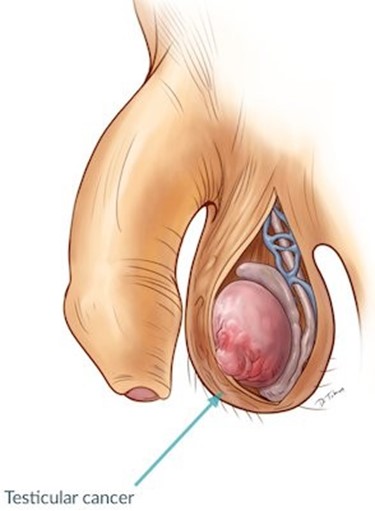
Testicular cancer may present as a painless lump or swelling in the testicle. It's important for the client to monitor for any new or unusual lumps, as they could be indicative of cancer.
Choice B rationale:
A decreased size of the testicle is not a typical manifestation of testicular cancer. It is more commonly associated with conditions like testicular atrophy due to other causes.
Choice C rationale:
Asymmetry in the position of the testicles, with one testicle descending lower than the other, is a normal variation and not a sign of testicular cancer.
Choice D rationale:
Dilated veins above the testicle can be a sign of a varicocele, which is a separate condition from testicular cancer. It is caused by abnormal enlargement of veins in the scrotum and is generally not associated with cancer.