
Nursing practice questions with comprehensive rationales
NurseDive Free Nursing Practice Question
A nurse is performing an assessment of a newborn's Babinski reflex. Which of the following findings should the nurse expect?
A. Flexion of the forearm.
Choice A is not an answer because flexion of the forearm is not a response to stimulation of the foot.
B. Downward curl of the toes.
Choice B is not an answer because downward curl of the toes is not a response to stimulation of the foot.
C. Dorsiflexion of the great toe.
The Babinski reflex, also known as the plantar reflex, is a normal reflex in infants that occurs when the sole of the foot is stroked from heel to toe. In response to this stimulus, the big toe moves upward or toward the top surface of the foot and the other toes fan out12.
D. Extension of the leg.
Choice D is not an answer because extension of the leg is not a response to stimulation of the foot.
This question is an excerpt from Nurse Dive's nursing test bank - ATI RN Maternal Newborn 2019 with NGN Proctored Exam. Take the full exam now
Full Explanation
The Babinski reflex, also known as the plantar reflex, is a normal reflex in infants
that occurs when the sole of the foot is stroked from heel to toe.
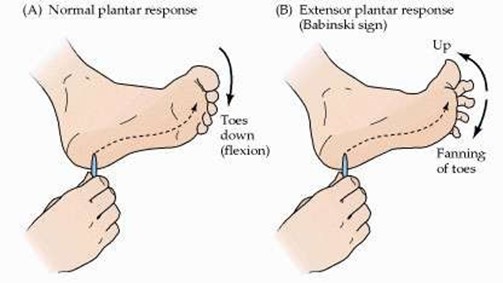
In response to this stimulus, the big toe moves upward or toward the top surface of the foot and the other toes fan out.
Choice A is not an answer because flexion of the forearm is not a response to stimulation of the foot.
Choice B is not an answer because downward curl of the toes is not a response
to stimulation of the foot.
Choice D is not an answer because extension of the leg is not a response to
stimulation of the foot.
Similar Questions
A nurse is assessing a newborn who was exposed to cocaine in utero.
Which of the following findings should the nurse expect?
A. Hypotonicity.
Choice A is not an answer because hypotonicity is not a common finding in newborns exposed to cocaine in utero.
B. High-pitched cry.
A newborn who was exposed to cocaine in utero may exhibit a high-pitched cry as well as other symptoms such as irritability, tremors, and feeding difficulties.
C. Increased head circumference.
Choice C is not an answer because increased head circumference is not a common finding in newborns exposed to cocaine in utero.
D. Decreased startle response.
Choice D is not an answer because decreased startle response is not a common finding in newborns exposed to cocaine in utero.
Full Explanation
A newborn who was exposed to cocaine in utero may exhibit a high-pitched cry as well as other symptoms such as irritability, tremors, and feeding difficulties.
Choice A is not an answer because hypotonicity is not a common finding in newborns exposed to cocaine in utero.
Choice C is not an answer because increased head circumference is not a common finding in newborns exposed to cocaine in utero.
Choice D is not an answer because decreased startle response is not a common finding in newborns exposed to cocaine in utero.
A nurse is using Nägele's Rule to calculate the expected delivery date of a client who reports that the first day of her last menstrual cycle was July 28th.
Which of the following dates should the nurse document as the client's expected delivery date?
A. April 21st.
Choice A is incorrect because April 21st is too early according to Nägele’s Rule calculation.
B. May 5th.
Nägele’s Rule is a method for estimating the expected date of delivery (EDD) or confinement (EDC). It involves adding seven days and one year, and subtracting three months, from the first day of the last menstrual period (LMP)1. Using this rule, if the first day of the client’s last menstrual period was July 28th, then adding seven days would be August 4th. Subtracting three months would be May 4th. Adding one year would be May 4th of the following year. Therefore, the nurse should document May 5th as the client’s expected delivery date.
C. May 21st.
Choice C is incorrect because May 21st is too late according to Nägele’s Rule calculation.
D. April 4th.
Choice D is incorrect because April 4th is too early according to Nägele’s Rule calculation.
Full Explanation
Nägele’s Rule is a method for estimating the expected date of delivery (EDD) or confinement (EDC).
It involves adding seven days and one year, and subtracting three months, from the first day of the last menstrual period (LMP)1.
Using this rule, if the first day of the client’s last menstrual period was July 28th, then adding seven days would be August 4th.
Subtracting three months would be May 4th.
Adding one year would be May 4th of the following year.
Therefore, the nurse should document May 5th as the client’s expected delivery date.
Choice A is incorrect because April 21st is too early according to Nägele’s Rule calculation.
Choice C is incorrect because May 21st is too late according to Nägele’s Rule calculation.
Choice D is incorrect because April 4th is too early according to Nägele’s Rule calculation.
A nurse is caring for a client who is at 32 weeks of gestation and has gestational diabetes mellitus.
Which of the following findings should the nurse report to the provider?
A. The client has non-pitting pedal edema.
Choice A is incorrect because non-pitting pedal edema is common during late pregnancy and is usually caused by physiologic edema resulting from hormone- induced sodium retention.
B. The client has a fundal height of 38 cm.
The nurse should report a fundal height of 38 cm to the provider. Fundal height is measured from the top of the pubic bone to the top of the uterus and is used to assess fetal growth. A fundal height measurement that is larger than expected for gestational age may indicate macrosomia, which is a common complication of gestational diabetes mellitus.
C. The client reports 12 fetal movements in hr.
Choice C is incorrect because 12 fetal movements in an hour are within normal range.
D. The client has a fasting blood glucose of 90 mg/du.
Choice D is incorrect because a fasting blood glucose level of 90 mg/dL is within normal range for a pregnant woman with gestational diabetes mellitus.
Full Explanation
The nurse should report a fundal height of 38 cm to the provider.
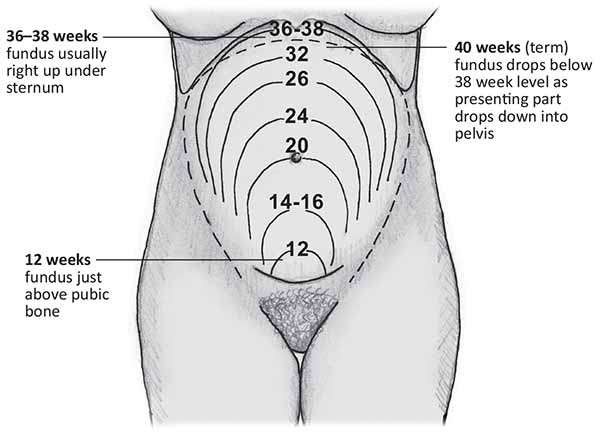
Fundal height is measured from the top of the pubic bone to the top of the uterus and is used to assess fetal growth.
A fundal height measurement that is larger than expected for gestational age may indicate macrosomia, which is a common complication of gestational diabetes mellitus.
Choice A is incorrect because non-pitting pedal edema is common during late pregnancy and is usually caused by physiologic edema resulting from hormone- induced sodium retention.
Choice C is incorrect because 12 fetal movements in an hour are within normal
range.
Choice D is incorrect because a fasting blood glucose level of 90 mg/dL is within normal range for a pregnant woman with gestational diabetes mellitus.