
Nursing practice questions with comprehensive rationales
NurseDive Free Nursing Practice Question
A nurse is planning care for a client who has a new prescription to receive a continuous infusion of total parenteral nutrition (TPN) Which of the following interventions should the nurse implement?
A. Change the TPN infusion tubing once every 3 days
Change the TPN infusion tubing once every 3 days: While changing the TPN infusion tubing regularly is a good practice to maintain asepsis and prevent infection, it is not the priority intervention in this situation. Regularly checking the client's blood glucose level is more crucial to monitor the effects of TPN on blood sugar levels.
B. Check the client's blood glucose level regularly
When caring for a client receiving a continuous infusion of total parenteral nutrition (TPN), the nurse should implement the intervention of checking the client's blood glucose level regularly. TPN is a highly concentrated intravenous nutrition solution containing glucose, amino acids, lipids, vitamins, and minerals, and it is used to provide complete nutrition when the client cannot take oral nutrition. Monitoring blood glucose levels regularly is essential because TPN is rich in glucose, which can significantly affect the client's blood sugar levels. Hyperglycemia (high blood sugar) is a potential complication of TPN infusion. Regular blood glucose monitoring allows the nurse to detect and address any changes in blood sugar levels promptly and to adjust the TPN infusion rate or administer insulin, if necessary, to maintain the client's blood sugar within the target range.
C. Insert the peripheral IV catheter for administration
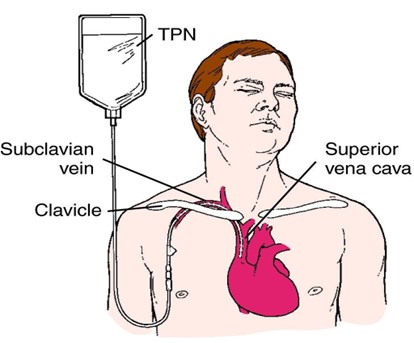
Insert the peripheral IV catheter for administration: Total parenteral nutrition is a hypertonic solution that can cause irritation and damage to peripheral veins. It is usually administered through a central venous catheter (CVC) placed in a large vein, such as the subclavian or jugular vein. Inserting a peripheral IV catheter for TPN administration is not recommended due to the risk of vein damage and thrombosis.
D. Monitor the client's weight every 3 days
Monitor the client's weight every 3 days: Monitoring the client's weight is an important part of assessing their nutritional status and fluid balance. However, the priority intervention for a client receiving TPN is checking their blood glucose level regularly, as hyperglycemia is a common and significant concern in TPN administration.
This question is an excerpt from Nurse Dive's nursing test bank - RN VATI Pharmacology S 2019 Proctored Exam. Take the full exam now
Full Explanation
When caring for a client receiving a continuous infusion of total parenteral nutrition (TPN), the nurse should implement the intervention of checking the client's blood glucose level regularly. TPN is a highly concentrated intravenous nutrition solution containing glucose, amino acids, lipids, vitamins, and minerals, and it is used to provide complete nutrition when the client cannot take oral nutrition.
Monitoring blood glucose levels regularly is essential because TPN is rich in glucose, which can significantly affect the client's blood sugar levels. Hyperglycemia (high blood sugar) is a potential complication of TPN infusion. Regular blood glucose monitoring allows the nurse to detect and address any changes in blood sugar levels promptly and to adjust the TPN infusion rate or administer insulin, if necessary, to maintain the client's blood sugar within the target range.
Let's go through the other options:
A. Change the TPN infusion tubing once every 3 days: While changing the TPN infusion tubing regularly is a good practice to maintain asepsis and prevent infection, it is not the priority intervention in this situation. Regularly checking the client's blood glucose level is more crucial to monitor the effects of TPN on blood sugar levels.
C. Insert the peripheral IV catheter for administration: Total parenteral nutrition is a hypertonic solution that can cause irritation and damage to peripheral veins. It is usually administered through a central venous catheter (CVC) placed in a large vein, such as the subclavian or jugular vein. Inserting a peripheral IV catheter for TPN administration is not recommended due to the risk of vein damage and thrombosis.
D. Monitor the client's weight every 3 days: Monitoring the client's weight is an important part of assessing their nutritional status and fluid balance. However, the priority intervention for a client receiving TPN is checking their blood glucose level regularly, as hyperglycemia is a common and significant concern in TPN administration.
Similar Questions
A nurse is reviewing the medication list of a client who has a new prescription for clopidogrel after undergoing coronary artery stenting. Which of the following findings should the nurse report to the provider?
A. The client is taking acetaminophen
The client is taking acetaminophen: Acetaminophen is not known to have significant interactions with clopidogrel. It is a commonly used pain reliever and fever reducer and does not usually affect the antiplatelet activity of clopidogrel.
B. The client is taking valerian
The client is taking valerian: Valerian is an herbal supplement often used as a sleep aid or to reduce anxiety. While there is limited evidence of significant interactions with clopidogrel, it is generally recommended to use caution when combining valerian with antiplatelet medications. However, it is not as concerning as ginkgo biloba in terms of potential bleeding risk.
C. The client is taking vitamin B6
The client is taking vitamin B6: Vitamin B6 is a water-soluble vitamin and is not expected to have significant interactions with clopidogrel. It is generally considered safe to use vitamin B6 with antiplatelet medications like clopidogrel.
D. The client is taking ginkgo biloba
The nurse should report to the provider that the client is taking ginkgo biloba. Ginkgo biloba is an herbal supplement that can interact with clopidogrel and other antiplatelet medications. It may increase the risk of bleeding when taken concurrently with clopidogrel, which is an antiplatelet medication used to prevent blood clots after coronary artery stenting.
Full Explanation
The nurse should report to the provider that the client is taking ginkgo biloba. Ginkgo biloba is an herbal supplement that can interact with clopidogrel and other antiplatelet medications. It may increase the risk of bleeding when taken concurrently with clopidogrel, which is an antiplatelet medication used to prevent blood clots after coronary artery stenting.
Let's go through the other options:
A. The client is taking acetaminophen: Acetaminophen is not known to have significant interactions with clopidogrel. It is a commonly used pain reliever and fever reducer and does not usually affect the antiplatelet activity of clopidogrel.
B. The client is taking valerian: Valerian is an herbal supplement often used as a sleep aid or to reduce anxiety. While there is limited evidence of significant interactions with clopidogrel, it is generally recommended to use caution when combining valerian with antiplatelet medications. However, it is not as concerning as ginkgo biloba in terms of potential bleeding risk.
C. The client is taking vitamin B6: Vitamin B6 is a water-soluble vitamin and is not expected to have significant interactions with clopidogrel. It is generally considered safe to use vitamin B6 with antiplatelet medications like clopidogrel.
A nurse is providing teaching for a client who has a new prescription for promethazine tablets. Which of the following client statements indicates an understanding of the teaching?
A. "This medication can cause diarrhea
"This medication can cause diarrhea": Diarrhea is not a common side effect of promethazine. While promethazine can cause certain gastrointestinal side effects like constipation or upset stomach, diarrhea is not typically associated with its use.
B. "The medication can cause increased salivation
"The medication can cause increased salivation": Increased salivation is not a common side effect of promethazine. While some antihistamines can cause dry mouth, which is the opposite of increased salivation, promethazine does not usually cause excessive salivation.
C. "This medication can cause pupil constriction"
"This medication can cause pupil constriction": Pupil constriction (miosis) is a potential side effect of some medications, but it is not commonly associated with promethazine. Promethazine is more likely to cause pupil dilation (mydriasis) rather than constriction.
D. "The medication can cause drowsiness
The client statement that indicates an understanding of the teaching is: "The medication can cause drowsiness." Promethazine is an antihistamine medication commonly used to treat various conditions, such as allergies, motion sickness, and nausea. One of the most common side effects of promethazine is drowsiness or sedation. It has a significant sedative effect, and it is often used to induce sleep or manage insomnia in some cases.
Full Explanation
The client statement that indicates an understanding of the teaching is: "The medication can cause drowsiness."
Promethazine is an antihistamine medication commonly used to treat various conditions, such as allergies, motion sickness, and nausea. One of the most common side effects of promethazine is drowsiness or sedation. It has a significant sedative effect, and it is often used to induce sleep or manage insomnia in some cases.
Let's go through the other options:
A. "This medication can cause diarrhea": Diarrhea is not a common side effect of promethazine. While promethazine can cause certain gastrointestinal side effects like constipation or upset stomach, diarrhea is not typically associated with its use.
B. "The medication can cause increased salivation": Increased salivation is not a common side effect of promethazine. While some antihistamines can cause dry mouth, which is the opposite of increased salivation, promethazine does not usually cause excessive salivation.
C. "This medication can cause pupil constriction": Pupil constriction (miosis) is a potential side effect of some medications, but it is not commonly associated with promethazine. Promethazine is more likely to cause pupil dilation (mydriasis) rather than constriction.
A nurse is assessing a client who reports feeling dizzy while getting out of bed. The nurse suspects orthostatic hypotension related to a medication the client is taking Which of the following medications should the nurse identify as likely causing this adverse effect?
A. Dabigatran
Dabigatran (A) is an anticoagulant used to prevent blood clots and does not typically cause orthostatic hypotension as a side effect.
B. Levothyroxine
Levothyroxine (B) is a thyroid hormone replacement medication used to treat hypothyroidism. It does not usually cause orthostatic hypotension.
C. Isoproterenol
Isoproterenol (C) is a non-selective beta-adrenergic agonist that is primarily used for cardiac stimulation. It can cause tachycardia and palpitations, but orthostatic hypotension is not a common side effect.
D. Furosemide
Furosemide, a loop diuretic, is known to cause orthostatic hypotension as an adverse effect. It works by increasing urine output and reducing fluid volume, which can lead to a decrease in blood pressure when standing up, causing dizziness or lightheadedness.
Full Explanation
Furosemide, a loop diuretic, is known to cause orthostatic hypotension as an adverse effect. It works by increasing urine output and reducing fluid volume, which can lead to a decrease in blood pressure when standing up, causing dizziness or lightheadedness.
Dabigatran (A) is an anticoagulant used to prevent blood clots and does not typically cause orthostatic hypotension as a side effect.
Levothyroxine (B) is a thyroid hormone replacement medication used to treat hypothyroidism. It does not usually cause orthostatic hypotension.
Isoproterenol (C) is a non-selective beta-adrenergic agonist that is primarily used for cardiac stimulation. It can cause tachycardia and palpitations, but orthostatic hypotension is not a common side effect.