Nursing practice questions with comprehensive rationales
NurseDive Free Nursing Practice Question
A nurse is planning care for a client who has hemiplegia. Which of the following interventions should the nurse include?
A. Instruct the client to sit on a rubber ring when seated in a chair.
Instructing the client to sit on a rubber ring may provide comfort for those with hemorrhoids or perineal discomfort but is not directly related to managing hemiplegia.
B. Raise the head of the client's bed to a 90° angle.
Raising the head of the client's bed to a 90° angle may be uncomfortable and may not address the specific needs related to hemiplegia.
C. Use moisturizing lotion while massaging the client's bony prominences.
Using moisturizing lotion while massaging the client's bony prominences is important for skin integrity but does not directly address the positioning needs of a client with hemiplegia.
D. Place pillows between the client's knees when in a side-lying position.
Placing pillows between the client's knees when in a side-lying position helps maintain proper alignment, prevents pressure ulcers, and promotes comfort for the client with hemiplegia.
This question is an excerpt from Nurse Dive's nursing test bank - Ati Rn Adult Med Surg 2023 Proctored Exam. Take the full exam now
Full Explanation
A) Instructing the client to sit on a rubber ring may provide comfort for those with hemorrhoids or perineal discomfort but is not directly related to managing hemiplegia.
B) Raising the head of the client's bed to a 90° angle may be uncomfortable and may not address the specific needs related to hemiplegia.
C) Using moisturizing lotion while massaging the client's bony prominences is important for skin integrity but does not directly address the positioning needs of a client with hemiplegia.
D) Placing pillows between the client's knees when in a side-lying position helps maintain proper alignment, prevents pressure ulcers, and promotes comfort for the client with hemiplegia.
Similar Questions
A nurse is caring for a client who weighs 190 lb and is receiving total parenteral nutrition. If the RDA of protein is 0.8 g/kg of body weight, how many grams of protein should the client receive daily? (Round the answer to the nearest whole number. Use a leading zero if it applies. Do not use a trailing zero.)
Full Explanation
To calculate the daily protein requirement for the client, first convert the weight from pounds to kilograms, knowing that 1 kilogram equals 2.2 pounds.
The client's weight in kilograms is 190 lb divided by 2.2, which equals approximately
86.36 kg.
Then, multiply the weight in kilograms by the recommended dietary allowance (RDA) of protein, which is 0.8 g/kg. So, 86.36 kg multiplied by 0.8 g/kg equals about
69.09 g. Rounding to the nearest whole number, the client should receive 69 grams of protein daily.

A nurse is admitting a client who reports tightness in their chest that radiates to left arm.
The nurse is reviewing the client's medical record. Select the four findings that require immediate follow-up.
A. Blood glucose level
The client’s blood glucose in this scenario is within the normal range.
B. Bowel sounds
The bowel sounds in this scenario are present in all the 4 quadrants which is normal.
C. Blood pressure
The client's blood pressure is elevated at 164/80 mm Hg. Hypertension can exacerbate cardiac ischemia and increase the risk of complications. Therefore, monitoring and potential management of blood pressure are warranted.
D. Pain level
The client's blood pressure is elevated at 164/80 mm Hg. Hypertension can exacerbate cardiac ischemia and increase the risk of complications. Therefore, monitoring and potential management of blood pressure are warranted.
E. Electrocardiogram findings
The client's blood pressure is elevated at 164/80 mm Hg. Hypertension can exacerbate cardiac ischemia and increase the risk of complications. Therefore, monitoring and potential management of blood pressure are warranted.
F. Lung sounds
The lungs are clear on auscultation of all the lobes which is normal.
G. Troponin T level
The client's blood pressure is elevated at 164/80 mm Hg. Hypertension can exacerbate cardiac ischemia and increase the risk of complications. Therefore, monitoring and potential management of blood pressure are warranted.
Full Explanation
A) The client’s blood glucose in this scenario is within the normal range.
B) The bowel sounds in this scenario are present in all the 4 quadrants which is normal.
C) The client's blood pressure is elevated at 164/80 mm Hg. Hypertension can exacerbate cardiac ischemia and increase the risk of complications. Therefore, monitoring and potential management of blood pressure are warranted.
D) The client's blood pressure is elevated at 164/80 mm Hg. Hypertension can exacerbate cardiac ischemia and increase the risk of complications. Therefore, monitoring and potential management of blood pressure are warranted.
E) The client's blood pressure is elevated at 164/80 mm Hg. Hypertension can exacerbate cardiac ischemia and increase the risk of complications. Therefore, monitoring and potential management of blood pressure are warranted.
F) The lungs are clear on auscultation of all the lobes which is normal.
G) The client's blood pressure is elevated at 164/80 mm Hg. Hypertension can exacerbate cardiac ischemia and increase the risk of complications. Therefore, monitoring and potential management of blood pressure are warranted.
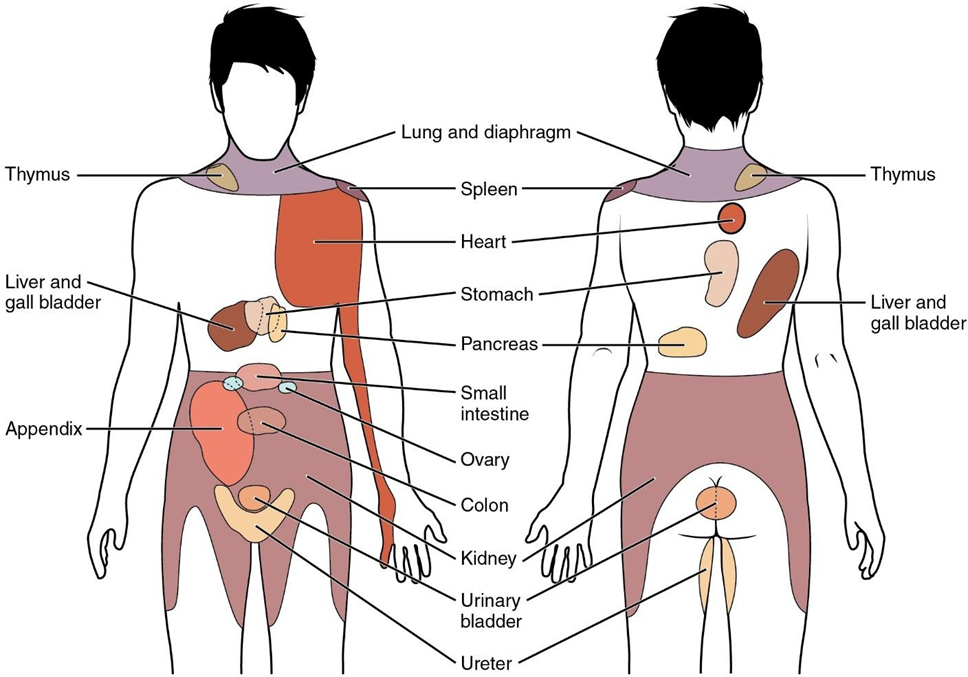
A nurse is assessing the pain status of a group of clients. Which of the following findings indicates a client is experiencing referred pain?
A. A client who has peritonitis reports generalized abdominal pain.
Generalized abdominal pain reported by a client with peritonitis indicates visceral pain.
B. A client who has pancreatitis reports pain in the left shoulder.
Pain in the left shoulder reported by a client with pancreatitis is an example of referred pain, as it occurs at a site distant from the actual pathology.
C. A client who has angina reports substernal chest pain.
Substernal chest pain reported by a client with angina indicates cardiac pain, not referred pain.
D. A client who is postoperative reports incisional pain.
Incisional pain reported by a postoperative client is localized and does not indicate referred pain.
Full Explanation
A) Generalized abdominal pain reported by a client with peritonitis indicates visceral pain.
B) Pain in the left shoulder reported by a client with pancreatitis is an example of referred pain, as it occurs at a site distant from the actual pathology.
C) Substernal chest pain reported by a client with angina indicates cardiac pain, not referred pain.
D) Incisional pain reported by a postoperative client is localized and does not indicate referred pain.