
Nursing practice questions with comprehensive rationales
NurseDive Free Nursing Practice Question
A nurse is planning care for a client who has left-sided hemiplegia following a stroke.
Which of the following actions should the nurse include in the plan of care?
A. Provide the client with a short-handled reacher.
The nurse should provide the client with a short-handled teacher. This can help the client to reach and grasp objects without having to overextend or strain their unaffected arm.
B. Place a plate guard on the client's meal tray.
The nurse should place a plate guard on the client’s meal tray. This can help prevent food from spilling off the plate and make it easier for the client to eat with one hand.
C. Remind the client to use a cane on his left side while ambulating.
Choice C is wrong because reminding the client to use a cane on his left side while ambulating could be unsafe as the client’s left side is affected by hemiplegia.
D. Position the bedside table on the client's left side.
Choice D is wrong because positioning the bedside table on the client’s left side could make it difficult for the client to reach items on the table.
This question is an excerpt from Nurse Dive's nursing test bank - ATI Adult Medical Surgical 2019 Proctored Exam. Take the full exam now
Full Explanation
The nurse should provide the client with a short-handled teacher.

This can help the client to reach and grasp objects without having to overextend or strain their unaffected arm.
Choice B is also correct.
The nurse should place a plate guard on the client’s meal tray.
This can help prevent food from spilling off the plate and make it easier for the client to eat with one hand.
Choice C is wrong because reminding the client to use a cane on his left side while ambulating could be unsafe as the client’s left side is affected by hemiplegia.
Choice D is wrong because positioning the bedside table on the client’s left side could make it difficult for the client to reach items on the table.
Similar Questions
A nurse is planning the discharge of a client who had an ischemic stroke.
The nurse should ensure that the client is discharged with which of the following types of pharmacologic therapy?
A. Antithrombotic.
The nurse should ensure that the client is discharged with antithrombotic pharmacologic therapy. Antithrombotic medications help prevent blood clots from forming and can reduce the risk of another ischemic stroke.
B. Diuretic.
Choice B is wrong because diuretics are used to treat fluid retention and high blood pressure and are not typically used for stroke prevention.
C. Anticonvulsant.
Choice C is wrong because anticonvulsants are used to prevent seizures and are not typically used for stroke prevention.
D. Opioid analgesic.
Choice D is wrong because opioid analgesics are used to treat pain and are not typically used for stroke prevention.
Full Explanation
The nurse should ensure that the client is discharged with antithrombotic pharmacologic therapy.
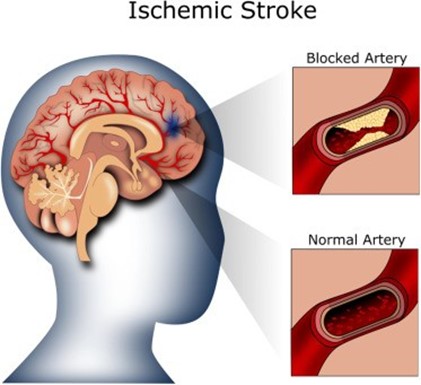
Antithrombotic medications help prevent blood clots from forming and can reduce the risk of another ischemic stroke.
Choice B is wrong because diuretics are used to treat fluid retention and high blood pressure and are not typically used for stroke prevention.
Choice C is wrong because anticonvulsants are used to prevent seizures and are not typically used for stroke prevention.
Choice D is wrong because opioid analgesics are used to treat pain and are not typically used for stroke prevention.
A nurse is caring for a client in the emergency department who experienced a full-thickness burn injury to the lower torso 1 hr ago.
Which of the following findings should the nurse expect?
A. Urinary diuresis.
Choice A, Urinary diuresis, is not the correct answer because it refers to increased production of urine and is not a common symptom of a full-thickness burn injury.
B. Hypotension.
A full-thickness burn injury can result in fluid loss and low blood volume (hypovolemia), which can lead to hypotension.
C. Decreased respiratory rate.
Choice C, Decreased respiratory rate, is not the correct answer because it refers to a decrease in the number of breaths per minute and is not a common symptom of a full-thickness burn injury.
D. Bradycardia.
Choice D, Bradycardia, is not the correct answer because it refers to a slow heart rate and is not a common symptom of a full-thickness burn injury.
Full Explanation
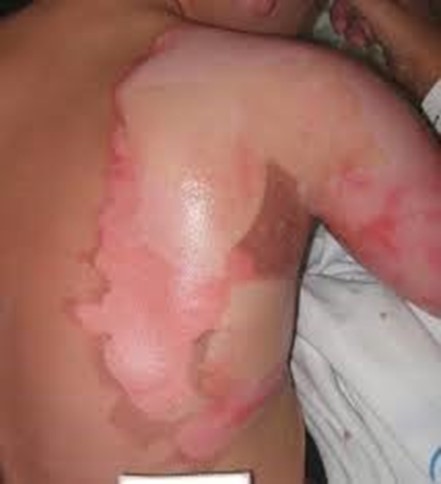
A full-thickness burn injury can result in fluid loss and low blood volume (hypovolemia), which can lead to hypotension.
Choice A, Urinary diuresis, is not the correct answer because it refers to increased production of urine and is not a common symptom of a full-thickness burn injury.
Choice C, Decreased respiratory rate, is not the correct answer because it refers to a decrease in the number of breaths per minute and is not a common symptom of a full-thickness burn injury.
Choice D, Bradycardia, is not the correct answer because it refers to a slow heart rate and is not a common symptom of a full-thickness burn injury.
A nurse is completing discharge teaching with a client who has a peripherally inserted central catheter (PICC) line in the left arm.
Which of the following instructions should the nurse include in the teaching?
A. Clean the insertion site using 20 mL of hydrogen peroxide.
Choice A, Clean the insertion site using 20 mL of hydrogen peroxide, is not the correct answer because hydrogen peroxide should not be used to clean the insertion site of a PICC line.
B. Change the catheter dressing daily.
Choice B, Changing the catheter dressing daily, is not the correct answer because the catheter dressing should be changed every 3 to 7 days or as directed by a healthcare provider.
C. Use a 10-mL syringe to flush the line.
A 10-mL syringe is the minimum size that should be used to flush a PICC line to prevent damage to the catheter.
D. Do not elevate the arm above the level of the heart.
Choice D, Do not elevate the arm above the level of the heart, is not the correct answer because there is no restriction on elevating the arm above the level of the heart with a PICC line.
Full Explanation
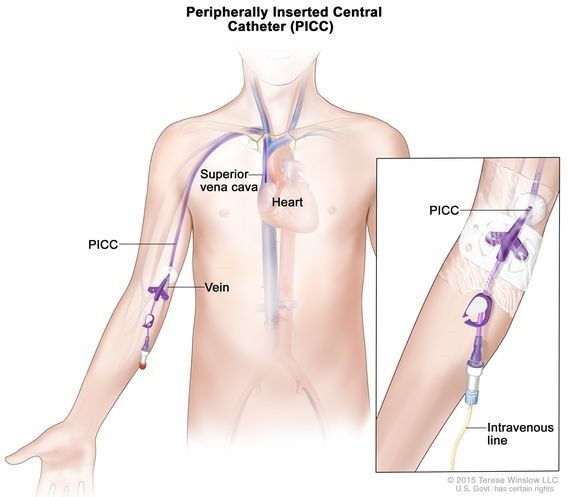
A 10-mL syringe is the minimum size that should be used to flush a PICC line to prevent damage to the catheter.
Choice A, Clean the insertion site using 20 mL of hydrogen peroxide, is not the correct answer because hydrogen peroxide should not be used to clean the insertion site of a PICC line.
Choice B, Changing the catheter dressing daily, is not the correct answer because the catheter dressing should be changed every 3 to 7 days or as directed by a healthcare provider.
Choice D, Do not elevate the arm above the level of the heart, is not the correct answer because there is no restriction on elevating the arm above the level of the heart with a PICC line.