
Nursing practice questions with comprehensive rationales
NurseDive Free Nursing Practice Question
A nurse is preparing to administer a continuous heparin infusion at 1600 units/hr. Available is heparin 25.000 units in dextrose 5% in water (DSW) 500 mL The nurse should set the IV pump to deliver how many mL/hr? (Round the answer to the nearest whole number. Use a leading zero if it applies. Do not use a trailing zero.)
This question is an excerpt from Nurse Dive's nursing test bank - ATI Med Surg Proctored Exam 6. Take the full exam now
Full Explanation
1. Determine the concentration of heparin in the solution:
- There are 25,000 units of heparin in 500 mL of D5W.
- Concentration = 25,000 units / 500 mL = 50 units/mL.
2. Calculate the required mL/hr for the desired infusion rate:
- The order is for 1600 units/hr.
- To find the mL/hr:
ML/HR=desired units/hr divided by unts/ml
=1600/50
=32ml/hr
Similar Questions
A nurse is educating coworkers about how to minimize back strain and avoid repeated episodes of low back pain. Which of the following strategies should the nurse include? (Select all that apply.)
A. Avoid prolonged sitting.
Avoiding prolonged sitting helps reduce pressure on the lower back and minimizes the risk of developing back strain or pain.
B. Sleep in a side-lying position with flexed knees.
Sleeping in a side-lying position with flexed knees helps maintain the natural curvature of the spine and reduces strain on the lower back.
C. Sleep on a soft mattress.
D. Try padded shoe insoles.
Using padded shoe insoles can provide additional support and cushioning to the feet and lower back, helping to reduce strain.
E. Apply heat for 10 min every hour.
Applying heat for short durations can help relax muscles and alleviate muscle tension, which can contribute to back pain relief. However, it's important not to overuse heat, so short intervals are recommended.
Full Explanation
A. Avoiding prolonged sitting helps reduce pressure on the lower back and minimizes the risk of developing back strain or pain.
B. Sleeping in a side-lying position with flexed knees helps maintain the natural curvature of the spine and reduces strain on the lower back.
D. Using padded shoe insoles can provide additional support and cushioning to the feet and lower back, helping to reduce strain.
E. Applying heat for short durations can help relax muscles and alleviate muscle tension, which can contribute to back pain relief. However, it's important not to overuse heat, so short intervals are recommended.
A nurse is caring for a client who is postoperative following a laminectomy with spinal fusion. Which of the following actions should the nurse take?
A. Position the client in a high-Fowler's position if clear drainage is noted on the dressing
Positioning the client in a high-Fowler's position if clear drainage is noted on the dressing is not a specific intervention for a laminectomy with spinal fusion. The nurse should follow the surgeon's specific postoperative orders regarding positioning and wound care.
B. Monitor sensory perception of the lower extremities.
Monitoring sensory perception of the lower extremities is a crucial nursing intervention after a laminectomy with spinal fusion. This is to assess for any signs of neurovascular compromise or nerve damage.
C. Assist the client into a knee-chest position to manage postoperative discomfort.
Assisting the client into a knee-chest position to manage postoperative discomfort is not a recommended position after a laminectomy with spinal fusion. The nurse should follow the surgeon's specific postoperative orders regarding positioning.
D. Maintain strict bed rest for the first 48 hr postoperative.
Maintaining strict bed rest for the first 48 hours postoperative is not typically indicated after a laminectomy with spinal fusion. Early mobilization and ambulation are often encouraged to prevent complications and promote recovery. The nurse should follow the surgeon's specific postoperative orders regarding activity and mobility.
Full Explanation
A. Positioning the client in a high-Fowler's position if clear drainage is noted on the dressing is not a specific intervention for a laminectomy with spinal fusion. The nurse should follow the surgeon's specific postoperative orders regarding positioning and wound care.
B. Monitoring sensory perception of the lower extremities is a crucial nursing intervention after a laminectomy with spinal fusion. This is to assess for any signs of neurovascular compromise or nerve damage.
C. Assisting the client into the knee-chest position to manage postoperative discomfort is not a recommended position after a laminectomy with spinal fusion. The nurse should follow the surgeon's specific postoperative orders regarding positioning.
D. Maintaining strict bed rest for the first 48 hours postoperative is not typically indicated after a laminectomy with spinal fusion. Early mobilization and ambulation are often encouraged to prevent complications and promote recovery. The nurse should follow the surgeon's specific postoperative orders regarding activity and mobility.
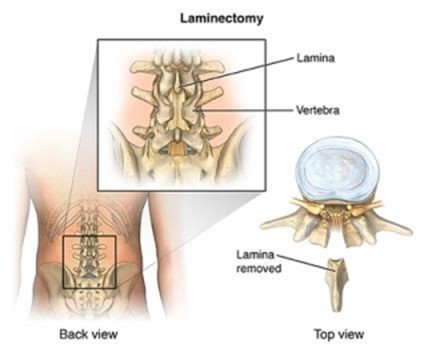
A nursing is planning care for an adolescent who is postoperative following scoliosis repair with Harrington rod instrumentation. Which of the following interventions should the nurse include in the plan of care?
A. Place the client in protective isolation.
Protective isolation is not routinely required for clients following scoliosis repair unless there is an underlying infection risk.
B. Initiate the use of a PCA pump for pain control.
A PCA pump may be used for pain control, but it is not specific to post-scoliosis repair care.
C. Keep the head of the bed at a 30° angle.
Keeping the head of the bed at 30° is not required; positioning should focus on spinal alignment.
D. Reposition the client by log rolling every-4 hr.
Log rolling the client every 4 hours is essential to maintain spinal alignment, prevent complications, and ensure safety following Harrington rod instrumentation.
Full Explanation
A. Protective isolation is not routinely required for clients following scoliosis repair unless there is an underlying infection risk.
B. A PCA pump may be used for pain control, but it is not specific to post-scoliosis repair care.
C. Keeping the head of the bed at 30° is not required; positioning should focus on spinal alignment.
D. Log rolling the client every 4 hours is essential to maintain spinal alignment, prevent complications, and ensure safety following Harrington rod instrumentation.