
Nursing practice questions with comprehensive rationales
NurseDive Free Nursing Practice Question
A nurse is preparing to administer Tissue plasminogen activator (tPA). What is the likely reason the client will receive this treatment?
A. The client is having an active seizure
Incorrect. The client is having an active seizure is not a reason to administer tPA, which is a clotbusting drug that dissolves blood clots and restores blood flow to the brain. Seizures are not caused by blood clots, but by abnormal electrical activity in the brain.
B. The client experienced a hemorrhagic stroke
Incorrect. The client experienced a hemorrhagic stroke is not a reason to administer tPA, which is a contraindication for this treatment. Hemorrhagic strokes are caused by bleeding in the brain, and tPA can worsen the bleeding and increase the risk of complications.
C. The client suffers from Parkinson's disease
Incorrect. The client suffers from Parkinson's disease is not a reason to administer tPA, which has no effect on this condition. Parkinson's disease is a degenerative disorder that affects the movement and coordination of the body, caused by the loss of dopamineproducing neurons in the brain.
D. The client experienced an ischemic stroke
Correct. The client experienced an ischemic stroke is a reason to administer tPA, which is the standard treatment for this condition if given within 4.5 hours of symptom onset. Ischemic strokes are caused by blood clots that block the blood vessels in the brain, and tPA can dissolve the clots and restore blood flow to the affected area.
This question is an excerpt from Nurse Dive's nursing test bank - Ati med surg adult care 2 proctored exam. Take the full exam now
Similar Questions
A nurse is caring for a client who reports a throbbing headache after a lumbar puncture. Which of the following actions is most likely to facilitate resolution of the headache?
A. Increase fluid intake.
Correct. Increasing fluid intake can help replenish cerebrospinal fluid (CSF) that was lost during the lumbar puncture, which can reduce the pressure difference between the brain and spinal cord that causes the headache.
B. Administer pain medication.
Incorrect. Administering pain medication can help relieve the headache temporarily, but it does not address the underlying cause of CSF loss and pressure difference.
C. Darken the client's room and close the door!
Incorrect. Darkening the client's room and closing the door can help reduce sensory stimuli that may aggravate the headache, but it does not address the underlying cause of CSF loss and pressure difference.
D. Elevating the head of the bed to 30
Incorrect. Elevating the head of the bed to 30 can worsen the headache by increasing the pressure difference between the brain and spinal cord, as gravity pulls more CSF away from the brain.
Full Explanation
A. Correct. Increasing fluid intake can help replenish cerebrospinal fluid (CSF) that was lost during the lumbar puncture, which can reduce the pressure difference between the brain and spinal cord that causes the headache.
B. Incorrect. Administering pain medication can help relieve the headache temporarily, but it does not address the underlying cause of CSF loss and pressure difference.
C. Incorrect. Darkening the client's room and closing the door can help reduce sensory stimuli that may aggravate the headache, but it does not address the underlying cause of CSF loss and pressure difference.
D. Incorrect. Elevating the head of the bed to 30 can worsen the headache by increasing the pressure difference between the brain and spinal cord, as gravity pulls more CSF away from the brain.
A nurse is receiving a transfer report for a client who has a head injury. The client has a Glasgow Coma Scale (GCS) score of 3 for eye opening, 5 for best verbal response, and 5 for best motor response. Which of the following is an appropriate conclusion based on this data?
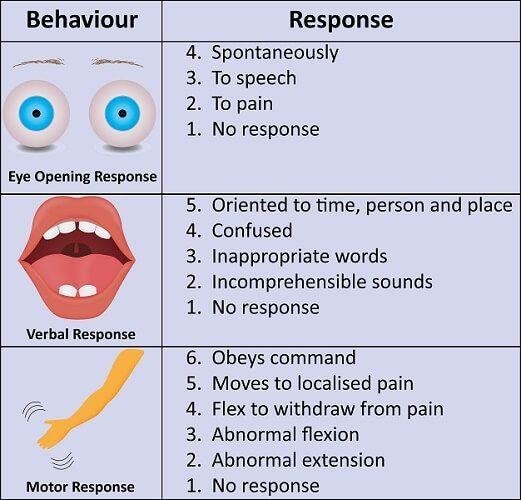
A. The client opens his eyes when spoken to
A GCS score of 3 for eye opening indicates that the client opens their eyes in response to speech. This accurately reflects the client's level of responsiveness.
B. The client can follow simple motor commands
A GCS score of 5 for motor response indicates that the client localizes pain or can follow simple motor commands. However, this does not fully encapsulate the most appropriate conclusion, given the specific GCS score for eye opening.
C. The client is unconscious
A total GCS score of 13 (3 for eye opening, 5 for verbal response, and 5 for motor response) suggests mild impairment, not unconsciousness. Unconsciousness is typically indicated by a GCS score of 8 or below.
D. The client is unable to make vocal sound.
A GCS score of 5 for verbal response indicates the client is oriented and can respond verbally, so they are capable of making vocal sounds.
Full Explanation
A. A GCS score of 3 for eye opening indicates that the client opens their eyes in response to speech. This accurately reflects the client's level of responsiveness.
B. A GCS score of 5 for motor response indicates that the client localizes pain or can follow simple motor commands. However, this does not fully encapsulate the most appropriate conclusion, given the specific GCS score for eye opening.
C. A total GCS score of 13 (3 for eye opening, 5 for verbal response, and 5 for motor response) suggests mild impairment, not unconsciousness. Unconsciousness is typically indicated by a GCS score of 8 or below.
D. A GCS score of 5 for verbal response indicates the client is oriented and can respond verbally, so they are capable of making vocal sounds.
A nurse enters a client's room and finds the client on the floor having a seizure. Which of the following is not an appropriate action for the nurse to take?
A. Record when the seizure began
Correct. Recording when the seizure began helps to determine its duration and severity.
B. Place the client's head on the nurse's lap
Incorrect. Placing the client's head on the nurse's lap may obstruct his airway and increase the risk of aspiration.
C. Place the client on his back
Correct. Placing the client on his back helps to maintain a patent airway and prevent injury.
D. Allow the client's arms and legs to move freely
Correct. Allowing the client's arms and legs to move freely prevents unnecessary restraint and reduces muscle damage.