
Nursing practice questions with comprehensive rationales
NurseDive Free Nursing Practice Question
A. "I will take my diuretic before sleep and drink fluids during the day."
Taking a diuretic before sleep and drinking fluids during the day is important but does not specifically address sodium intake.
B. "I will read food labels and limit my sodium to 4 grams per day."
This statement indicates an understanding of the importance of limiting sodium intake, which is crucial in managing congestive heart failure.
C. "I plan to pace my activities to avoid fatigue."
Pacing activities is important but is not specific to sodium intake.
D. "I should use naproxen to manage discomfort."
Naproxen is not typically used to manage discomfort in congestive heart failure.
This question is an excerpt from Nurse Dive's nursing test bank - Ati Rn Nsg 232 Proctored Exam Med Surg. Take the full exam now
Full Explanation
Rationale:
A. Taking a diuretic before sleep and drinking fluids during the day is important but does not specifically address sodium intake.
B. This statement indicates an understanding of the importance of limiting sodium intake, which is crucial in managing congestive heart failure.
C. Pacing activities is important but is not specific to sodium intake.
D. Naproxen is not typically used to manage discomfort in congestive heart failure.
Similar Questions
A nurse is caring for a client diagnosed with atrial fibrillation and is receiving heparin. Which of the following findings is the nurse's priority?
A. The client experiences sudden weakness of one arm and leg
Sudden weakness of one arm and leg may indicate a stroke, which is a potential complication of atrial fibrillation.
B. The client's ECG tracing shows irregular heart rate without P waves.
An irregular heart rate without P waves is characteristic of atrial fibrillation and is expected.
C. The client's urine output is cloudy and odorous.
Cloudy and odorous urine may indicate a urinary tract infection but is not the priority in this case.
D. The client has an aPTT of 80 seconds.
An aPTT of 80 seconds is within the therapeutic range for heparin therapy.
Full Explanation
Rationale:
A. Sudden weakness of one arm and leg may indicate a stroke, which is a potential complication of atrial fibrillation.
B. An irregular heart rate without P waves is characteristic of atrial fibrillation and is expected.
C. Cloudy and odorous urine may indicate a urinary tract infection but is not the priority in this case.
D. An aPTT of 80 seconds is within the therapeutic range for heparin therapy.
A nurse is collecting a medication history from a client who is scheduled to have a cardiac catheterization. Which of the following medications taken by the client interacts with contrast material and places the client at risk for acute kidney injury?
A. Nitroglycerin
Nitroglycerin does not interact with contrast material.
B. Carvedilol
Carvedilol does not interact with contrast material.
C. Atorvastatin
Atorvastatin does not interact with contrast material.
D. Metformin
Metformin can interact with contrast material and increase the risk of acute kidney injury. It is typically held before and after procedures involving contrast material.
Full Explanation
Rationale:
A. Nitroglycerin does not interact with contrast material.
B. Carvedilol does not interact with contrast material.
C. Atorvastatin does not interact with contrast material.
D. Metformin can interact with contrast material and increase the risk of acute kidney injury. It is typically held before and after procedures involving contrast material.
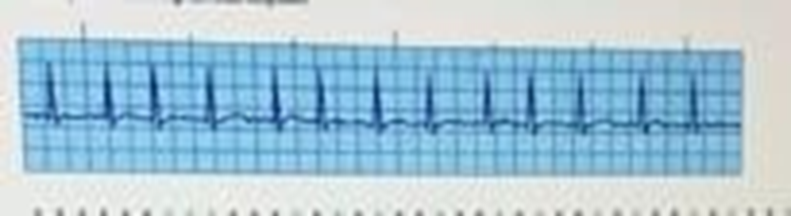
Identify the following Cardiac Rhythm:
A. Sinus Tachycardia
This is not correct since a sinus tachycardia show have a sinus P wave unlike in the strip.
B. Junctional Rhythm
This is incorrect since a junctional rhythm should have a regular ventricular rhythm unlike in the above strip which is irregular.
C. First Degree Heart Block
A first degree heart block should have a PR interval greater than 0.20 without a disruption in the atrial to ventricular conduction.
D. Atrial Fibrillation
This is correct since the rhythm is irregular and the P waves are absent.
Full Explanation
Rationale:
A. This is not correct since a sinus tachycardia show have a sinus P wave unlike in the strip.
B. This is incorrect since a junctional rhythm should have a regular ventricular rhythm unlike in the above strip which is irregular.
C. A first degree heart block should have a PR interval greater than 0.20 without a disruption in the atrial to ventricular conduction.
D. This is correct since the rhythm is irregular and the P waves are absent.