
Nursing practice questions with comprehensive rationales
NurseDive Free Nursing Practice Question
A nurse is reinforcing teaching about self-care with an adolescent client who has infectious mononucleosis with splenomegaly.
Which of the following statements by the client indicates an understanding of the teaching?
A. “I will take an antibiotic for the next 10 days.”
Choice A is wrong because antibiotics are not effective for infectious mononucleosis, which is caused by a virus.
B. “I will not play soccer until my doctor tells me I can.”
“I will not play soccer until my doctor tells me I can.” This statement indicates that the client understands the risk of splenic rupture due to splenomegaly and the need to avoid contact sports until the spleen returns to normal size.
C. “I will need to get a varicella booster in 1 month.”
Choice C is wrong because varicella booster is not related to infectious mononucleosis and there is no evidence that the client needs it.
D. “I will expect the whites of my eyes to turn yellow.”
Choice D is wrong because jaundice (yellowing of the eyes and skin) is not a common manifestation of infectious mononucleosis and may indicate another condition such as hepatitis.
This question is an excerpt from Nurse Dive's nursing test bank - ATI PN Capstone Proctored Comprehensive Assessment 2020 B. Take the full exam now
Full Explanation
“I will not play soccer until my doctor tells me I can.” This statement indicates that the client understands the risk of splenic rupture due to splenomegaly and the need to avoid contact sports until the spleen returns to normal size.
Choice A is wrong because antibiotics are not effective for infectious mononucleosis, which is caused by a virus.
Choice C is wrong because varicella booster is not related to infectious mononucleosis and there is no evidence that the client needs it.
Choice D is wrong because jaundice (yellowing of the eyes and skin) is not a common manifestation of infectious mononucleosis and may indicate another condition such as hepatitis.
Normal ranges for spleen size are 7 to 14 cm in length and 3 to 4 cm in thickness.
Similar Questions
A nurse is checking a newborn’s Moro reflex.
Which of the following actions should the nurse take to elicit this reflex?
A. Place the newborn on their abdomen and observe the movement of their extremities.
Choice A is wrong because placing the newborn on their abdomen and observing the movement of their extremities will not trigger the Moro reflex. This position may elicit other reflexes such as the crawling reflex or the tonic neck reflex.
B. Stroke the newborn’s cheek toward their mouth.
Choice B is wrong because stroking the newborn’s cheek toward their mouth will not trigger the Moro reflex. This action will elicit the rooting reflex, which helps the baby find the breast or bottle to start feeding.
C. Stroke upward on the lateral aspect of the newborn’s foot.
Choice C is wrong because stroking upward on the lateral aspect of the newborn’s foot will not trigger the Moro reflex. This action will elicit the Babinski reflex, which causes the big toe to extend upward and the other toes to fan out.
D. Place the newborn on a flat surface and clap hands loudly.
This action will elicit the Moro reflex, also known as the startle reflex, which is a normal, involuntary reaction that newborns and infants have when they’re startled. In response to the sound, the baby will throw back his or her head, extend out his or her arms and legs, cry, then pull the arms and legs back in.
Full Explanation
Place the newborn on a flat surface and clap hands loudly.
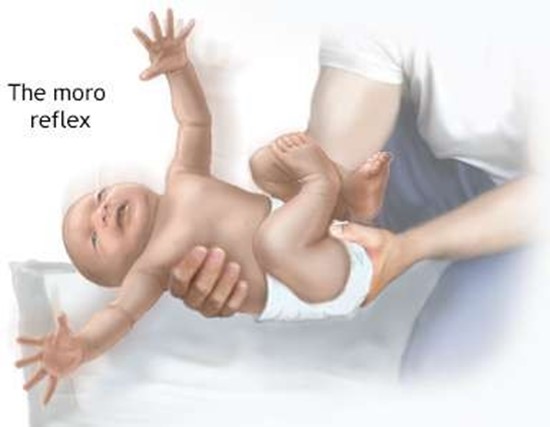
This action will elicit the Moro reflex, also known as the startle reflex, which is a normal, involuntary reaction that newborns and infants have when they’re startled. In response to the sound, the baby will throw back his or her head, extend out his or her arms and legs, cry, then pull the arms and legs back in.
Choice A is wrong because placing the newborn on their abdomen and observing the movement of their extremities will not trigger the Moro reflex.
This position may elicit other reflexes such as the crawling reflex or the tonic neck reflex.
Choice B is wrong because stroking the newborn’s cheek toward their mouth will not trigger the Moro reflex. This action will elicit the rooting reflex, which helps the baby find the breast or bottle to start feeding.
Choice C is wrong because stroking upward on the lateral aspect of the newborn’s foot will not trigger the Moro reflex. This action will elicit the Babinski reflex, which causes the big toe to extend upward and the other toes to fan out.
A nurse is preparing to provide report on a client using the Situation-Background- Assessment-Recommendation (SBAR) Communication tool.
Identify the order in which the nurse should give report.
A. Provide a brief description of the client’s diagnosis.
Choice A is wrong because it is part of the Background section of the SBAR tool, which comes after the Situation section.
B. Discuss suggestions for continuing the client’s care.
The nurse should give report using the SBAR Communication tool in the following order: Situation, Background, Assessment, Recommendation. This tool provides a framework for communication between members of the health care team about a patient’s condition. It allows for an easy and focused way to set expectations for what will be communicated and how between members of the team.
C. State the client’s most recent vital signs.
Choice C is wrong because it is part of the Assessment section of the SBAR tool, which comes after the Background section.
D. Review the client’s pertinent medical history.
Choice D is wrong because it is also part of the Background section of the SBAR tool, which comes after the Situation section.
Full Explanation
The nurse should give report using the SBAR Communication tool in the following order: Situation, Background, Assessment, Recommendation. This tool provides a framework for communication between members of the health care team about a patient’s condition. It allows for an easy and focused way to set expectations for what will be communicated and how between members of the team.
Choice A is wrong because it is part of the Background section of the SBAR tool, which comes after the Situation section.
Choice C is wrong because it is part of the Assessment section of the SBAR tool, which comes after the Background section.
Choice D is wrong because it is also part of the Background section of the SBAR tool, which comes after the Situation section.
A nurse is selecting foods for a client who is in the manic phase of bipolar disorder.
Which of the following foods should the nurse offer the client?
A. Creamed corn.
Choice A is wrong because Creamed corn is wrong because it is a low-protein, high-carbohydrate food that can increase blood glucose levels and cause mood swings.
B. Mashed potatoes.
Choice B is wrong because Mashed potatoes is wrong because it is a low-protein, high-starch food that can also affect blood glucose levels and mood stability.
C. Spaghetti with meat sauce.
Choice C is wrong because Spaghetti with meat sauce is wrong because it is a complex food that requires utensils and attention to eat, which can be difficult for a client who is manic and distractible.
D. Milkshake.
The nurse should offer the client a milkshake because it is a high-calorie, high- protein, and easy-to-consume food that can meet the nutritional needs of a client who is in the manic phase of bipolar disorder. Clients who are manic often have increased activity, decreased appetite, and poor attention span, which can lead to weight loss and malnutrition.
Full Explanation
The nurse should offer the client a milkshake because it is a high-calorie, high- protein, and easy-to-consume food that can meet the nutritional needs of a client who is in the manic phase of bipolar disorder. Clients who are manic often have increased activity, decreased appetite, and poor attention span, which can lead to weight loss and malnutrition.
Choice A is wrong because Creamed corn is wrong because it is a low-protein, high-carbohydrate food that can increase blood glucose levels and cause mood swings.
Choice B is wrong because Mashed potatoes is wrong because it is a low-protein, high-starch food that can also affect blood glucose levels and mood stability.
Choice C is wrong because Spaghetti with meat sauce is wrong because it is a complex food that requires utensils and attention to eat, which can be difficult for a client who is manic and distractible.
Normal ranges for potassium are 3.5 to 5.0 mEq/L.