
Nursing practice questions with comprehensive rationales
NurseDive Free Nursing Practice Question
A nurse is reinforcing teaching with a client about following a low-cholesterol diet after coronary artery bypass grafting. Which of the following food choices reflects the client's understanding of these dietary instructions?
A. Liver
LiverLiver is high in cholesterol and should be limited in a low-cholesterol diet. It is a rich source of dietary cholesterol.
B. Milk
MilkWhile milk itself is not particularly high in cholesterol, it contains saturated fat. In a low-cholesterol diet, it is often recommended to choose low-fat or fat-free dairy products to reduce saturated fat intake.
C. Beans
Beans This is the correct choice. Beans are a plant-based protein source that is low in cholesterol. They are high in fiber and contribute to heart-healthy eating.
D. Eggs
EggsEggs are a source of dietary cholesterol. While current dietary guidelines suggest that moderate egg consumption may be acceptable for many individuals, those following a low-cholesterol diet may need to be mindful of their overall cholesterol intake from various sources.
This question is an excerpt from Nurse Dive's nursing test bank - Ati Custom Pn Basic Care And Comfort Assessment Proctored Exam. Take the full exam now
Full Explanation
A. Liver
Liver is high in cholesterol and should be limited in a low-cholesterol diet. It is a rich source of dietary cholesterol.
B. Milk
While milk itself is not particularly high in cholesterol, it contains saturated fat. In a low-cholesterol diet, it is often recommended to choose low-fat or fat-free dairy products to reduce saturated fat intake.
C. Beans
This is the correct choice. Beans are a plant-based protein source that is low in cholesterol. They are high in fiber and contribute to heart-healthy eating.
D. Eggs
Eggs are a source of dietary cholesterol. While current dietary guidelines suggest that moderate egg consumption may be acceptable for many individuals, those following a low-cholesterol diet may need to be mindful of their overall cholesterol intake from various sources.
Similar Questions
A client who has chronic lymphocytic leukemia is starting chemotherapy treatments and asks if she needs to make any dietary changes. Which of the following statements by the nurse is appropriate?
A. “Use sugar-free gum if you experience a metallic taste in your mouth.”
“Use sugar-free gum if you experience a metallic taste in your mouth.”This is the appropriate choice. Chemotherapy can cause a metallic taste in the mouth, and using sugar-free gum or candies can help alleviate this taste disturbance.
B. “Drink fluids at mealtime to prevent early satiety.”
“Drink fluids at mealtime to prevent early satiety.”This statement is not advisable. Drinking fluids at mealtime may lead to early satiety, making it challenging for the client to consume adequate nutrition. It is generally recommended to drink fluids between meals.
C. “Foods that are higher in fat can help nausea.”
“Foods that are higher in fat can help nausea.” This statement is not accurate. High-fat foods may exacerbate nausea for some individuals undergoing chemotherapy. The focus during periods of nausea is often on easily digestible, low-fat, and bland foods.
D. “Raw fruits and vegetables will be easier for your body to digest.”
“Raw fruits and vegetables will be easier for your body to digest.”This statement is not accurate. Raw fruits and vegetables may be harder to digest, and during chemotherapy, the digestive system can be sensitive. It is generally recommended to choose cooked or processed fruits and vegetables for easier digestion.
Full Explanation
A. “Use sugar-free gum if you experience a metallic taste in your mouth.”
This is the appropriate choice. Chemotherapy can cause a metallic taste in the mouth, and using sugar-free gum or candies can help alleviate this taste disturbance.
B. “Drink fluids at mealtime to prevent early satiety.”
This statement is not advisable. Drinking fluids at mealtime may lead to early satiety, making it challenging for the client to consume adequate nutrition. It is generally recommended to drink fluids between meals.
C. “Foods that are higher in fat can help nausea.”
This statement is not accurate. High-fat foods may exacerbate nausea for some individuals undergoing chemotherapy. The focus during periods of nausea is often on easily digestible, low-fat, and bland foods.
D. “Raw fruits and vegetables will be easier for your body to digest.”
This statement is not accurate. Raw fruits and vegetables may be harder to digest, and during chemotherapy, the digestive system can be sensitive. It is generally recommended to choose cooked or processed fruits and vegetables for easier digestion.
A nurse is reinforcing teaching with a client who has Crohn’s Disease and is experiencing frequent cramping and diarrhea. Which of the following statements should the nurse include in the teaching?
A. “Increase your caloric intake by eating foods high in protein.”
“Increase your caloric intake by eating foods high in protein.”This is the appropriate choice. Increasing caloric intake with high-protein foods can help meet nutritional needs for individuals with Crohn's Disease, especially if malabsorption is a concern.
B. “Include fresh fruits and vegetables at each meal.”
“Include fresh fruits and vegetables at each meal.”While fresh fruits and vegetables are generally healthy, they may exacerbate symptoms in some individuals with Crohn's Disease, especially during flare-ups. It may be advisable to choose cooked or processed fruits and vegetables to minimize irritation.
C. “Maintain your weight by eating high fat foods.”
“Maintain your weight by eating high-fat foods.” This statement is not advisable. High-fat foods can contribute to symptoms such as cramping and diarrhea in individuals with Crohn's Disease. A well-balanced diet with an appropriate mix of nutrients is generally recommended.
D. “Drink whole milk to ensure adequate calcium intake.”
“Drink whole milk to ensure adequate calcium intake.”This statement is not advisable without considering individual tolerance. Whole milk is high in fat and may be difficult to digest for some individuals with Crohn's Disease. Additionally, if lactose intolerance is present, it may worsen symptoms. Alternative sources of calcium may need to be considered.
Full Explanation
A. “Increase your caloric intake by eating foods high in protein.”
This is the appropriate choice. Increasing caloric intake with high-protein foods can help meet nutritional needs for individuals with Crohn's Disease, especially if malabsorption is a concern.
B. “Include fresh fruits and vegetables at each meal.”
While fresh fruits and vegetables are generally healthy, they may exacerbate symptoms in some individuals with Crohn's Disease, especially during flare-ups. It may be advisable to choose cooked or processed fruits and vegetables to minimize irritation.
C. “Maintain your weight by eating high-fat foods.”
This statement is not advisable. High-fat foods can contribute to symptoms such as cramping and diarrhea in individuals with Crohn's Disease. A well-balanced diet with an appropriate mix of nutrients is generally recommended.
D. “Drink whole milk to ensure adequate calcium intake.”
This statement is not advisable without considering individual tolerance. Whole milk is high in fat and may be difficult to digest for some individuals with Crohn's Disease. Additionally, if lactose intolerance is present, it may worsen symptoms. Alternative sources of calcium may need to be considered.
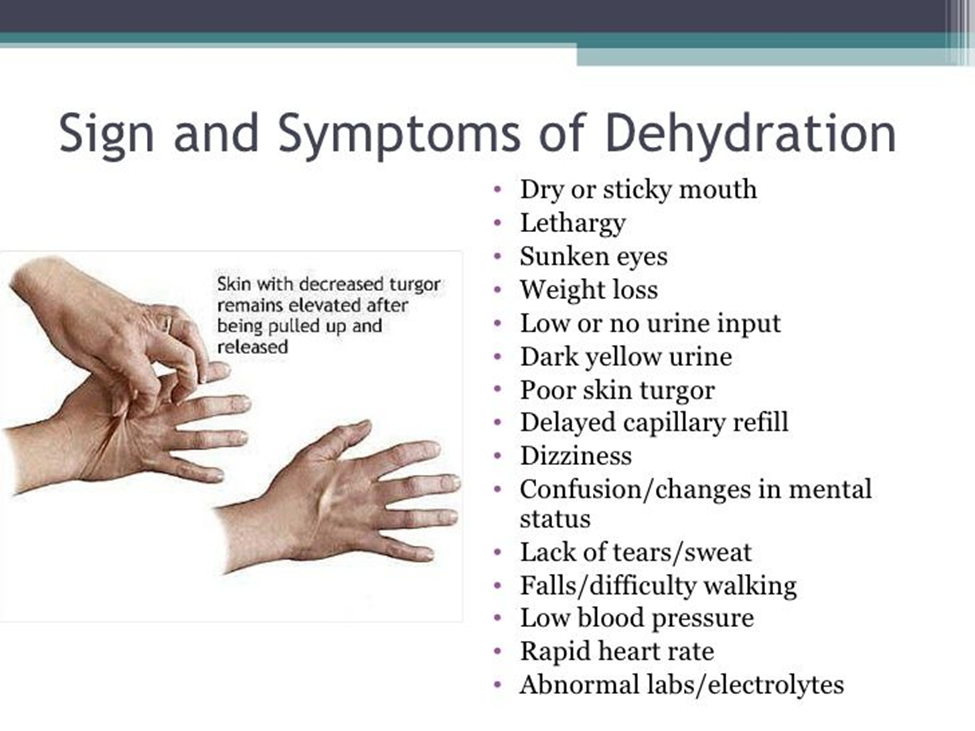
A nurse in a community clinic is collecting data from an older adult client who has a body mass index of 17.5. When evaluating the client for dehydration, the nurse should look for which of the following indications of fluid-volume deficit?
A. Tenting
TentingTenting refers to the delayed recoil of the skin when pinched. In a dehydrated state, the skin loses elasticity, leading to tenting due to decreased skin turgor. This is a specific sign of fluid-volume deficit.
B. Protruding eyeballs
Protruding eyeballsProtruding eyeballs are not typically associated with dehydration. This could be related to other conditions such as thyroid dysfunction, but it is not a specific indicator of fluid-volume deficit.
C. Elevated blood pressure
Elevated blood pressure Elevated blood pressure is not a typical sign of dehydration. In fact, dehydration often leads to a decrease in blood pressure due to reduced blood volume.
D. Dry mucous membranes
Dry mucous membranesDry mucous membranes can be an indication of dehydration, but in the context of the question, tenting (Option A) is a more specific sign related to skin turgor and is commonly assessed when evaluating for dehydration.
Full Explanation
A. Tenting
Tenting refers to the delayed recoil of the skin when pinched. In a dehydrated state, the skin loses elasticity, leading to tenting due to decreased skin turgor. This is a specific sign of fluid-volume deficit.
B. Protruding eyeballs
Protruding eyeballs are not typically associated with dehydration. This could be related to other conditions such as thyroid dysfunction, but it is not a specific indicator of fluid-volume deficit.
C. Elevated blood pressure
Elevated blood pressure is not a typical sign of dehydration. In fact, dehydration often leads to a decrease in blood pressure due to reduced blood volume.
D. Dry mucous membranes
Dry mucous membranes can be an indication of dehydration, but in the context of the question, tenting (Option A) is a more specific sign related to skin turgor and is commonly assessed when evaluating for dehydration.