
Nursing practice questions with comprehensive rationales
NurseDive Free Nursing Practice Question
A nurse is teaching a client who has chronic kidney disease and a new prescription for epoetin alfa. The nurse should instruct the client to increase dietary intake of which of the following substances?
A. Sodium
Increasing sodium intake is generally not recommended in chronic kidney disease, as it can exacerbate hypertension and fluid retention.
B. Iron
Epoetin alfa is a medication used to treat anemia associated with chronic kidney disease, and iron supplementation is often necessary to support erythropoiesis.
C. Potassium
Potassium intake may need to be restricted in chronic kidney disease, especially in later stages when kidney function declines.
D. Protein
Protein intake may need to be adjusted in chronic kidney disease, but it's not directly related to the prescription of epoetin alfa.
This question is an excerpt from Nurse Dive's nursing test bank - Ati Med Surg Proctored Exam 8. Take the full exam now
Full Explanation
A. Increasing sodium intake is generally not recommended in chronic kidney disease, as it can exacerbate hypertension and fluid retention.
B. Epoetin alfa is a medication used to treat anemia associated with chronic kidney disease, and iron supplementation is often necessary to support erythropoiesis.
C. Potassium intake may need to be restricted in chronic kidney disease, especially in later stages when kidney function declines.
D. Protein intake may need to be adjusted in chronic kidney disease, but it's not directly related to the prescription of epoetin alfa.
Similar Questions
A nurse in a public clinic is researching health data on culturally diverse populations in the community. Which of the following population groups should the nurse anticipate having end- stage renal disease due to diabetes mellitus?
A. Black American
Black Americans have a higher prevalence of diabetes mellitus compared to other racial/ethnic groups in the United States, and diabetes is a leading cause of end-stage renal disease.
B. Hispanic/Latino
While Hispanic/Latino individuals also have an increased risk of diabetes mellitus, it is less pronounced compared to Black Americans.
C. Non-Hispanic White
Non-Hispanic White individuals have a lower prevalence of diabetes mellitus compared to Black and Hispanic/Latino populations.
D. Asian American
Asian Americans have a varied prevalence of diabetes mellitus depending on specific ethnicities within this group, but it is generally lower than in Black Americans.
Full Explanation
A. Black Americans have a higher prevalence of diabetes mellitus compared to other racial/ethnic groups in the United States, and diabetes is a leading cause of end-stage renal disease.
B. While Hispanic/Latino individuals also have an increased risk of diabetes mellitus, it is less pronounced compared to Black Americans.
C. Non-Hispanic White individuals have a lower prevalence of diabetes mellitus compared to Black and Hispanic/Latino populations.
D. Asian Americans have a varied prevalence of diabetes mellitus depending on specific ethnicities within this group, but it is generally lower than in Black Americans.
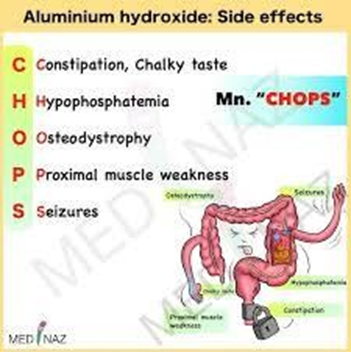
A nurse is providing teaching to a client who has renal failure and an elevated phosphorous level. The provider instructed the client to take aluminum hydroxide 300 mg PO three times daily. For which of the following adverse effects should the nurse inform the client?
A. Constipation
Constipation is a common adverse effect of aluminum hydroxide, an antacid often used to bind phosphate in patients with renal failure to prevent hyperphosphatemia.
B. Muscle spasms
Muscle spasms are not typically associated with aluminum hydroxide.
C. Metallic taste
Metallic taste is not a common adverse effect of aluminum hydroxide.
D. Headache
Headache is not a common adverse effect of aluminum hydroxide.
Full Explanation
A. Constipation is a common adverse effect of aluminum hydroxide, an antacid often used to bind phosphate in patients with renal failure to prevent hyperphosphatemia.
B. Muscle spasms are not typically associated with aluminum hydroxide.
C. Metallic taste is not a common adverse effect of aluminum hydroxide.
D. Headache is not a common adverse effect of aluminum hydroxide.
A nurse is caring for a client who had total thyroidectomy and a serum calcium level of 7.6 mg/dL. Which of the following findings should the nurse expect?
A. Constipation
Constipation is not typically associated with hypocalcemia.
B. Shortened QT intervals
Shortened QT intervals are not characteristic of hypocalcemia; rather, prolongation of QT intervals is more common.
C. Hypoactive deep tendon reflexes
Hypoactive deep tendon reflexes, would suggest a decrease in neuromuscular excitability, which is contrary to the increased excitability seen in hypocalcemia. Therefore, hypoactive deep tendon reflexes is more commonly associated with hypercalcemia and not hypocalcemia.
D. Tingling of the extremities
Tingling of the extremities is a common symptom of hypocalcemia.
Full Explanation
A. Constipation is not typically associated with hypocalcemia.
B. Shortened QT intervals are not characteristic of hypocalcemia; rather, prolongation of QT intervals is more common.
C. Hypoactive deep tendon reflexes, would suggest a decrease in neuromuscular excitability, which is contrary to the increased excitability seen in hypocalcemia. Therefore, hypoactive deep tendon reflexes is more commonly associated with hypercalcemia and not hypocalcemia.
D. Tingling of the extremities is a common symptom of hypocalcemia.