
Nursing practice questions with comprehensive rationales
NurseDive Free Nursing Practice Question
A nurse on a medical-surgical unit is caring for a group of clients. Which of the following clients should the nurse see first?
A. A client who is postoperative and reports intermittent nausea
The client who is postoperative and reports intermittent nausea can be assessed and managed after addressing the client with the elevated blood pressure and headache.
B. A client whose blood pressure is 160/90 mm Hg and reports a headache
Hypertensive crisis is a severe increase in blood pressure that can lead to organ damage or other complications. Prompt assessment and intervention are necessary to prevent further escalation of blood pressure and potential complications. While all the clients mentioned require attention, the client with elevated blood pressure and a headache poses a higher immediate risk. The nurse should assess the client's blood pressure, evaluate for signs of target organ damage, and initiate appropriate interventions, which may include administering antihypertensive medications as prescribed and monitoring closely for any changes in the client's condition.
C. A client who is scheduled for surgery in 2 hr
The client scheduled for surgery in 2 hours can be addressed according to the scheduled timeline.
D. A client who is postoperative and has a Jackson-Pratt drain
The client who is postoperative and has a Jackson-Pratt drain should be assessed and managed, but their condition does not require immediate intervention compared to the client with the elevated blood pressure and headache.
This question is an excerpt from Nurse Dive's nursing test bank - ATI PN Comprehensive Predictor 2023 - Proctored Exam 1. Take the full exam now
Full Explanation
Hypertensive crisis is a severe increase in blood pressure that can lead to organ damage or other complications. Prompt assessment and intervention are necessary to prevent further escalation of blood pressure and potential complications.
While all the clients mentioned require attention, the client with elevated blood pressure and a headache poses a higher immediate risk. The nurse should assess the client's blood pressure, evaluate for signs of target organ damage, and initiate appropriate interventions, which may include administering antihypertensive medications as prescribed and monitoring closely for any changes in the client's condition.
The client who is postoperative and reports intermittent nausea can be assessed and managed after addressing the client with the elevated blood pressure and headache.
The client scheduled for surgery in 2 hours can be addressed according to the scheduled timeline.
Similar Questions
A nurse is assisting in developing a list of internet sites for clients to obtain valid health information. When evaluating internet resources, which of the following findings indicates the information likely contains credible medical information?
A. The author's name is listed without credentials.
The author's name listed without credentials does not provide information about the author's expertise or qualifications. It is important to assess the author's credentials and expertise to determine their credibility.
B. The author cites references to statements made.
Valid and reliable health information sources should provide references or citations to support the information they present. This demonstrates that the information is based on evidence and has been reviewed by experts in the field. It allows readers to verify the accuracy and reliability of the information by referring to the cited sources.
C. The website URL is listed as .com.
The website URL being listed as .com does not provide information about the accuracy or reliability of the content. Different types of websites, such as .org or .gov, can also contain credible health information.
D. The website was last updated 3 years ago.
The website being last updated 3 years ago raises concerns about the currency and relevance of the information. Health information can quickly evolve, and it is important to access up-to-date resources.
Full Explanation
Valid and reliable health information sources should provide references or citations to support the information they present. This demonstrates that the information is based on evidence and has been reviewed by experts in the field. It allows readers to verify the accuracy and reliability of the information by referring to the cited sources.
The author's name listed without credentials does not provide information about the author's expertise or qualifications. It is important to assess the author's credentials and expertise to determine their credibility.
The website URL being listed as .com does not provide information about the accuracy or reliability of the content. Different types of websites, such as .org or .gov, can also contain credible health information.
The website being last updated 3 years ago raises concerns about the currency and relevance of the information. Health information can quickly evolve, and it is important to access up-to-date resources.
A nurse is contributing to the plan of care for a client who has major depressive disorder.
Which of the following recommendations should the nurse include in the plan of care?
A. Suggest the client exercise before going to bed.
Exercise has been shown to have mood-enhancing effects and can help alleviate symptoms of depression. However, exercise should be done earlier in the day rather than right before bedtime, as it can have stimulating effects that may interfere with sleep.
B. Recommend the client spend time alone in his room.
It is important to encourage the client to engage in activities and spend time with others. Isolation and spending excessive time alone can exacerbate depressive symptoms. However, it is also important to respect the client's need for privacy and personal space.
C. Encourage the client to use positive self-talk.
Helping the client develop positive self-talk and challenging negative thoughts can be beneficial in managing depressive symptoms. Assisting the client in recognizing negative self-perceptions and replacing them with more positive and realistic thoughts can help improve mood and self-esteem.
D. Offer the client low-protein snacks throughout the day.
While diet does play a role in overall well-being, there is no specific evidence to support the use of low-protein snacks for the treatment of major depressive disorder. It is important to provide the client with a well-balanced diet that includes a variety of nutrients to support overall health.
Full Explanation
Helping the client develop positive self-talk and challenging negative thoughts can be beneficial in managing depressive symptoms. Assisting the client in recognizing negative self-perceptions and replacing them with more positive and realistic thoughts can help improve mood and self-esteem.
Exercise has been shown to have mood-enhancing effects and can help alleviate symptoms of depression. However, exercise should be done earlier in the day rather than right before bedtime, as it can have stimulating effects that may interfere with sleep.
It is important to encourage the client to engage in activities and spend time with others. Isolation and spending excessive time alone can exacerbate depressive symptoms. However, it is also important to respect the client's need for privacy and personal space.
While diet does play a role in overall well-being, there is no specific evidence to support the use of low-protein snacks for the treatment of major depressive disorder. It is important to provide the client with a well-balanced diet that includes a variety of nutrients to support overall health.
A nurse is contributing to the plan of care for a client who has a chest tube set to continuous suction to relieve a pneumothorax. Which of the following interventions should the nurse include?
A. Ensure the device is kept below the level of the client's chest.
Ensuring the device is kept below the level of the client's chest is important to ensure that the drainage system functions properly by allowing the fluid and air to flow downhill. Placing the device below the level of the chest helps facilitate gravity drainage.
B. Clamp the chest tube every 4 hr.
Continuous suction is required for proper functioning of the chest tube drainage system. Clamping the chest tube can disrupt the suction and impede the removal of air or fluid from the pleural space. Only in specific circumstances, such as when changing the drainage system or assessing for air leaks, may the healthcare provider request a temporary clamping of the chest tube.
C. Place the client in a supine position.
Positioning the client semi-Fowler's, with the head of the bed elevated, can help promote lung expansion and improve oxygenation. The specific positioning may vary depending on the client's condition and the healthcare provider's recommendations.
D. Empty the collection chamber every 8 hr.
The nurse should empty the collection chamber as per the facility's protocol, which typically includes monitoring the drainage and emptying it when it reaches a certain level. Regular emptying of the collection chamber helps maintain proper functioning of the chest tube system and allows for accurate measurement of drainage output.
Full Explanation
Ensuring the device is kept below the level of the client's chest is important to ensure that the drainage system functions properly by allowing the fluid and air to flow downhill. Placing the device below the level of the chest helps facilitate gravity drainage.
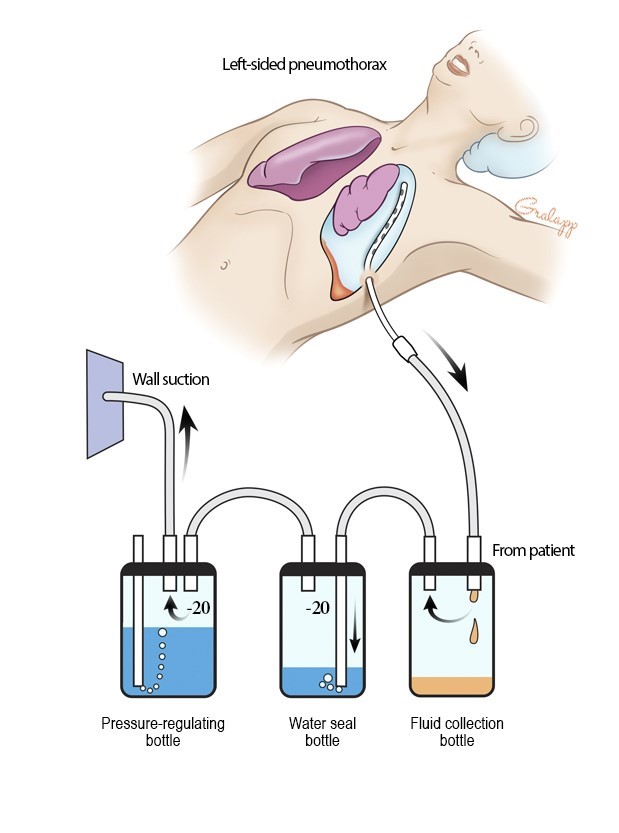
Continuous suction is required for proper functioning of the chest tube drainage system. Clamping the chest tube can disrupt the suction and impede the removal of air or fluid from the pleural space. Only in specific circumstances, such as when changing the drainage system or assessing for air leaks, may the healthcare provider request a temporary clamping of the chest tube.
Positioning the client semi-Fowler's, with the head of the bed elevated, can help promote lung expansion and improve oxygenation. The specific positioning may vary depending on the client's condition and the healthcare provider's recommendations.
The nurse should empty the collection chamber as per the facility's protocol, which typically includes monitoring the drainage and emptying it when it reaches a certain level. Regular emptying of the collection chamber helps maintain proper functioning of the chest tube system and allows for accurate measurement of drainage output.