
Nursing practice questions with comprehensive rationales
NurseDive Free Nursing Practice Question
A patient is stuporous but reacts by withdrawing from painful stimuli. Which term is most appropriate for this patient?
A. Semicomatose
Semicomatose:This term suggests a state between consciousness and coma. A patient who is semicomatose may exhibit some level of responsiveness but is typically unresponsive or only responds to intense stimuli.
B. Somnolent
Somnolent:Somnolence refers to a state of drowsiness or sleepiness. A somnolent patient may appear sleepy, have difficulty staying awake, and may be slow to respond to stimuli. However, the withdrawal from painful stimuli described in the scenario suggests a higher level of responsiveness than what would typically be expected in a somnolent state.
C. Lethargic
Lethargic: Lethargy describes a state of reduced alertness or responsiveness. A lethargic patient may appear drowsy, sluggish, and have diminished responses to stimuli. The description of the patient as stuporous (having a decreased level of consciousness) but still reacting by withdrawing from painful stimuli aligns with the characteristics of lethargy.
D. Comatose
Comatose:Coma refers to a state of profound unconsciousness where the patient is unresponsive to all stimuli, including painful stimuli. A comatose patient does not demonstrate any purposeful movement or response to stimuli. Since the patient in the scenario exhibits some response to painful stimuli by withdrawing, they do not meet the criteria for being comatose.
This question is an excerpt from Nurse Dive's nursing test bank - Ati Lpn Med Surg Neuro Test 2024 Proctored Exam. Take the full exam now
Full Explanation
A. Semicomatose:
This term suggests a state between consciousness and coma. A patient who is semicomatose may exhibit some level of responsiveness but is typically unresponsive or only responds to intense stimuli.
B. Somnolent:
Somnolence refers to a state of drowsiness or sleepiness. A somnolent patient may appear sleepy, have difficulty staying awake, and may be slow to respond to stimuli. However, the withdrawal from painful stimuli described in the scenario suggests a higher level of responsiveness than what would typically be expected in a somnolent state.
C. Lethargic:
Lethargy describes a state of reduced alertness or responsiveness. A lethargic patient may appear drowsy, sluggish, and have diminished responses to stimuli. The description of the patient as stuporous (having a decreased level of consciousness) but still reacting by withdrawing from painful stimuli aligns with the characteristics of lethargy.
D. Comatose:
Coma refers to a state of profound unconsciousness where the patient is unresponsive to all stimuli, including painful stimuli. A comatose patient does not demonstrate any purposeful movement or response to stimuli. Since the patient in the scenario exhibits some response to painful stimuli by withdrawing, they do not meet the criteria for being comatose.
Similar Questions
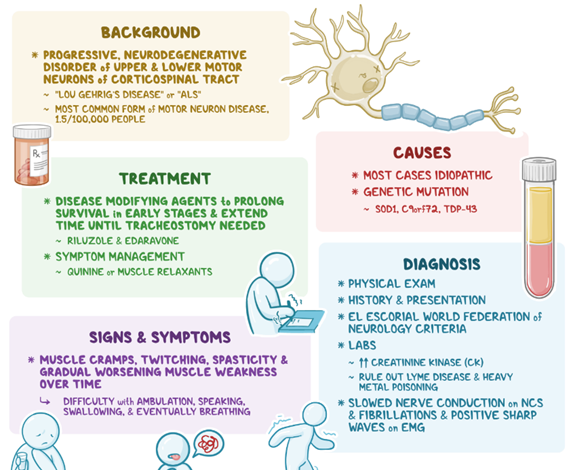
Which reason explains why a patient with amyotrophic lateral sclerosis (ALS) is uniquely prone to depression?
A. Intellectual capacity is not affected.
Intellectual capacity is not affected:This statement refers to the fact that ALS primarily affects motor neurons, leading to muscle weakness and paralysis, but it typically does not directly impact cognitive function or intellectual capacity. While cognitive impairment is not a hallmark feature of ALS, some individuals may experience changes in cognitive function or behavior, such as executive dysfunction or frontotemporal dementia, in later stages of the disease. However, depression in ALS is not primarily linked to changes in intellectual capacity but rather to other factors such as altered communication, physical limitations, and loss of autonomy.
B. Communication is altered.
Communication is altered:ALS can affect the muscles involved in speech and swallowing, leading to difficulties in communicationAs the disease progresses, patients may experience dysarthria (difficulty speaking clearly) and dysphagia (difficulty swallowing), which can impair their ability to communicate effectively with others. Altered communication can result in frustration, social isolation, and feelings of being misunderstood, all of which are risk factors for depression.
C. Mobility is limited.
Mobility is limited:ALS causes progressive muscle weakness and paralysis, which can significantly impair mobility over time. As the disease advances, individuals with ALS may become increasingly dependent on mobility aids such as wheelchairs or may require assistance with mobility tasks. Limited mobility can lead to feelings of loss of independence, decreased participation in activities, and increased dependence on caregivers, all of which can contribute to depression.
D. Nutritional intake is poor.
Nutritional intake is poor:ALS can affect the muscles involved in swallowing and chewing, leading to difficulties with eating and drinking. Dysphagia, or difficulty swallowing, is a common symptom in ALS and can result in poor nutritional intake and weight loss. Malnutrition and weight loss are associated with increased morbidity and mortality in ALS, and they can also contribute to feelings of weakness, fatigue, and overall decline in quality of life, which may exacerbate depression
Full Explanation
A. Intellectual capacity is not affected:
This statement refers to the fact that ALS primarily affects motor neurons, leading to muscle weakness and paralysis, but it typically does not directly impact cognitive function or intellectual capacity. While cognitive impairment is not a hallmark feature of ALS, some individuals may experience changes in cognitive function or behavior, such as executive dysfunction or frontotemporal dementia, in later stages of the disease. However, depression in ALS is not primarily linked to changes in intellectual capacity but rather to other factors such as altered communication, physical limitations, and loss of autonomy.
B. Communication is altered:
ALS can affect the muscles involved in speech and swallowing, leading to difficulties in communicationAs the disease progresses, patients may experience dysarthria (difficulty speaking clearly) and dysphagia (difficulty swallowing), which can impair their ability to communicate effectively with others. Altered communication can result in frustration, social isolation, and feelings of being misunderstood, all of which are risk factors for depression.
C. Mobility is limited:
ALS causes progressive muscle weakness and paralysis, which can significantly impair mobility over time. As the disease advances, individuals with ALS may become increasingly dependent on mobility aids such as wheelchairs or may require assistance with mobility tasks. Limited mobility can lead to feelings of loss of independence, decreased participation in activities, and increased dependence on caregivers, all of which can contribute to depression.
D. Nutritional intake is poor:
ALS can affect the muscles involved in swallowing and chewing, leading to difficulties with eating and drinking. Dysphagia, or difficulty swallowing, is a common symptom in ALS and can result in poor nutritional intake and weight loss. Malnutrition and weight loss are associated with increased morbidity and mortality in ALS, and they can also contribute to feelings of weakness, fatigue, and overall decline in quality of life, which may exacerbate depression.
A nurse is caring for a client who has multiple sclerosis and reports a tightening feeling around their torso. Which of the following conditions should the nurse recognize this finding indicates?
A. Lhermitte's sign
Lhermitte's sign:Lhermitte's sign is a neurological symptom characterized by a sensation of electric shock-like pain that radiates down the spine and into the limbs, typically triggered by flexing the neck forward. It is often described as shooting or stabbing pain and is commonly associated with lesions or damage to the cervical spinal cord. Lhermitte's sign is not associated with a tightening sensation around the torso but rather with shooting pain down the spine and limbs.
B. Trigeminal neuralgia
Trigeminal neuralgia:Trigeminal neuralgia is a neurological condition characterized by severe, shooting pain along the trigeminal nerve, which supplies sensation to the face. The pain is typically triggered by activities such as chewing, speaking, or touching the face. Trigeminal neuralgia causes sudden, intense, electric shock-like pain in the face, particularly in the areas supplied by the trigeminal nerve (e.g., cheek, jaw, forehead). It is not associated with a tightening sensation around the torso.
C. MS hug
MS hug: The "MS hug" is a symptom experienced by some individuals with multiple sclerosis, characterized by a sensation of tightness, pressure, or squeezing around the chest, abdomen, or torso. It can feel like a band tightening around the body and may be described as a constricting or girdling sensation. The MS hug is caused by spasms or tightening of the muscles surrounding the rib cage or the intercostal muscles due to damage to the nerves that control muscle function in MS.
D. Paroxysmal spasms
Paroxysmal spasms:Paroxysmal spasms refer to sudden, involuntary muscle contractions or spasms that occur intermittently. These spasms can affect various parts of the body and are commonly associated with conditions like multiple sclerosis. However, they typically present as brief, sudden contractions rather than a persistent tightening sensation around the torso.
Full Explanation
A. Lhermitte's sign:
Lhermitte's sign is a neurological symptom characterized by a sensation of electric shock-like pain that radiates down the spine and into the limbs, typically triggered by flexing the neck forward. It is often described as shooting or stabbing pain and is commonly associated with lesions or damage to the cervical spinal cord. Lhermitte's sign is not associated with a tightening sensation around the torso but rather with shooting pain down the spine and limbs.
B. Trigeminal neuralgia:
Trigeminal neuralgia is a neurological condition characterized by severe, shooting pain along the trigeminal nerve, which supplies sensation to the face. The pain is typically triggered by activities such as chewing, speaking, or touching the face. Trigeminal neuralgia causes sudden, intense, electric shock-like pain in the face, particularly in the areas supplied by the trigeminal nerve (e.g., cheek, jaw, forehead). It is not associated with a tightening sensation around the torso.
C. MS hug:
The "MS hug" is a symptom experienced by some individuals with multiple sclerosis, characterized by a sensation of tightness, pressure, or squeezing around the chest, abdomen, or torso. It can feel like a band tightening around the body and may be described as a constricting or girdling sensation. The MS hug is caused by spasms or tightening of the muscles surrounding the rib cage or the intercostal muscles due to damage to the nerves that control muscle function in MS.
D. Paroxysmal spasms:
Paroxysmal spasms refer to sudden, involuntary muscle contractions or spasms that occur intermittently. These spasms can affect various parts of the body and are commonly associated with conditions like multiple sclerosis. However, they typically present as brief, sudden contractions rather than a persistent tightening sensation around the torso.
A nurse is preparing to administer diazepam 3 mg IM. The amount available is diazepam for injection 5 mg/mL. How many mL should the nurse administer? (Round the answer to the nearest tenth. Use a leading zero if it applies. Do not use a trailing zero.)
Full Explanation
To calculate the dose of diazepam in mL, the nurse should use the formula:
Dose (mL) = Desired dose (mg) / Available dose (mg/mL)
Plugging in the values from the question, we get:
Dose (mL) = 3 mg / 5 mg/mL
Simplifying, we get:
Dose (mL) = 0.6 mL
Therefore, the nurse should administer 0.6 mL of diazepam IM.