Nursing practice questions with comprehensive rationales
NurseDive Free Nursing Practice Question
After receiving a change of shift report for clients on a medical surgical unit, which activity should the nurse delegate to the practical nurse (PN)?
A. Evaluate and update plans of care for clients.
Evaluating and updating plans of care for clients is a responsibility that falls within the scope of practice of registered nurses. It requires a higher level of assessment, clinical judgment, and decision-making, which are typically beyond the scope of practice of a practical nurse.
B. Verify the readiness of clients for discharge.
Verifying the readiness of clients for discharge typically involves comprehensive assessments, coordination with other healthcare professionals, and decision-making regarding the appropriateness of discharge. This task is generally performed by registered nurses (RNs) or other members of the healthcare team with advanced training.
C. Insert urinary catheters for uncomplicated clients.
Delegation involves assigning tasks to individuals who have the appropriate skills and competence to perform them safely and effectively. Inserting urinary catheters for uncomplicated clients is a task that can be delegated to a practical nurse. It is a common procedure within the scope of practice for a practical nurse, and it does not require the level of assessment and critical thinking involved in evaluating and updating plans of care or receiving a postoperative client and conducting an assessment.
D. Receive a postoperative client and conduct the assessment.
Receiving a postoperative client and conducting the assessment involves comprehensive assessment skills and critical thinking, which are typically within the scope of practice of a registered nurse or an advanced practice nurse.
This question is an excerpt from Nurse Dive's nursing test bank - RN Hesi Exit Proctored Exam. Take the full exam now
Full Explanation
Delegation involves assigning tasks to individuals who have the appropriate skills and competence to perform them safely and effectively. Inserting urinary catheters for uncomplicated clients is a task that can be delegated to a practical nurse. It is a common procedure within the scope of practice for a practical nurse, and it does not require the level of assessment and critical thinking involved in evaluating and updating plans of care or receiving a postoperative client and conducting an assessment.
Verifying the readiness of clients for discharge typically involves comprehensive assessments, coordination with other healthcare professionals, and decision-making regarding the appropriateness of discharge. This task is generally performed by registered nurses (RNs) or other members of the healthcare team with advanced training.
Evaluating and updating plans of care for clients is a responsibility that falls within the scope of practice of registered nurses. It requires a higher level of assessment, clinical judgment, and decision-making, which are typically beyond the scope of practice of a practical nurse.
Receiving a postoperative client and conducting the assessment involves comprehensive assessment skills and critical thinking, which are typically within the scope of practice of a registered nurse or an advanced practice nurse.
Similar Questions
The nurse discovers that a male client has attempted suicide by slashing his wrists. Which action(s) should the nurse do first?
A. Check the client's level of consciousness.
Assessing the client's level of consciousness involves observing their responsiveness, orientation, and ability to follow commands. If the client is unresponsive or exhibits any signs of altered consciousness, the nurse should immediately activate the emergency response system and begin resuscitative measures, such as administering oxygen and initiating cardiopulmonary resuscitation (CPR) if necessary. Once the client's level of consciousness is established and the emergency response system has been activated if necessary, the nurse can proceed to assess the depth of the slashes, estimate the amount of blood loss, and find the object used to cause the injuries. These assessments will provide important information about the extent and severity of the client's injuries, which will guide subsequent interventions.
B. Determine the depth of the slashes.
C. Estimate the amount of blood loss.
D. Find the object used to cause the injuries.
Full Explanation
Assessing the client's level of consciousness involves observing their responsiveness, orientation, and ability to follow commands. If the client is unresponsive or exhibits any signs of altered consciousness, the nurse should immediately activate the emergency response system and begin resuscitative measures, such as administering oxygen and initiating cardiopulmonary resuscitation (CPR) if necessary.
Once the client's level of consciousness is established and the emergency response system has been activated if necessary, the nurse can proceed to assess the depth of the slashes, estimate the amount of blood loss, and find the object used to cause the injuries. These assessments will provide important information about the extent and severity of the client's injuries, which will guide subsequent interventions.
Patient Data
History and Physical Nurses' Notes Laboratory Results Flow Sheet
Review H and P, nurse's note, laboratory result, and flow sheet.
What information should the nurse collect as part of the focused assessment for dehydration in this child? Select all that apply.
A. Level of consciousness
Assessing the level of consciousness, pupil size and reactiveness, and respiratory rate are important aspects of the neurological and respiratory assessments but are not specific to the assessment of dehydration
B. Capillary refill
This is a quick and simple way to assess the adequacy of peripheral perfusion and can help identify signs of dehydration.
C. Temperature
Fever is a potential cause of dehydration, so monitoring the temperature is an important part of the assessment.
D. Blood pressure
Blood pressure can be affected by dehydration, so monitoring it is important in determining the severity of dehydration and in guiding appropriate interventions.
F. Pupil size and reactiveness
Assessing the level of consciousness, pupil size and reactiveness, and respiratory rate are important aspects of the neurological and respiratory assessments but are not specific to the assessment of dehydration
G. Skin turgor
Assessing the skin turgor, or the elasticity of the skin, is another useful indicator of dehydration.
H. Heart rate
Tachycardia can be a sign of dehydration, so monitoring the heart rate is an important component of the assessment.
Full Explanation
- Capillary refill: This is a quick and simple way to assess the adequacy of peripheral perfusion and can help identify signs of dehydration.
- Skin turgor: Assessing the skin turgor, or the elasticity of the skin, is another useful indicator of dehydration.
- Heart rate: Tachycardia can be a sign of dehydration, so monitoring the heart rate is an important component of the assessment.
- Blood pressure: Blood pressure can be affected by dehydration, so monitoring it is important in determining the severity of dehydration and in guiding appropriate interventions.
- Temperature: Fever is a potential cause of dehydration, so monitoring the temperature is an important part of the assessment.
- Skin color of hands and feet: Checking the color of the skin on the hands and feet can help identify signs of poor perfusion and dehydration.
Assessing the level of consciousness, pupil size and reactiveness, and respiratory rate are important aspects of the neurological and respiratory assessments but are not specific to the assessment of dehydration.
When should the nurse conduct an Allen's test?
A. Just before arterial blood gasses are drawn peripherally.
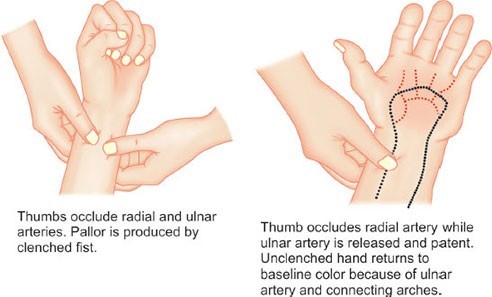
Allen's test is a procedure used to assess the patency of the ulnar artery and the collateral circulation of the hand. It is performed to determine the adequacy of collateral circulation before obtaining arterial blood gases from the radial artery. The test helps ensure that the ulnar artery is functioning properly and can supply blood to the hand if the radial artery is used for blood sampling or other invasive procedures. The test involves occluding both the ulnar and radial arteries while the patient clenches their fist. The nurse then releases pressure on the ulnar artery while maintaining occlusion of the radial artery. The hand should quickly regain normal coloration, indicating adequate collateral circulation. It's important to note that the Allen's test is specific to the assessment of collateral circulation in the hand and is not used for other purposes such as assessing deep vein thrombosis, cardiac output calculation, or obtaining pulmonary artery pressures.
B. Prior to attempting a cardiac output calculation.
C. To assess for presence of a deep vein thrombus in the leg.
D. When pulmonary artery pressures are obtained.
Full Explanation
Allen's test is a procedure used to assess the patency of the ulnar artery and the collateral circulation of the hand. It is performed to determine the adequacy of collateral circulation before obtaining arterial blood gases from the radial artery. The test helps ensure that the ulnar artery is functioning properly and can supply blood to the hand if the radial artery is used for blood sampling or other invasive procedures.
The test involves occluding both the ulnar and radial arteries while the patient clenches their fist. The nurse then releases pressure on the ulnar artery while maintaining occlusion of the radial artery. The hand should quickly regain normal coloration, indicating adequate collateral circulation.
It's important to note that the Allen's test is specific to the assessment of collateral circulation in the hand and is not used for other purposes such as assessing deep vein thrombosis, cardiac output calculation, or obtaining pulmonary artery pressures.