
Nursing practice questions with comprehensive rationales
NurseDive Free Nursing Practice Question
All the following are functions of the digestive system except:
A. Break down ingested foods
Break down ingested foods: The digestive system performs mechanical and chemical breakdown (e.g., chewing, enzymes) of ingested food.
B. Digest ingested foods to release nutrients
Digest ingested foods to release nutrients: Digestion (chemical breakdown) releases absorbable nutrients (amino acids, monosaccharides, fatty acids).
C. Production of red blood cells
Production of red blood cells: Hematopoiesis (production of RBCs) occurs mainly in bone marrow (and in fetal life the liver/spleen), not as a function of the digestive tract.
D. Excretion of waste products
Excretion of waste products: The digestive system eliminates undigested material and some metabolic wastes as feces.
This question is an excerpt from Nurse Dive's nursing test bank - HUMAN ANATOMY AND PHYSIOLOGY II PROCTORED EXAM (ARIZONA COLLEGE). Take the full exam now
Full Explanation
A. Break down ingested foods: The digestive system performs mechanical and chemical breakdown (e.g., chewing, enzymes) of ingested food.
B. Digest ingested foods to release nutrients: Digestion (chemical breakdown) releases absorbable nutrients (amino acids, monosaccharides, fatty acids).
C. Production of red blood cells: Hematopoiesis (production of RBCs) occurs mainly in bone marrow (and in fetal life the liver/spleen), not as a function of the digestive tract.
D. Excretion of waste products: The digestive system eliminates undigested material and some metabolic wastes as feces.
Similar Questions
Which of the following terms describes difficult or labored breathing?
A. Eupnea
Eupnea: Eupnea means normal, unlabored breathing (normal respiratory rate and depth) -not difficult breathing.
B. Dyspnea
Dyspnea: Dyspnea describes difficult or labored breathing (shortness of breath).
C. Hyperpnea
Hyperpnea: Hyperpnea means increased depth and/or rate of breathing (e.g., during exercise), not necessarily “difficult” or labored breathing.
D. Apnea
Apnea: Apnea means a temporary absence of breathing (no breathing), the opposite of labored breathing.
Full Explanation
A. Eupnea: Eupnea means normal, unlabored breathing (normal respiratory rate and depth) -not difficult breathing.
B. Dyspnea: Dyspnea describes difficult or labored breathing (shortness of breath).
C. Hyperpnea: Hyperpnea means increased depth and/or rate of breathing (e.g., during exercise), not necessarily “difficult” or labored breathing.
D. Apnea: Apnea means a temporary absence of breathing (no breathing), the opposite of labored breathing.
Which of the following are pancreatic secretions? (Select all that apply)
A. Pepsin
Pepsin: Pepsin is an active protease produced in the stomach (from pepsinogen) -not a pancreatic secretion.
B. Sodium bicarbonate
Sodium bicarbonate: The pancreas secretes bicarbonate-rich fluid to neutralize acidic chyme in the duodenum -pancreatic secretion .
C. Amylase
Amylase: Pancreatic amylase digests starches into sugars in the small intestine -pancreatic secretion .
D. Nuclease
Nuclease: The pancreas secretes nucleases (e.g., deoxyribonuclease, ribonuclease) to digest nucleic acids -pancreatic secretion .
E. Lipase
Lipase: Pancreatic lipase hydrolyzes triglycerides into free fatty acids and monoglycerides -pancreatic secretion .
F. Pepsinogen
Pepsinogen: Pepsinogen is secreted by chief cells in the stomach, not by the pancreas -not a pancreatic secretion.
Full Explanation
A. Pepsin: Pepsin is an active protease produced in the stomach (from pepsinogen) -not a pancreatic secretion.
B. Sodium bicarbonate: The pancreas secretes bicarbonate-rich fluid to neutralize acidic chyme in the duodenum -pancreatic secretion .
C. Amylase: Pancreatic amylase digests starches into sugars in the small intestine -pancreatic secretion .
D. Nuclease: The pancreas secretes nucleases (e.g., deoxyribonuclease, ribonuclease) to digest nucleic acids -pancreatic secretion .
E. Lipase: Pancreatic lipase hydrolyzes triglycerides into free fatty acids and monoglycerides -pancreatic secretion .
F. Pepsinogen: Pepsinogen is secreted by chief cells in the stomach, not by the pancreas -not a pancreatic secretion.
Letter C indicates what part of the nephron?
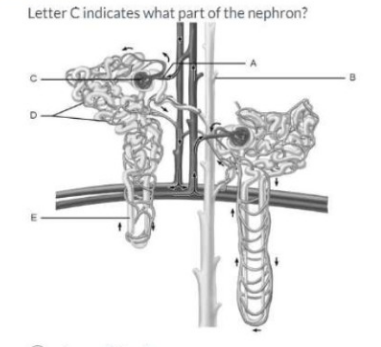
A. Loop of Henle
Loop of Henle: The Loop of Henle is the U-shaped segment of the nephron that extends into the medulla and concentrates urine.
B. Proximal Convoluted Tubule
Proximal Convoluted Tubule: The PCT is the first convoluted segment after Bowman's capsule and is responsible for bulk reabsorption of solutes and water.
C. Bowman's Capsule
Bowman's Capsule: Bowman's capsule is the double-walled cup that surrounds the glomerular capillary tuft and collects filtrate.
D. Glomerulus
Glomerulus: The glomerulus is the capillary tuft inside Bowman's capsule that performs plasma filtration.
E. Collecting Duct
The collecting duct collects filtrate from multiple nephrons and participates in final water/solute adjustments.
Full Explanation
A. Loop of Henle: The Loop of Henle is the U-shaped segment of the nephron that extends into the medulla and concentrates urine.
B. Proximal Convoluted Tubule: The PCT is the first convoluted segment after Bowman's capsule and is responsible for bulk reabsorption of solutes and water.
C. Bowman's Capsule: Bowman's capsule is the double-walled cup that surrounds the glomerular capillary tuft and collects filtrate.
D. Glomerulus: The glomerulus is the capillary tuft inside Bowman's capsule that performs plasma filtration.
E. Collecting Duct: The collecting duct collects filtrate from multiple nephrons and participates in final water/solute adjustments.