
Nursing practice questions with comprehensive rationales
NurseDive Free Nursing Practice Question
An Asian family arrives with their newborn for a well visit. When assessing the infant, the nurse observes the following skin irregularity. What is the nurse's priority action?
A. Notify child protective services
Reason: Notifying child protective services is not the priority action, as it is not indicated by the skin irregularity. The skin irregularity is most likely a Mongolian spot, which is a benign, bluish-gray or purple patch of pigmentation that is common in infants of Asian, African, or Hispanic descent. It is not a sign of abuse or injury, but rather a normal variation of skin color.
B. Record the finding
Reason: This is the correct choice. Recording the finding is the priority action, as it documents the presence and location of the Mongolian spot and prevents confusion or misdiagnosis in the future. The Mongolian spot usually fades by age 2 to 4 years, but it may persist into adulthood.
C. Notify the healthcare provider
Reason: Notifying the healthcare provider is not the priority action, as it is not necessary for the skin irregularity. The skin irregularity is not a cause for concern or intervention, but rather a normal variation of skin color.
D. Interview the clients about the injury
Reason: Interviewing the clients about the injury is not the priority action, as it is not appropriate for the skin irregularity. The skin irregularity is not an injury, but rather a normal variation of skin color. Interviewing the clients about it may imply suspicion or accusation of abuse, which can damage the nurse-client relationship and trust.
This question is an excerpt from Nurse Dive's nursing test bank - ATI Med Surg Proctored Exam 4. Take the full exam now
Full Explanation
Choice A Reason: Notifying child protective services is not the priority action, as it is not indicated by the skin irregularity. The skin irregularity is most likely a Mongolian spot, which is a benign, bluish-gray or purple patch of pigmentation that is common in infants of Asian, African, or Hispanic descent. It is not a sign of abuse or injury, but rather a normal variation of skin color.
Choice B Reason: This is the correct choice. Recording the finding is the priority action, as it documents the presence and location of the Mongolian spot and prevents confusion or misdiagnosis in the future. The Mongolian spot usually fades by age 2 to 4 years, but it may persist into adulthood.
Choice C Reason: Notifying the healthcare provider is not the priority action, as it is not necessary for the skin irregularity. The skin irregularity is not a cause for concern or intervention, but rather a normal variation of skin color.
Choice D Reason: Interviewing the clients about the injury is not the priority action, as it is not appropriate for the skin irregularity. The skin irregularity is not an injury, but rather a normal variation of skin color. Interviewing the clients about it may imply suspicion or accusation of abuse, which can damage the nurse-client relationship and trust.
Similar Questions
A nurse is preparing a client with extensive burns for hydrotherapy. What is the priority action by the nurse?
A. Educate the client about the therapy
Reason: Educating the client about the therapy is an important action by the nurse, but not the priority one. The nurse should explain the purpose, procedure, benefits, and risks of hydrotherapy to the client before starting it, but only after ensuring their comfort and pain relief.
B. Provide analgesics after therapy ends
Reason: Providing analgesics after therapy ends is not enough, as the nurse should provide them before and during therapy as well. Hydrotherapy involves cleansing and debriding of burn wounds with water jets or whirlpools, which can be very painful and stressful for the client.
C. Provide analgesics before therapy begins
Reason: This is the correct choice. Providing analgesics before therapy begins is the priority action by the nurse, as it reduces pain and anxiety for the client and facilitates wound healing. The nurse should assess the client's pain level and administer appropriate analgesics at least 30 minutes before hydrotherapy.
D. Ensure there are clean supplies
Reason: Ensuring there are clean supplies is an essential action by the nurse, but not the priority one. The nurse should use sterile or clean equipment and solutions for hydrotherapy to prevent infection and contamination of burn wounds, but only after ensuring their comfort and pain relief.
Full Explanation
Choice A Reason: Educating the client about the therapy is an important action by the nurse, but not the priority one. The nurse should explain the purpose, procedure, benefits, and risks of hydrotherapy to the client before starting it, but only after ensuring their comfort and pain relief.
Choice B Reason: Providing analgesics after therapy ends is not enough, as the nurse should provide them before and during therapy as well. Hydrotherapy involves cleansing and debriding of burn wounds with water jets or whirlpools, which can be very painful and stressful for the client.
Choice C Reason: This is the correct choice. Providing analgesics before therapy begins is the priority action by the nurse, as it reduces pain and anxiety for the client and facilitates wound healing. The nurse should assess the client's pain level and administer appropriate analgesics at least 30 minutes before hydrotherapy.
Choice D Reason: Ensuring there are clean supplies is an essential action by the nurse, but not the priority one. The nurse should use sterile or clean equipment and solutions for hydrotherapy to prevent infection and contamination of burn wounds, but only after ensuring their comfort and pain relief.
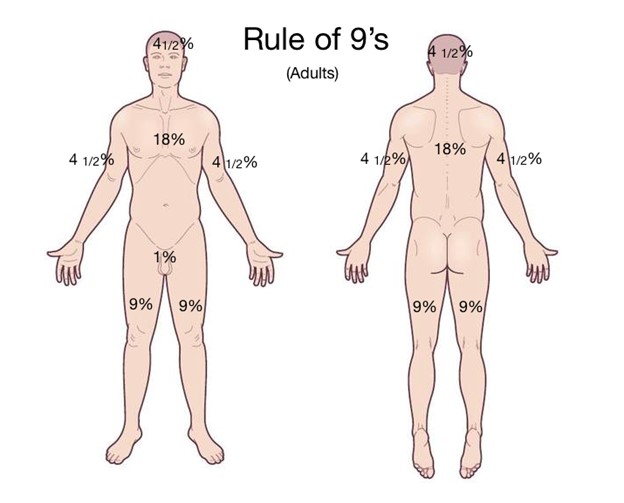
A nurse in an emergency department is caring for a client who has burns on the front and back of both his legs and arms. Using the rule of nines, the nurse should document burns to which percentage of the client's total body surface area (TBSA)?
A. 36 percent
Reason: This is the correct choice. Using the rule of nines, each arm accounts for 9 percent of TBSA, each leg accounts for 18 percent of TBSA, and front and back are equally divided. Therefore, burns on both sides of both arms and legs equal to (9 + 9) x 2 + (18 + 18) x 2 = 36 percent of TBSA.
B. 54 percent
Reason: This choice is incorrect. Using the rule of nines, burns on both sides of both arms and legs equal to 36 percent of TBSA, not 54 percent. To get 54 percent of TBSA, one would have to add burns on both sides of head and neck (9 percent), chest (9 percent), and abdomen (9 percent).
C. 27 percent
Reason: This choice is incorrect. Using the rule of nines, burns on both sides of both arms and legs equal to 36 percent of TBSA, not 27 percent. To get 27 percent of TBSA, one would have to subtract burns on both sides of one leg (18 percent).
D. 18 percent
Reason: This choice is incorrect. Using the rule of nines, burns on both sides of both arms and legs equal to 36 percent of TBSA, not 18 percent. To get 18 percent of TBSA, one would have to divide burns on both sides of both arms and legs by two.
E. 9 percent
Choice E Reason: This choice is incorrect. Using the rule of nines, burns on both sides of both arms and legs equal to 36 percent of TBSA, not 9 percent. To get 9 percent of TBSA, one would have to divide burns on both sides of both arms and legs by four.
Full Explanation
Choice A Reason: This is the correct choice. Using the rule of nines, each arm accounts for 9 percent of TBSA, each leg accounts for 18 percent of TBSA, and front and back are equally divided. Therefore, burns on both sides of both arms and legs equal to (9 + 9) x 2 + (18 + 18) x 2 = 36 percent of TBSA.
Choice B Reason: This choice is incorrect. Using the rule of nines, burns on both sides of both arms and legs equal to 36 percent of TBSA, not 54 percent. To get 54 percent of TBSA, one would have to add burns on both sides of head and neck (9 percent), chest (9 percent), and abdomen (9 percent).
Choice C Reason: This choice is incorrect. Using the rule of nines, burns on both sides of both arms and legs equal to 36 percent of TBSA, not 27 percent. To get 27 percent of TBSA, one would have to subtract burns on both sides of one leg (18 percent).
Choice D Reason: This choice is incorrect. Using the rule of nines, burns on both sides of both arms and legs equal to 36 percent of TBSA, not 18 percent. To get 18 percent of TBSA, one would have to divide burns on both sides of both arms and legs by two.
Choice E Reason: This choice is incorrect. Using the rule of nines, burns on both sides of both arms and legs equal to 36 percent of TBSA, not 9 percent. To get 9 percent of TBSA, one would have to divide burns on both sides of both arms and legs by four.
The nurse educator asks the student nurse to explain the most common causes of blindness in the United States. Which of the following options will the student nurse select as one of the top causes of blindness?
A. Head trauma
Reason: Head trauma is not one of the top causes of blindness in the United States, but rather a possible cause of it. Head trauma can damage the optic nerve, retina, or brain, leading to vision loss or impairment.
B. Cardiovascular disease
Reason: Cardiovascular disease is not one of the top causes of blindness in the United States, but rather a risk factor for it. Cardiovascular disease can affect the blood supply and oxygen delivery to the eyes, leading to conditions such as glaucoma, macular degeneration, or retinal vein occlusion.
C. Syphilis
Reason: Syphilis is not one of the top causes of blindness in the United States, but rather a rare cause of it. Syphilis is a sexually transmitted infection that can affect the eyes, leading to inflammation, scarring, or detachment of the retina.
D. Diabetic retinopathy
Reason: This is the correct choice. Diabetic retinopathy is one of the top causes of blindness in the United States, affecting about 4.1 million adults. Diabetic retinopathy is a complication of diabetes that damages the blood vessels in the retina, leading to bleeding, swelling, or leakage of fluid. It can cause blurred vision, floaters, or blindness if left untreated.
Full Explanation
Choice A Reason: Head trauma is not one of the top causes of blindness in the United States, but rather a possible cause of it. Head trauma can damage the optic nerve, retina, or brain, leading to vision loss or impairment.
Choice B Reason: Cardiovascular disease is not one of the top causes of blindness in the United States, but rather a risk factor for it. Cardiovascular disease can affect the blood supply and oxygen delivery to the eyes, leading to conditions such as glaucoma, macular degeneration, or retinal vein occlusion.
Choice C Reason: Syphilis is not one of the top causes of blindness in the United States, but rather a rare cause of it. Syphilis is a sexually transmitted infection that can affect the eyes, leading to inflammation, scarring, or detachment of the retina.
Choice D Reason: This is the correct choice. Diabetic retinopathy is one of the top causes of blindness in the United States, affecting about 4.1 million adults. Diabetic retinopathy is a complication of diabetes that damages the blood vessels in the retina, leading to bleeding, swelling, or leakage of fluid. It can cause blurred vision, floaters, or blindness if left untreated.