
Nursing practice questions with comprehensive rationales
NurseDive Free Nursing Practice Question
Calculate the amount to administer using a tuberculin syringe:
Ordered: Darbepoetin Alfa 12.5 mcg subcut weekly
On hand: See label
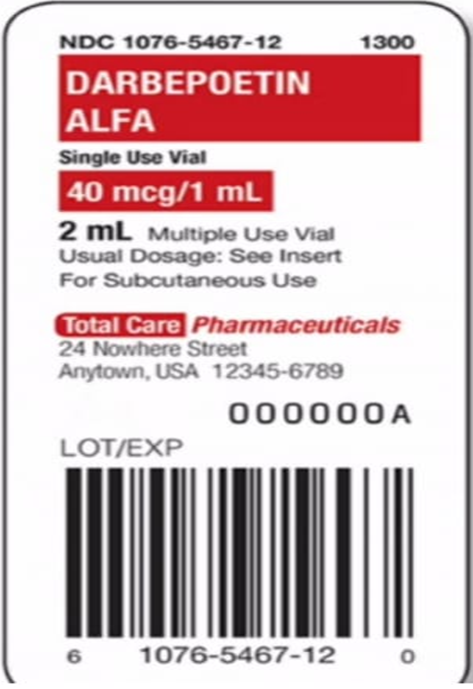
This question is an excerpt from Nurse Dive's nursing test bank - Dosage calculation proctored exam (hellen fluid college). Take the full exam now
Full Explanation
Calculation:
Ordered dose: 12.5 mcg.
- Medication concentration from the label.
The label indicates a concentration of 40 mcg/1 mL or 40 mcg/mL.
- Calculate the volume to administer.
Volume (mL) = Desired Dose / Concentration
= 12.5 mcg / 40 mcg/mL
= 0.3125 mL.
- Rounded to the nearest hundredth
= 0.31 mL.
Similar Questions
Find the flow rate for manual regulation: __________ (Round to the nearest whole number)
Ordered: 1,800 mL RL q12h using tubing calibrated to 15 gtt/mL
Full Explanation
Calculation:
- To find the flow rate in drops per minute (gtt/min), use the formula:
Flow rate (gtt/min) = (Total volume (mL) × Drop factor (gtt/mL)) / Time (min)
Total volume = 1,800 mL.
Drop factor = 15 gtt/mL.
- Convert the total time from hours to minutes.
Total time = 12 hours × 60 minutes/hour
= 720 minutes.
- Calculate the flow rate.
Flow rate = (1,800 mL × 15 gtt/mL) / 720 minutes
= 27,000 gtt / 720 minutes
= 37.5 gtt/min.
- Round the answer to the nearest whole number.
= 38 gtt/min.
The dosage strength of a solution with a strength of 50% is
A. 5 g of medication per 100 mL solution.
5 g of medication per 100 mL solution: This describes a 5% solution, not a 50% one. A 5% solution means there are 5 grams of drug in 100 mL of solution.
B. 1g of medication per 50 ml. solution.
1 g of medication per 50 mL solution: This reflects a 2% concentration (1 g in 50 mL = 2 g in 100 mL = 2%). It does not match 50% strength.
C. 1:1,000.
1:1,000: A 1:1,000 ratio means 1 gram of medication in 1,000 mL of solution (or 0.1%), which is far more diluted than a 50% solution.
D. 50 g of medication per 100 mL solution.
50 g of medication per 100 mL solution: A 50% solution means there are 50 grams of solute per 100 mL of solution. This is the correct expression of a 50% concentration by weight/volume (w/v).
Full Explanation
A. 5 g of medication per 100 mL solution: This describes a 5% solution, not a 50% one. A 5% solution means there are 5 grams of drug in 100 mL of solution.
B. 1 g of medication per 50 mL solution: This reflects a 2% concentration (1 g in 50 mL = 2 g in 100 mL = 2%). It does not match 50% strength.
C. 1:1,000: A 1:1,000 ratio means 1 gram of medication in 1,000 mL of solution (or 0.1%), which is far more diluted than a 50% solution.
D. 50 g of medication per 100 mL solution: A 50% solution means there are 50 grams of solute per 100 mL of solution. This is the correct expression of a 50% concentration by weight/volume (w/v).
Zinacef 750 mg IV q 8h is ordered. This would be what type of intravenous infusion?
A. KVO
KVO: "Keep vein open" infusions are minimal-rate fluids used to maintain IV line patency, not to deliver active medications like Zinacef. This does not apply to scheduled antibiotic therapy.
B. therapeutic
therapeutic: Zinacef (cefuroxime) is an antibiotic used to treat infections. Since it is being administered on a scheduled basis (750 mg IV q8h), it is used therapeutically to manage a medical condition.
C. replacement
replacement: Replacement fluids are used to restore lost fluids and electrolytes due to vomiting, diarrhea, bleeding, or other losses. They are not used for medication administration.
D. maintenance
maintenance: Maintenance fluids meet basic daily fluid and electrolyte requirements in patients unable to eat or drink. They do not involve scheduled doses of antibiotics or other medications.
Full Explanation
A. KVO: "Keep vein open" infusions are minimal-rate fluids used to maintain IV line patency, not to deliver active medications like Zinacef. This does not apply to scheduled antibiotic therapy.
B. therapeutic: Zinacef (cefuroxime) is an antibiotic used to treat infections. Since it is being administered on a scheduled basis (750 mg IV q8h), it is used therapeutically to manage a medical condition.
C. replacement: Replacement fluids are used to restore lost fluids and electrolytes due to vomiting, diarrhea, bleeding, or other losses. They are not used for medication administration.
D. maintenance: Maintenance fluids meet basic daily fluid and electrolyte requirements in patients unable to eat or drink. They do not involve scheduled doses of antibiotics or other medications.