
Nursing practice questions with comprehensive rationales
NurseDive Free Nursing Practice Question
During a prenatal visit, a pregnant woman says, "I know the amniotic fluid is important, but can you tell me more about it?" When describing amniotic fluid to a pregnant woman, which description would the nurse most likely include?
A. This fluid acts as a cushion to help protect your baby from injury.
Reason: This is correct because this description accurately reflects one of the main functions of amniotic fluid, which is to act as a shock absorber and buffer against external forces or movements that could harm the fetus. Amniotic fluid also allows the fetus to move freely and develop its muscles and bones.
B. The amount of fluid remains fairly constant throughout the pregnancy.
Reason: This is incorrect because this description is false. The amount of amniotic fluid changes throughout the pregnancy, depending on the stage of fetal development and other factors. The normal range of amniotic fluid volume is between 500 and 1000 mL at term. Too much or too little amniotic fluid can indicate a problem with the fetus or the placenta.
C. The fluid is mostly protein to provide nourishment to your baby.
Reason: This is incorrect because this description is false. The fluid is not mostly protein, but mostly water (about 98%). The water comes from the mother's blood plasma and the fetal urine. The remaining 2% of amniotic fluid consists of various substances, such as electrolytes, hormones, enzymes, antibodies, and fetal cells. Amniotic fluid does not provide nourishment to the fetus, but rather protects it from infection and helps regulate its temperature.
D. This fluid acts as a transport mechanism for oxygen and nutrients.
Reason: This is incorrect because this description is false. Amniotic fluid does not act as a transport mechanism for oxygen and nutrients, but rather as a barrier that prevents them from reaching the fetus directly. Oxygen and nutrients are delivered to the fetus through the placenta and the umbilical cord, which are connected to the maternal blood circulation.
This question is an excerpt from Nurse Dive's nursing test bank - Ati Maternal Newborn 4 Proctored Exam. Take the full exam now
Full Explanation
Choice A Reason: This is correct because this description accurately reflects one of the main functions of amniotic fluid, which is to act as a shock absorber and buffer against external forces or movements that could harm the fetus. Amniotic fluid also allows the fetus to move freely and develop its muscles and bones.
Choice B Reason: This is incorrect because this description is false. The amount of amniotic fluid changes throughout the pregnancy, depending on the stage of fetal development and other factors. The normal range of amniotic fluid volume is between 500 and 1000 mL at term. Too much or too little amniotic fluid can indicate a problem with the fetus or the placenta.
Choice C Reason: This is incorrect because this description is false. The fluid is not mostly protein, but mostly water (about 98%). The water comes from the mother's blood plasma and the fetal urine. The remaining 2% of amniotic fluid consists of various substances, such as electrolytes, hormones, enzymes, antibodies, and fetal cells. Amniotic fluid does not provide nourishment to the fetus, but rather protects it from infection and helps regulate its temperature.
Choice D Reason: This is incorrect because this description is false. Amniotic fluid does not act as a transport mechanism for oxygen and nutrients, but rather as a barrier that prevents them from reaching the fetus directly. Oxygen and nutrients are delivered to the fetus through the placenta and the umbilical cord, which are connected to the maternal blood circulation.
Similar Questions
A nurse is teaching a pregnant client in her first trimester about discomforts that she may experience. The nurse determines that the teaching was successful when the woman identifies which discomforts as common during the first trimester? Select all that apply.
A. Breast tenderness
Choice A Reason: This is correct because breast tenderness is a common discomfort during the first trimester of pregnancy. It is caused by hormonal changes that stimulate breast growth and prepare them for lactation. Breast tenderness may also be accompanied by swelling, tingling, or sensitivity.
B. Urinary frequency
Choice B Reason: This is correct because urinary frequency is a common discomfort during the first trimester of pregnancy. It is caused by hormonal changes that increase blood flow to the kidneys and bladder, as well as by the growing uterus that puts pressure on the bladder. Urinary frequency may also be associated with increased thirst or urinary tract infections.
C. Backache
Choice C Reason: This is incorrect because backache is not a common discomfort during the first trimester of pregnancy. It usually occurs in later stages of pregnancy, when the weight of the fetus and the uterus shifts the center of gravity and strains the back muscles and ligaments. Backache may also be caused by poor posture, stress, or fatigue.
D. Cravings
Choice D Reason: This is correct because cravings are a common discomfort during the first trimester of pregnancy. They are caused by hormonal changes that affect the sense of taste and smell, as well as by emotional or psychological factors. Cravings may vary from person to person and may include foods that are sweet, salty, sour, or spicy.
E. Leg cramps
Choice E Reason: This is incorrect because leg cramps are not a common discomfort during the first trimester of pregnancy. They usually occur in later stages of pregnancy, when there is increased pressure on the nerves and blood vessels that supply the legs. Leg cramps may also be caused by dehydration, electrolyte imbalance, or muscle fatigue.
Full Explanation
Choice A Reason: This is correct because breast tenderness is a common discomfort during the first trimester of pregnancy. It is caused by hormonal changes that stimulate breast growth and prepare them for lactation. Breast tenderness may also be accompanied by swelling, tingling, or sensitivity.
Choice B Reason: This is correct because urinary frequency is a common discomfort during the first trimester of pregnancy. It is caused by hormonal changes that increase blood flow to the kidneys and bladder, as well as by the growing uterus that puts pressure on the bladder. Urinary frequency may also be associated with increased thirst or urinary tract infections.
Choice C Reason: This is incorrect because backache is not a common discomfort during the first trimester of pregnancy. It usually occurs in later stages of pregnancy, when the weight of the fetus and the uterus shifts the center of gravity and strains the back muscles and ligaments. Backache may also be caused by poor posture, stress, or fatigue.
Choice D Reason: This is correct because cravings are a common discomfort during the first trimester of pregnancy. They are caused by hormonal changes that affect the sense of taste and smell, as well as by emotional or psychological factors. Cravings may vary from person to person and may include foods that are sweet, salty, sour, or spicy.
Choice E Reason: This is incorrect because leg cramps are not a common discomfort during the first trimester of pregnancy. They usually occur in later stages of pregnancy, when there is increased pressure on the nerves and blood vessels that supply the legs. Leg cramps may also be caused by dehydration, electrolyte imbalance, or muscle fatigue.
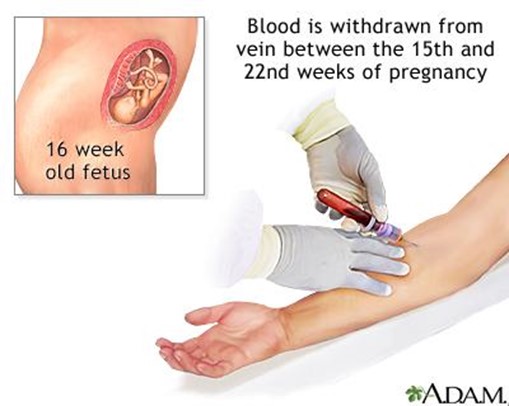
A pregnant woman undergoes a triple/quadruple screen at 16 to 18 weeks' gestation. What would the nurse suspect if the woman's alpha-fetoprotein (AFP) level is decreased?
A. Sickle-cell anemia
Reason: This is incorrect because sickle-cell anemia is a genetic disorder that affects the shape and function of red blood cells. It does not affect the AFP level, which is a protein produced by the fetus and placenta. Sickle-cell anemia can be detected by other prenatal tests, such as hemoglobin electrophoresis or DNA analysis.
B. Cardiac defects
Reason: This is incorrect because cardiac defects are structural abnormalities of the heart or blood vessels that affect the blood flow and oxygen delivery to the fetus. They may cause an increased AFP level, not a decreased one, as they can lead to fetal distress or edema. Cardiac defects can be detected by other prenatal tests, such as fetal echocardiography or ultrasound.
C. Down syndrome
Reason: This is correct because Down syndrome is a chromosomal disorder that results from an extra copy of chromosome 21. It causes various physical and mental developmental delays and defects in the fetus. It is associated with a decreased AFP level, as well as decreased levels of human chorionic gonadotropin (hCG) and unconjugated estriol (uE3). Down syndrome can be confirmed by other prenatal tests, such as amniocentesis or chorionic villus sampling (CVS).
D. Respiratory disorders
Reason: This is incorrect because respiratory disorders are problems that affect the breathing and gas exchange of the fetus. They may cause an increased AFP level, not a decreased one, as they can lead to fetal distress or edema. Respiratory disorders can be detected by other prenatal tests, such as fetal biophysical profile (BPP) or nonstress test (NST).
Full Explanation
Choice A Reason: This is incorrect because sickle-cell anemia is a genetic disorder that affects the shape and function of red blood cells. It does not affect the AFP level, which is a protein produced by the fetus and placenta. Sickle-cell anemia can be detected by other prenatal tests, such as hemoglobin electrophoresis or DNA analysis.
Choice B Reason: This is incorrect because cardiac defects are structural abnormalities of the heart or blood vessels that affect the blood flow and oxygen delivery to the fetus. They may cause an increased AFP level, not a decreased one, as they can lead to fetal distress or edema. Cardiac defects can be detected by other prenatal tests, such as fetal echocardiography or ultrasound.
Choice C Reason: This is correct because Down syndrome is a chromosomal disorder that results from an extra copy of chromosome 21. It causes various physical and mental developmental delays and defects in the fetus. It is associated with a decreased AFP level, as well as decreased levels of human chorionic gonadotropin (hCG) and unconjugated estriol (uE3). Down syndrome can be confirmed by other prenatal tests, such as amniocentesis or chorionic villus sampling (CVS).
Choice D Reason: This is incorrect because respiratory disorders are problems that affect the breathing and gas exchange of the fetus. They may cause an increased AFP level, not a decreased one, as they can lead to fetal distress or edema. Respiratory disorders can be detected by other prenatal tests, such as fetal biophysical profile (BPP) or nonstress test (NST).
A nurse is caring for a client who has an NG tube set to low intermittent suction. The nurse irrigates the NG tube twice with 30 mL of normal saline solution during his shift. At the end of the shift, the NG canister contains 475 mL. What amount of NG drainage should the nurse record? (Round the answer to the nearest whole number. Use a leading zero if it applies. Do not use a trailing zero.)
Full Explanation
To calculate the amount of NG drainage, the nurse should subtract the amount of irrigation fluid from the amount of fluid in the NG canister. The irrigation fluid is not part of the drainage, but rather a way to keep the NG tube patent and prevent clogging.
The amount of irrigation fluid is 30 mL x 2 = 60 mL.
The amount of fluid in the NG canister is 475 mL.
Therefore, the amount of NG drainage is 475 mL - 60 mL = 415 mL.
The answer should be rounded to the nearest whole number and use a leading zero if it applies. Do not use a trailing zero.
Therefore, the final answer is 415 mL.