
Nursing practice questions with comprehensive rationales
NurseDive Free Nursing Practice Question
The client reports having a cold earlier in the week, but she was feeling better before the hike. The nurse begins client education and asks the client what potential asthma triggers may have been involved in her recent exacerbation. For each statement click to specify if the client has an understanding or no understanding of asthma triggers.
Client Statements below.
A. I should have taken some allergy medications before going on the hike.
B. I should have eaten a snack halfway through the hike.
C. My friend smoked cigarettes during the hike.
D. I have been very stressed out lately and should work on stress management.
E. I should have taken an extra dose of Fluticasone- Salmeterol.
This question is an excerpt from Nurse Dive's nursing test bank - RN Hesi Exit Proctored Exam. Take the full exam now
Full Explanation
A. Understanding: The client recognizes that taking allergy medications before the hike might have helped prevent an exacerbation.
B. No understanding: The client doesn't realize that eating a snack could impact asthma symptoms. Proper education is needed here.
C. Understanding: The client acknowledges that exposure to cigarette smoke during the hike could have contributed to the exacerbation.
D. Understanding: The client identifies that stress management could be important in preventing asthma exacerbations.
E. No understanding: The client is not aware that taking an extra dose of Fluticasone-Salmeterol could have been beneficial. Further education is necessary.
Similar Questions
The client is a 32-year-old multigravida at 28 weeks' gestation, who presents to the obstetrician's office for a routine prenatal visit. Obstetrical history reveals she has given birth three times; once at 35 weeks (twins), once at 38 weeks (singleton) and once at 41 weeks (singleton). All of these children are alive and well. She had one spontaneous abortion at 10 weeks' gestation. Her fourth child weighed 9 pounds (4.08 kg) at 41 weeks gestation.
The nurse is reviewing nurses' notes to determine if there are any variations.
Click to highlight the findings that would indicate the client has developed a complication related to pregnancy.
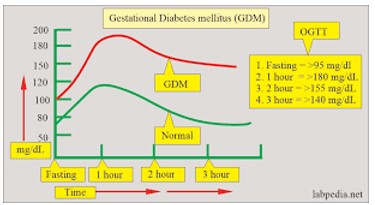
Client is at 28 weeks. She has been receiving prenatal care since 8 weeks' gestation. Her fasting 1-hour glucose screening level, which was done 1 week prior, is 164 mg/dl. (9.1 mmol/L) Her 3-hour oral glucose tolerance test results reveal a fasting blood sugar of 168 (9.3 mmol/L) and a two-hour postprandial of 220 mg/dL (12.2 mmol/L).
A. Her fasting 1-hour glucose screening level, which was done 1 week prior
None
B. Her 3-hour oral glucose tolerance test results
None
C. a two-hour postprandial of 220 mg/dL
None
Full Explanation
Her fasting 1-hour glucose screening level, which was done 1 week prior, is 164 mg/dl. (9.1 mmol/L) Her 3-hour oral glucose tolerance test results reveal a fasting blood sugar of 168 (9.3 mmol/L) and a two-hour postprandial of 220 mg/dL (12.2 mmol/L).
The client has gestational diabetes mellitus (GDM), which is a condition that affects some pregnant women and causes high blood sugar levels. This is bad during pregnancy because it can increase the risk of complications for both the mother and the baby, such as preeclampsia, macrosomia, birth trauma, neonatal hypoglycemia, and congenital anomalies. The client needs to follow a diet and exercise plan to control her blood sugar levels and prevent further complications. She may also need to take insulin injections or oral medications if diet and exercise are not enough. The client should monitor her blood sugar levels regularly and report any abnormal results to her health care provider. The client should also have regular prenatal visits and ultrasounds to check the growth and development of the baby.
Which instruction should the nurse delegate to an unlicensed assistive personnel (UAP)?
A. Call the pharmacy to obtain a client's next antibiotic dose.
This task is beyond the scope of practice for a UAP. Calling the pharmacy to obtain medications requires clinical judgment and understanding of medication administration, which is the responsibility of licensed nursing personnel.
B. Observe a client's gait to determine the need for assistance.
This task requires assessment skills, which are beyond the scope of practice for a UAP. Determining a client's need for assistance with mobility requires clinical judgment.
C. Bring a sterile chest drainage unit from central supply to the unit.
This task is appropriate to delegate to a UAP. It involves transporting an item from one location to another, which does not require clinical judgment or assessment.
D. Evaluate a client's urinary catheter for proper drainage.
This task requires assessment skills and clinical judgment, which are beyond the scope of practice for a UAP. Evaluating a client's urinary catheter involves assessing for patency and signs of complications, which should be done by a licensed nurse.
Full Explanation
Click to mark whether the following are signs and symptoms of cerebral edema, respiratory distress, or both.
A. Course breath sounds
B. Decreased level of consciousness
C. Seizure activity
D. Irritability
E. Bradycardia
Full Explanation
Course breath sounds - Respiratory Distress
Decreased level of consciousness - Cerebral Edema
Seizure activity - Cerebral Edema
Irritability - Both (Can be associated with both cerebral edema and respiratory distress)
Bradycardia - Cerebral Edema
Rationale:
Course breath sounds - Respiratory Distress
Course breath sounds could indicate the presence of secretions or fluid in the airways, which is a sign of respiratory distress. It suggests that there might be a problem with the airway or lung function.
Decreased level of consciousness - Cerebral Edema
A decreased level of consciousness can be a sign of cerebral edema, which is the swelling of the brain due to increased intracranial pressure. This can lead to changes in the child's mental status and responsiveness.
Seizure activity - Cerebral Edema
Seizure activity can be a manifestation of cerebral edema. Swelling and pressure in the brain can irritate brain tissue and lead to seizures.
Irritability - Both (Can be associated with both cerebral edema and respiratory distress) Irritability can be seen in both cerebral edema and respiratory distress. In cerebral edema, the pressure on the brain can cause discomfort and irritability. In respiratory distress, the child may be uncomfortable due to difficulty breathing.
Bradycardia - Cerebral Edema
Bradycardia (slow heart rate) can be associated with increased intracranial pressure and cerebral edema. It can be a response to the pressure on the brain.