
Nursing practice questions with comprehensive rationales
NurseDive Free Nursing Practice Question
Identify the phases of the uterine cycle. (Select all that apply)
A. Secretory phase
Secretory phase: The secretory phase is a uterine (endometrial) phase that follows ovulation when the endometrium is prepared for implantation by progesterone-driven secretions
B. Proliferative phase
Proliferative phase: The proliferative phase is the pre-ovulatory uterine phase in which the endometrium rebuilds under the influence of estrogen.
C. Ovulatory phase
Ovulatory phase: “Ovulatory” refers to ovulation and is classically part of the ovarian cycle (the moment of egg release), not listed as a primary uterine cycle phase.
D. Menses
Menses: Menses (menstrual phase) is the shedding of the functional layer of the endometrium and is a primary uterine cycle phase.
E. Luteal phase
Luteal phase: The luteal phase is an ovarian cycle phase (post-ovulation, corpus luteum activity). Although it corresponds in time to the uterine secretory phase, “luteal” names the ovarian, not uterine, phase.
This question is an excerpt from Nurse Dive's nursing test bank - HUMAN ANATOMY AND PHYSIOLOGY II PROCTORED EXAM (ARIZONA COLLEGE). Take the full exam now
Full Explanation
A. Secretory phase: The secretory phase is a uterine (endometrial) phase that follows ovulation when the endometrium is prepared for implantation by progesterone-driven secretions
B. Proliferative phase: The proliferative phase is the pre-ovulatory uterine phase in which the endometrium rebuilds under the influence of estrogen.
C. Ovulatory phase: “Ovulatory” refers to ovulation and is classically part of the ovarian cycle (the moment of egg release), not listed as a primary uterine cycle phase.
D. Menses: Menses (menstrual phase) is the shedding of the functional layer of the endometrium and is a primary uterine cycle phase.
E. Luteal phase: The luteal phase is an ovarian cycle phase (post-ovulation, corpus luteum activity). Although it corresponds in time to the uterine secretory phase, “luteal” names the ovarian, not uterine, phase.
Similar Questions
Identify the structure labeled C.
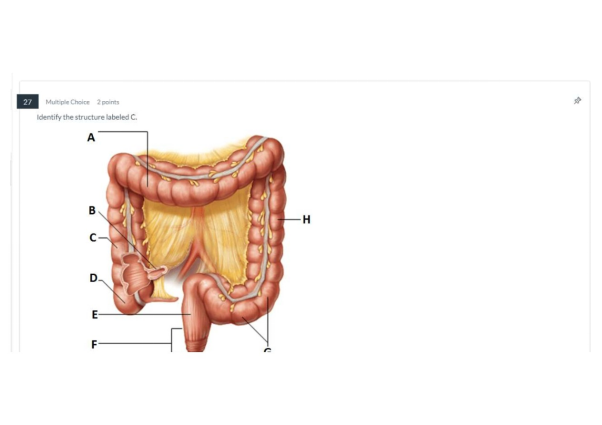
A. A
B. B
C. C
C- Ascending colon: The ascending colon is the right-sided large-intestine segment that ascends from the cecum to the hepatic (right colic) flexure; on a standard abdominal/colonic diagram the ascending colon is vertical on the right side and shows haustral markings.
D. D
E. E
Full Explanation
C- Ascending colon: The ascending colon is the right-sided large-intestine segment that ascends from the cecum to the hepatic (right colic) flexure; on a standard abdominal/colonic diagram the ascending colon is vertical on the right side and shows haustral markings.
Which hormone is responsible for regulating the process of spermatogenesis?
A. Follicle Stimulating Hormone (FSH)
Follicle Stimulating Hormone (FSH): FSH directly stimulates Sertoli cells in the testes to support sperm development and the process of spermatogenesis .
B. Luteinizing Hormone (LH)
Luteinizing Hormone (LH): LH stimulates Leydig cells to produce testosterone, which indirectly supports spermatogenesis, but LH itself is not the primary regulator of the spermatogenic process.
C. Estrogen
Estrogen: Estrogen is present in males in small amounts (via aromatization of androgens) and has modulatory roles, but it is not the main hormone regulating spermatogenesis.
D. Progesterone
Progesterone: Progesterone has little to no direct role in regulating spermatogenesis in males.
Full Explanation
A. Follicle Stimulating Hormone (FSH): FSH directly stimulates Sertoli cells in the testes to support sperm development and the process of spermatogenesis .
B. Luteinizing Hormone (LH): LH stimulates Leydig cells to produce testosterone, which indirectly supports spermatogenesis, but LH itself is not the primary regulator of the spermatogenic process.
C. Estrogen: Estrogen is present in males in small amounts (via aromatization of androgens) and has modulatory roles, but it is not the main hormone regulating spermatogenesis.
D. Progesterone: Progesterone has little to no direct role in regulating spermatogenesis in males.
The stomach can expand up to eighty times its empty volume partly due to _______ in its walls.
A. Microvilli
Microvilli: Microvilli are tiny apical membrane projections that greatly increase surface area for absorption (mainly in the small intestine), not responsible for stomach expansion.
B. Plica circularis
Plica circularis: Plicae circularis (circular folds) are permanent folds of the small intestine mucosa that aid absorption, not found in the stomach.
C. Haustra
Haustra: Haustra are sacculations of the large intestine (colon), not structures of the stomach.
D. Rugae
Rugae: Rugae are the longitudinal mucosal folds in the stomach wall that allow the stomach to stretch and expand as it fills .
Full Explanation
A. Microvilli: Microvilli are tiny apical membrane projections that greatly increase surface area for absorption (mainly in the small intestine), not responsible for stomach expansion.
B. Plica circularis: Plicae circularis (circular folds) are permanent folds of the small intestine mucosa that aid absorption, not found in the stomach.
C. Haustra: Haustra are sacculations of the large intestine (colon), not structures of the stomach.
D. Rugae: Rugae are the longitudinal mucosal folds in the stomach wall that allow the stomach to stretch and expand as it fills .