
Nursing practice questions with comprehensive rationales
NurseDive Free Nursing Practice Question
Iron is a component of what substance?
A. Biliverdin
Biliverdin: biliverdin is a green pigment formed during heme breakdown and does not contain iron.
B. Heme
Heme: the heme moiety of hemoglobin contains an iron atom (Fe²⁺) at its center that binds oxygen.
C. Bilirubin
Bilirubin: bilirubin is a breakdown product of biliverdin and does not contain iron.
D. Globin
Globin: globin is the protein part of hemoglobin (amino-acid chains); iron is in the heme portion, not the globin polypeptide.
This question is an excerpt from Nurse Dive's nursing test bank - Anatomy and physiology proctored exam (Ivy college). Take the full exam now
Full Explanation
A. Biliverdin: biliverdin is a green pigment formed during heme breakdown and does not contain iron.
B. Heme: the heme moiety of hemoglobin contains an iron atom (Fe²⁺) at its center that binds oxygen.
C. Bilirubin: bilirubin is a breakdown product of biliverdin and does not contain iron.
D. Globin: globin is the protein part of hemoglobin (amino-acid chains); iron is in the heme portion, not the globin polypeptide.
Similar Questions
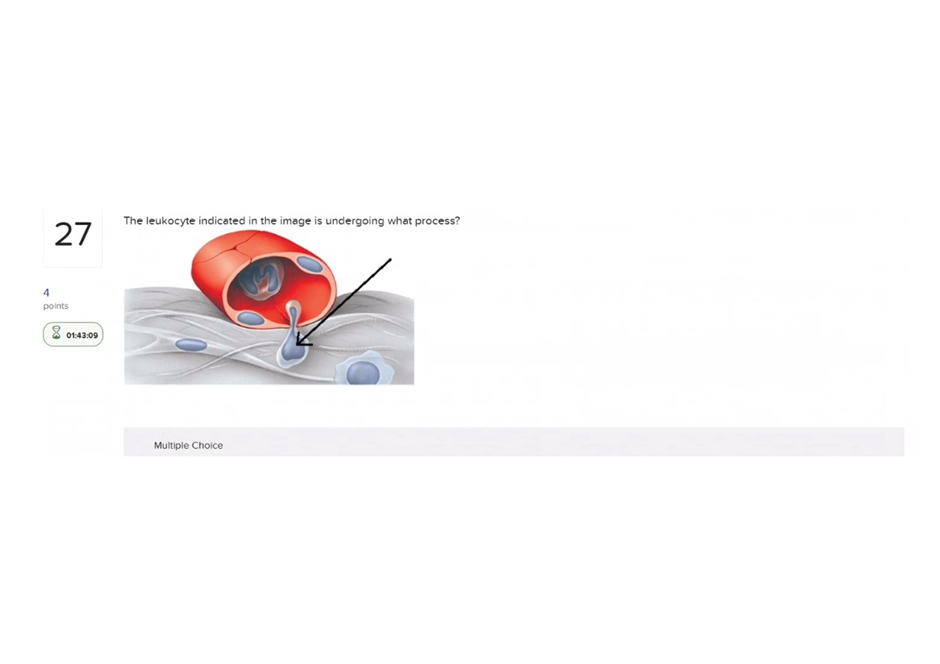
The leukocyte indicated in the image is undergoing what process?
A. Diapedesis
Diapedesis (transmigration): the cell is shown squeezing through the vessel wall (leaving the bloodstream), which is diapedesis (also called extravasation).
B. Phagocytosis
Phagocytosis: phagocytosis is ingestion of particles/pathogens by a phagocyte; the image shows movement out of a vessel, not engulfment of material.
C. Chemotaxis
Chemotaxis: Incorrect (related but not the pictured action) -chemotaxis is directed movement toward chemical signals; a leukocyte may chemotax once in the tissue, but the image specifically shows the mechanical passage through the endothelium (diapedesis).
D. Margination
Margination/Rolling: margination/rolling are earlier steps along the endothelium where leukocytes slow and adhere; the image shows a cell already squeezing through the wall, which is the next step (diapedesis).
Full Explanation
A. Diapedesis (transmigration): the cell is shown squeezing through the vessel wall (leaving the bloodstream), which is diapedesis (also called extravasation).
B. Phagocytosis: phagocytosis is ingestion of particles/pathogens by a phagocyte; the image shows movement out of a vessel, not engulfment of material.
C. Chemotaxis: Incorrect (related but not the pictured action) -chemotaxis is directed movement toward chemical signals; a leukocyte may chemotax once in the tissue, but the image specifically shows the mechanical passage through the endothelium (diapedesis).
D. Margination/Rolling: margination/rolling are earlier steps along the endothelium where leukocytes slow and adhere; the image shows a cell already squeezing through the wall, which is the next step (diapedesis).
What type of antigens are found on the surface of red blood cells of a person with type AB blood?
A. Both antigens A and B
Both antigens A and B: type AB RBCs express both A and B surface antigens.
B. Neither antigens A nor antigens B
Neither antigens A nor antigens B: that describes type O, not AB.
C. Antigens A only
Antigens A only: that describes type A, not AB.
D. Antigens B only
Antigens B only: that describes type B, not AB.
Full Explanation
A. Both antigens A and B: type AB RBCs express both A and B surface antigens.
B. Neither antigens A nor antigens B: that describes type O, not AB.
C. Antigens A only: that describes type A, not AB.
D. Antigens B only: that describes type B, not AB.
Plasma electrolytes include
A. fibrinogen, globulins, and albumin
Fibrinogen, globulins, and albumin: those are plasma proteins, not electrolytes (they’re large molecules, not ions).
B. bicarbonate, magnesium, chloride, and potassium ions
Bicarbonate, magnesium, chloride, and potassium ions: these are ions dissolved in plasma and are classically considered electrolytes.
C. monocytes, basophils, and eosinophils
Monocytes, basophils, and eosinophils: those are white blood cells (formed elements), not electrolytes.
D. creatinine, urea, and uric acid
Creatinine, urea, and uric acid: those are nitrogenous waste/metabolites present in plasma, not electrolytes.
Full Explanation
A. Fibrinogen, globulins, and albumin: those are plasma proteins, not electrolytes (they’re large molecules, not ions).
B. Bicarbonate, magnesium, chloride, and potassium ions: these are ions dissolved in plasma and are classically considered electrolytes.
C. Monocytes, basophils, and eosinophils: those are white blood cells (formed elements), not electrolytes.
D. Creatinine, urea, and uric acid: those are nitrogenous waste/metabolites present in plasma, not electrolytes.