
Nursing practice questions with comprehensive rationales
NurseDive Free Nursing Practice Question
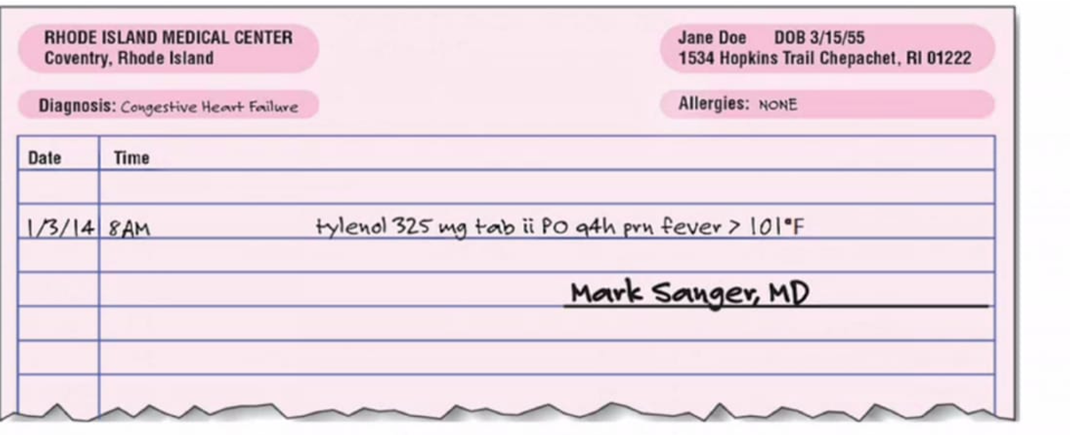
Jane Doe was given Tylenol for her fever at 8 a.m. At noon, her temperature was 39.2°C. What action should be taken at noon?
A. Do not administer Tylenol, her temperature is below 101°F
B. Administer one-half 325 mg Tylenol tablet.
C. Administer one 325 mg Tylenol tablet.
D. Administer two 325 mg Tylenol tablets.
Rationale: Check the time condition: The last dose was given at 8 a.m., and the order is for "q4h" (every 4 hours). At noon, exactly 4 hours have passed, so the time condition is met. Check the temperature condition: The patient's temperature is 39.2°C, but the order specifies a temperature in Fahrenheit (> 101°F). Convert to determine if the condition is met. Conversion: F= (C×1.8) + 32 = (39.2×1.8)+32 = 70.56+32 = 102.56°F Evaluate the order: The patient's temperature of 102.56°F is greater than the ordered condition of 101°F. Both the time and temperature conditions for administering the Tylenol have been met. The order is for "Tylenol 325 mg tab ii," which means two tablets of 325 mg each.
This question is an excerpt from Nurse Dive's nursing test bank - Dosage calculation proctored exam (hellen fluid college). Take the full exam now
Full Explanation
Rationale:
- Check the time condition: The last dose was given at 8 a.m., and the order is for "q4h" (every 4 hours). At noon, exactly 4 hours have passed, so the time condition is met.
- Check the temperature condition: The patient's temperature is 39.2°C, but the order specifies a temperature in Fahrenheit (> 101°F).
Convert to determine if the condition is met.
Conversion: F= (C×1.8) + 32
= (39.2×1.8)+32
= 70.56+32
= 102.56°F
- Evaluate the order: The patient's temperature of 102.56°F is greater than the ordered condition of 101°F. Both the time and temperature conditions for administering the Tylenol have been met.
- The order is for "Tylenol 325 mg tab ii," which means two tablets of 325 mg each.
Similar Questions
A 2-week-old infant's head circumference is measured to be 37.2 cm. This measurement, converted to millimeters, is ______________mm.
Full Explanation
Calculation:
- To convert centimeters (cm) to millimeters (mm), use the conversion factor of 10 mm per 1 cm.
1 cm = 10 mm
Measurement in mm = 37.2 cm × 10 mm/cm
= 372 mm.
Ordered: Erythromycin Base Filmtab 250 mg #28; take 1 tab po q6h. What is the days' supply?
A. 5 days
B. 7 days
Calculation: Total tablets = 28 tablets. Calculate the number of tablets to be taken per day. The order is to take 1 tablet every 6 hours ("q6h"). Number of doses per day = 24 hours / 6 hours/dose = 4 doses per day. Since each dose is 1 tablet, the patient takes 4 tablets per day. Calculate the total days' supply. Days' supply = Total tablets / Tablets per day = 28 tablets / 4 tablets/day = 7 days.
C. 28 days
D. 4 days
Full Explanation
Calculation:
Total tablets = 28 tablets.
- Calculate the number of tablets to be taken per day.
The order is to take 1 tablet every 6 hours ("q6h").
Number of doses per day = 24 hours / 6 hours/dose
= 4 doses per day.
Since each dose is 1 tablet, the patient takes 4 tablets per day.
- Calculate the total days' supply.
Days' supply = Total tablets / Tablets per day
= 28 tablets / 4 tablets/day
= 7 days.
Which of the following syringes should be used to measure 60 units of insulin?
A. tuberculin syringe
tuberculin syringe: Tuberculin syringes are calibrated in milliliters (typically 1 mL total) and not in insulin units. Using them for insulin risks serious dosing errors due to miscalculation or misreading.
B. U-100, 50 unit capacity insulin syringe
U-100, 50 unit capacity insulin syringe: This syringe only holds up to 50 units of insulin. Since the ordered dose is 60 units, this syringe is not large enough and should not be used for this administration.
C. U-100, 100 unit capacity insulin syringe
U-100, 100 unit capacity insulin syringe: This is the correct syringe for giving 60 units of insulin. It is specifically calibrated for insulin dosing and can measure up to 100 units accurately and safely.
D. standard syringe
standard syringe: Standard syringes are usually marked in milliliters, not insulin units. Using them for insulin administration increases the risk of dosing errors and is not recommended for safety reasons.
Full Explanation
A. tuberculin syringe: Tuberculin syringes are calibrated in milliliters (typically 1 mL total) and not in insulin units. Using them for insulin risks serious dosing errors due to miscalculation or misreading.
B. U-100, 50 unit capacity insulin syringe: This syringe only holds up to 50 units of insulin. Since the ordered dose is 60 units, this syringe is not large enough and should not be used for this administration.
C. U-100, 100 unit capacity insulin syringe: This is the correct syringe for giving 60 units of insulin. It is specifically calibrated for insulin dosing and can measure up to 100 units accurately and safely.
D. standard syringe: Standard syringes are usually marked in milliliters, not insulin units. Using them for insulin administration increases the risk of dosing errors and is not recommended for safety reasons.