
Nursing practice questions with comprehensive rationales
NurseDive Free Nursing Practice Question
Ordered: Erythromycin Base Filmtab 250 mg #28; take 1 tab po q6h. What is the days' supply?
A. 5 days
B. 7 days
Calculation: Total tablets = 28 tablets. Calculate the number of tablets to be taken per day. The order is to take 1 tablet every 6 hours ("q6h"). Number of doses per day = 24 hours / 6 hours/dose = 4 doses per day. Since each dose is 1 tablet, the patient takes 4 tablets per day. Calculate the total days' supply. Days' supply = Total tablets / Tablets per day = 28 tablets / 4 tablets/day = 7 days.
C. 28 days
D. 4 days
This question is an excerpt from Nurse Dive's nursing test bank - Dosage calculation proctored exam (hellen fluid college). Take the full exam now
Full Explanation
Calculation:
Total tablets = 28 tablets.
- Calculate the number of tablets to be taken per day.
The order is to take 1 tablet every 6 hours ("q6h").
Number of doses per day = 24 hours / 6 hours/dose
= 4 doses per day.
Since each dose is 1 tablet, the patient takes 4 tablets per day.
- Calculate the total days' supply.
Days' supply = Total tablets / Tablets per day
= 28 tablets / 4 tablets/day
= 7 days.
Similar Questions
Which of the following syringes should be used to measure 60 units of insulin?
A. tuberculin syringe
tuberculin syringe: Tuberculin syringes are calibrated in milliliters (typically 1 mL total) and not in insulin units. Using them for insulin risks serious dosing errors due to miscalculation or misreading.
B. U-100, 50 unit capacity insulin syringe
U-100, 50 unit capacity insulin syringe: This syringe only holds up to 50 units of insulin. Since the ordered dose is 60 units, this syringe is not large enough and should not be used for this administration.
C. U-100, 100 unit capacity insulin syringe
U-100, 100 unit capacity insulin syringe: This is the correct syringe for giving 60 units of insulin. It is specifically calibrated for insulin dosing and can measure up to 100 units accurately and safely.
D. standard syringe
standard syringe: Standard syringes are usually marked in milliliters, not insulin units. Using them for insulin administration increases the risk of dosing errors and is not recommended for safety reasons.
Full Explanation
A. tuberculin syringe: Tuberculin syringes are calibrated in milliliters (typically 1 mL total) and not in insulin units. Using them for insulin risks serious dosing errors due to miscalculation or misreading.
B. U-100, 50 unit capacity insulin syringe: This syringe only holds up to 50 units of insulin. Since the ordered dose is 60 units, this syringe is not large enough and should not be used for this administration.
C. U-100, 100 unit capacity insulin syringe: This is the correct syringe for giving 60 units of insulin. It is specifically calibrated for insulin dosing and can measure up to 100 units accurately and safely.
D. standard syringe: Standard syringes are usually marked in milliliters, not insulin units. Using them for insulin administration increases the risk of dosing errors and is not recommended for safety reasons.
Calculate the amount to administer using a tuberculin syringe:
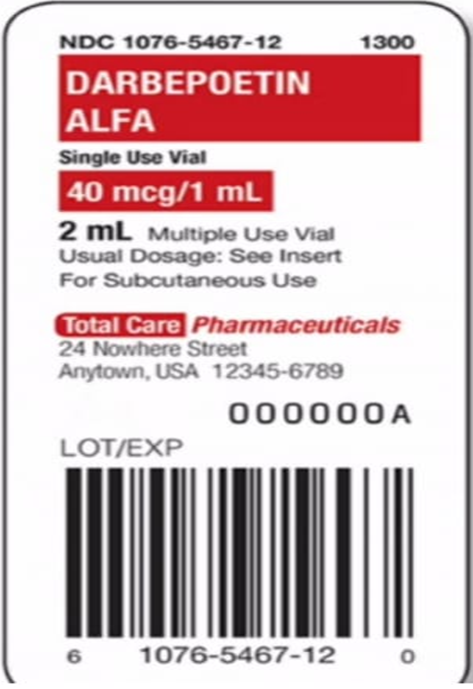
Ordered: Darbepoetin Alfa 12.5 mcg subcut weekly
On hand: See label
Full Explanation
Calculation:
Ordered dose: 12.5 mcg.
- Medication concentration from the label.
The label indicates a concentration of 40 mcg/1 mL or 40 mcg/mL.
- Calculate the volume to administer.
Volume (mL) = Desired Dose / Concentration
= 12.5 mcg / 40 mcg/mL
= 0.3125 mL.
- Rounded to the nearest hundredth
= 0.31 mL.
Find the flow rate for manual regulation: __________ (Round to the nearest whole number)
Ordered: 1,800 mL RL q12h using tubing calibrated to 15 gtt/mL
Full Explanation
Calculation:
- To find the flow rate in drops per minute (gtt/min), use the formula:
Flow rate (gtt/min) = (Total volume (mL) × Drop factor (gtt/mL)) / Time (min)
Total volume = 1,800 mL.
Drop factor = 15 gtt/mL.
- Convert the total time from hours to minutes.
Total time = 12 hours × 60 minutes/hour
= 720 minutes.
- Calculate the flow rate.
Flow rate = (1,800 mL × 15 gtt/mL) / 720 minutes
= 27,000 gtt / 720 minutes
= 37.5 gtt/min.
- Round the answer to the nearest whole number.
= 38 gtt/min.