
Nursing practice questions with comprehensive rationales
NurseDive Free Nursing Practice Question
Microdrip tubing has a drop factor of
A. 60 gtt/ml
60 gtt/mL: Microdrip tubing universally delivers 60 drops per milliliter (gtt/mL). It is used when precise, small-volume infusions are required, such as for pediatrics or medication titration.
B. 20 gtt/mL
20 gtt/mL: This is a common drop factor for macrodrip tubing, not microdrip. It delivers larger drops and is used for general fluid administration, not precise dosing.
C. 10 gtt/mL
10 gtt/mL: This drop factor also applies to macrodrip tubing, especially for rapid fluid replacement. It is not suitable for microdrip administration.
D. 15 gtt/mL
15 gtt/mL: Like 10 and 20, this is another macrodrip factor. It is used for routine fluid infusions, but does not provide the fine control offered by microdrip tubing.
This question is an excerpt from Nurse Dive's nursing test bank - Dosage calculation proctored exam (hellen fluid college). Take the full exam now
Full Explanation
A. 60 gtt/mL: Microdrip tubing universally delivers 60 drops per milliliter (gtt/mL). It is used when precise, small-volume infusions are required, such as for pediatrics or medication titration.
B. 20 gtt/mL: This is a common drop factor for macrodrip tubing, not microdrip. It delivers larger drops and is used for general fluid administration, not precise dosing.
C. 10 gtt/mL: This drop factor also applies to macrodrip tubing, especially for rapid fluid replacement. It is not suitable for microdrip administration.
D. 15 gtt/mL: Like 10 and 20, this is another macrodrip factor. It is used for routine fluid infusions, but does not provide the fine control offered by microdrip tubing.
Similar Questions
Calculate the amount of amoxicillin oral suspension to administer to an 8-year-old male who weighs 54 lb.
Ordered:
Amoxicillin, oral suspension, 40 mg/kg/day in divided doses q8h
On hand: Amoxicillin, oral suspension 250 mg/5 mL
Full Explanation
- Convert the patient's weight from pounds (lb) to kilograms (kg)
Patient's weight in kg = 54 lb / 2.2 lb/kg
= 24.5454 kg.
- Calculate the total daily dose in milligrams (mg).
Total daily dose = Ordered dose (mg/kg/day) × Patient's weight (kg)
= 40 mg/kg/day × 24.5454 kg
= 981.816 mg/day.
- Calculate the dose per administration (since the medication is given "q8h," which is 3 doses/day).
Dose per administration = Total daily dose (mg/day) / 3 doses/day
= 981.816 mg / 3
= 327.272 mg/dose.
- Determine the concentration of the available medication.
Available is 250 mg in 5 mL.
Concentration = 250 mg / 5 mL
= 50 mg/mL.
- Calculate the volume in milliliters (mL) to administer per dose.
Volume (mL) = Dose per administration (mg) / Concentration (mg/mL)
= 327.272 mg / 50 mg/mL
= 6.5454 mL/dose.
- Round the answer to the nearest hundredth.
= 6.55 mL/dose.
Jane Doe was given Tylenol for her fever at 8 a.m. At noon, her temperature was 39.2°C. What action should be taken at noon?
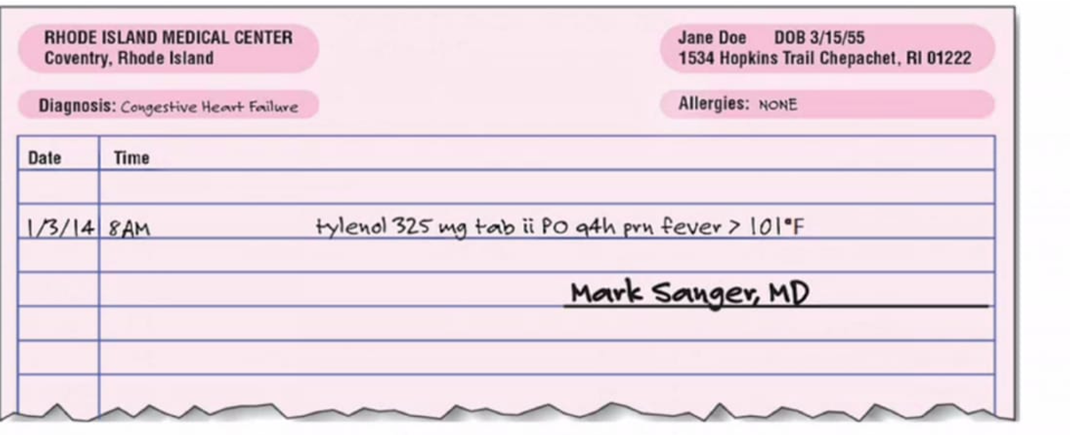
A. Do not administer Tylenol, her temperature is below 101°F
B. Administer one-half 325 mg Tylenol tablet.
C. Administer one 325 mg Tylenol tablet.
D. Administer two 325 mg Tylenol tablets.
Rationale: Check the time condition: The last dose was given at 8 a.m., and the order is for "q4h" (every 4 hours). At noon, exactly 4 hours have passed, so the time condition is met. Check the temperature condition: The patient's temperature is 39.2°C, but the order specifies a temperature in Fahrenheit (> 101°F). Convert to determine if the condition is met. Conversion: F= (C×1.8) + 32 = (39.2×1.8)+32 = 70.56+32 = 102.56°F Evaluate the order: The patient's temperature of 102.56°F is greater than the ordered condition of 101°F. Both the time and temperature conditions for administering the Tylenol have been met. The order is for "Tylenol 325 mg tab ii," which means two tablets of 325 mg each.
Full Explanation
Rationale:
- Check the time condition: The last dose was given at 8 a.m., and the order is for "q4h" (every 4 hours). At noon, exactly 4 hours have passed, so the time condition is met.
- Check the temperature condition: The patient's temperature is 39.2°C, but the order specifies a temperature in Fahrenheit (> 101°F).
Convert to determine if the condition is met.
Conversion: F= (C×1.8) + 32
= (39.2×1.8)+32
= 70.56+32
= 102.56°F
- Evaluate the order: The patient's temperature of 102.56°F is greater than the ordered condition of 101°F. Both the time and temperature conditions for administering the Tylenol have been met.
- The order is for "Tylenol 325 mg tab ii," which means two tablets of 325 mg each.
A 2-week-old infant's head circumference is measured to be 37.2 cm. This measurement, converted to millimeters, is ______________mm.
Full Explanation
Calculation:
- To convert centimeters (cm) to millimeters (mm), use the conversion factor of 10 mm per 1 cm.
1 cm = 10 mm
Measurement in mm = 37.2 cm × 10 mm/cm
= 372 mm.