Nursing practice questions with comprehensive rationales
NurseDive Free Nursing Practice Question
The healthcare provider prescribes the antibiotic tetracycline HCI for an adult client that arrived at an outpatient clinic. Which instruction should the nurse include in the teaching plan for this client?
A. Take with orange juice to enhance Gl absorption.
Choice A rationale: Tetracycline should generally be taken on an empty stomach, as certain food and beverages, including orange juice, can interfere with its absorption. The nurse should instruct the client to take tetracycline with water and on an empty stomach unless otherwise specified by the healthcare provider.
B. Protect the skin from sunlight while taking the drug.
Choice B rationale: Tetracycline is an antibiotic that can make the skin more sensitive to sunlight, leading to an increased risk of sunburn and photosensitivity reactions. To prevent these adverse effects, the nurse should instruct the client to protect their skin from sunlight while taking the medication. This includes using sunscreen, wearing protective clothing, and avoiding prolonged sun exposure. It is essential to educate the client about this potential side effect to ensure their safety and minimize skin reactions during treatment.
C. Return to the clinic weekly to obtain serum drug levels.
Choice C rationale: Tetracycline does not require routine monitoring of serum drug levels. It is an antibiotic with a well-established dosing regimen, and monitoring drug levels is not necessary for its safe and effective use.
D. Take with milk or antacids to prevent gastrointestinal (GI) irritation.
Choice D rationale: While taking tetracycline with milk or antacids may help reduce GI irritation, it can also interfere with the absorption of the medication. Therefore, it is generally recommended to take tetracycline with water and on an empty stomach to ensure optimal absorption and effectiveness.
This question is an excerpt from Nurse Dive's nursing test bank - Hesi Pharmacology Proctored Exam 2. Take the full exam now
Full Explanation
Choice A rationale: Tetracycline should generally be taken on an empty stomach, as certain food and beverages, including orange juice, can interfere with its absorption. The nurse should instruct the client to take tetracycline with water and on an empty stomach unless otherwise specified by the healthcare provider.
Choice B rationale: Tetracycline is an antibiotic that can make the skin more sensitive to sunlight, leading to an increased risk of sunburn and photosensitivity reactions. To prevent these adverse effects, the nurse should instruct the client to protect their skin from sunlight while taking the medication. This includes using sunscreen, wearing protective clothing, and avoiding prolonged sun exposure. It is essential to educate the client about this potential side effect to ensure their safety and minimize skin reactions during treatment.
Choice C rationale: Tetracycline does not require routine monitoring of serum drug levels. It is an antibiotic with a well-established dosing regimen, and monitoring drug levels is not necessary for its safe and effective use.
Choice D rationale: While taking tetracycline with milk or antacids may help reduce GI irritation, it can also interfere with the absorption of the medication. Therefore, it is generally recommended to take tetracycline with water and on an empty stomach to ensure optimal absorption and effectiveness.
Similar Questions
A client is receiving intravenous (IV) vancomycin and the nurse plans to draw blood for a peak and trough to determine the serum level of the drug. Which collection times provide the best determination of these levels?
A. Two hours after completion of the IV dose and two hours before the next administration of the medication.
Drawing the peak level two hours after the IV dose is too late to capture the drug's highest serum concentration. Similarly, drawing the trough two hours before the next dose does not reflect the lowest drug level accurately.
B. One hour after completion of the IV dose and one hour before the next administration of the medication.
Drawing the peak level one hour after completion of the IV dose ensures an accurate measurement of the highest serum concentration, as vancomycin typically peaks within this time frame. Drawing the trough one hour before the next dose ensures the lowest concentration of the drug is measured, providing precise therapeutic monitoring.
C. Thirty minutes into the administration of the IV dose and 30 minutes before the next administration of the medication.
This timing does not allow for accurate peak and trough level determination. The peak level should be drawn closer to the completion of the infusion (around 30 minutes), and the trough level should be drawn just before the next dose (within 30 minutes).
D. Immediately after completion of the IV dose and 30 minutes before the next administration of the medication.
Drawing the peak level immediately after the completion of the IV dose is too early, as the drug needs time to distribute in the bloodstream and reach its highest concentration. While drawing the trough 30 minutes before the next dose is appropriate, the incorrect timing of the peak makes this option unsuitable.
E. None
None
F. None
None
Full Explanation
choice A, Drawing the peak level two hours after the IV dose is too late to capture the drug's highest serum concentration. Similarly, drawing the trough two hours before the next dose does not reflect the lowest drug level accurately.
Choice B, Drawing the peak level one hour after completion of the IV dose ensures an accurate measurement of the highest serum concentration, as vancomycin typically peaks within this time frame. Drawing the trough one hour before the next dose ensures the lowest concentration of the drug is measured, providing precise therapeutic monitoring.
Choice C is incorrect because drawing blood 30 minutes into the IV dose would not allow the full dose to circulate and reach peak levels in the bloodstream.
Choice D. Drawing the peak level immediately after the completion of the IV dose is too early, as the drug needs time to distribute in the bloodstream and reach its highest concentration. While drawing the trough 30 minutes before the next dose is appropriate, the incorrect timing of the peak makes this option unsuitable.
A male client with a history of heart failure (HF) complains of heartburn when he lies down after dinner.
The home health nurse should encourage the client to talk to the healthcare provider about using which over-the-counter medication to relieve this problem?
A. Low sodium antacid.
Heartburn when lying down after dinner can be a symptom of gastroesophageal reflux disease (GERD), which is a common concern in individuals with heart failure. Antacids are commonly used to relieve heartburn by neutralizing stomach acid. For patients with heart failure, it is essential to use low sodium antacids because excess sodium intake can worsen fluid retention and lead to increased heart failure symptoms. Low sodium antacids are specifically designed to minimize the sodium content, making them a suitable choice for individuals with heart failure.
B. Diphenhydramine.
Diphenhydramine is an antihistamine commonly used for allergy relief and as a sleep aid due to its sedative effects. However, it is not an appropriate choice for relieving heartburn. Diphenhydramine does not have any direct effect on stomach acid, and it is not indicated for GERD or heartburn relief.
C. Low dose aspirin.
Low dose aspirin is primarily used as an antiplatelet agent to reduce the risk of blood clots and is commonly prescribed for patients with certain cardiovascular conditions. However, it is not a suitable medication for relieving heartburn. In fact, aspirin can irritate the stomach lining and worsen symptoms of heartburn and gastric irritation.
D. Acetaminophen.
Acetaminophen is a common over-the-counter pain reliever and fever reducer. While it is useful for managing pain and fever, it does not have any effect on stomach acid and is not indicated for heartburn relief. Acetaminophen is not an appropriate choice for addressing heartburn symptoms.
Full Explanation
Choice A rationale: Heartburn when lying down after dinner can be a symptom of gastroesophageal reflux disease (GERD), which is a common concern in individuals with heart failure. Antacids are commonly used to relieve heartburn by neutralizing stomach acid. For patients with heart failure, it is essential to use low sodium antacids because excess sodium intake can worsen fluid retention and lead to increased heart failure symptoms. Low sodium antacids are specifically designed to minimize the sodium content, making them a suitable choice for individuals with heart failure.
Choice B rationale: Diphenhydramine is an antihistamine commonly used for allergy relief and as a sleep aid due to its sedative effects. However, it is not an appropriate choice for relieving heartburn. Diphenhydramine does not have any direct effect on stomach acid, and it is not indicated for GERD or heartburn relief.
Choice C rationale: Low dose aspirin is primarily used as an antiplatelet agent to reduce the risk of blood clots and is commonly prescribed for patients with certain cardiovascular conditions. However, it is not a suitable medication for relieving heartburn. In fact, aspirin can irritate the stomach lining and worsen symptoms of heartburn and gastric irritation.
Choice D rationale: Acetaminophen is a common over-the-counter pain reliever and fever reducer. While it is useful for managing pain and fever, it does not have any effect on stomach acid and is not indicated for heartburn relief. Acetaminophen is not an appropriate choice for addressing heartburn symptoms.
The nurse is providing instructions about a client's new medications. How should the nurse explain the purpose of probenecid, a uricosuric drug?
A. Prevents the formation of kidney stones.
Probenecid does not prevent kidney stones. Its primary function is to increase the excretion of uric acid in the urine.
B. Increases the strength of the urine stream.
Probenecid does not affect the strength of the urine stream. Its action is specific to uric acid excretion.
C. Decreases pain and burning during urination
Probenecid is not used to alleviate pain and burning during urination. Its main indication is for gout and hyperuricemia.
D. Promotes excretion of uric acid in the urine.
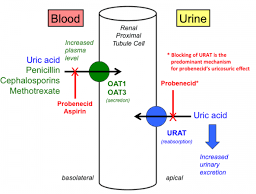
Probenecid is a uricosuric drug used to treat gout and hyperuricemia. It works by inhibiting the reabsorption of uric acid in the kidneys, which promotes its excretion in the urine. By increasing uric acid excretion, probenecid helps to reduce the concentration of uric acid in the blood and prevent gout attacks.
Full Explanation
Choice A rationale: Probenecid does not prevent kidney stones. Its primary function is to increase the excretion of uric acid in the urine.
Choice B rationale: Probenecid does not affect the strength of the urine stream. Its action is specific to uric acid excretion.
Choice C rationale: Probenecid is not used to alleviate pain and burning during urination. Its main indication is for gout and hyperuricemia.
Choice D rationale: Probenecid is a uricosuric drug used to treat gout and hyperuricemia. It works by inhibiting the reabsorption of uric acid in the kidneys, which promotes its excretion in the urine. By increasing uric acid excretion, probenecid helps to reduce the concentration of uric acid in the blood and prevent gout attacks.