Nursing practice questions with comprehensive rationales
NurseDive Free Nursing Practice Question
The home health nurse is assessing a 17-year-old pregnant client at 34 weeks of gestation who has been diagnosed with preeclampsia. Upon assessment, the nurse finds that the client has gained 2 pounds in the past week and her blood pressure is 144/92 mmHg. Which assessment finding would require further action by the nurse?
A. Visual disturbances
Visual disturbances would require further action by the nurse as they can be a sign of worsening preeclampsia and a potential indication for immediate medical attention. The client's recent weight gain and elevated blood pressure are also concerning findings, but visual disturbances are a more urgent symptom. Frequent voiding in large amounts and 1+ pedal edema are common in pregnancy, while one headache in the past week may or may not be significant depending on the context.
B. Frequent voiding in large amounts
C. 1+ pedal edema
D. One headache in the past week
This question is an excerpt from Nurse Dive's nursing test bank - Final Exam OB + Community Proctored Exam. Take the full exam now
Full Explanation
Visual disturbances would require further action by the nurse as they can be a sign of worsening preeclampsia and a potential indication for immediate medical attention. The client's recent weight gain and elevated blood pressure are also concerning findings, but visual disturbances are a more urgent symptom. Frequent voiding in large amounts and 1+ pedal edema are common in pregnancy, while one headache in the past week may or may not be significant depending on the context.
Similar Questions
A nurse is administering a magnesium sulfate infusion for a client with severe preeclampsia. The nurse knows that the goal of magnesium sulfate therapy is to:
A. Lower blood pressure in the hypertensive client.
B. Shorten the duration of the labor induction.
C. Prevent a boggy uterus and lessen lochial flow after delivery.
D. Prevent and treat seizure activity.
Magnesium sulfate is a medication commonly used to prevent and treat seizure activity in pregnant women with preeclampsia and eclampsia. It works by decreasing neuromuscular irritability and depressing the central nervous system.
Full Explanation
Magnesium sulfate is a medication commonly used to prevent and treat seizure activity in pregnant women with preeclampsia and eclampsia. It works by decreasing neuromuscular irritability and depressing the central nervous system.
Which of the following patients is most at risk for uterine rupture?
A. A G3P2 whose youngest child is 3 years old.
B. A G2P1 who has had one prior lower transverse cesarean section.
C. A CS4 who has had three prior lower transverse cesarean sections.
A CS4 who has had three prior lower transverse cesarean sections is at the highest risk for uterine rupture. The risk of uterine rupture increases with each subsequent cesarean section, and a history of three or more prior lower transverse cesarean sections is considered a significant risk factor for uterine rupture.
D. AG4P3 whose last baby was born at term gestation.
Full Explanation
A CS4 who has had three prior lower transverse cesarean sections is at the highest risk for uterine rupture. The risk of uterine rupture increases with each subsequent cesarean section, and a history of three or more prior lower transverse cesarean sections is considered a significant risk factor for uterine rupture.
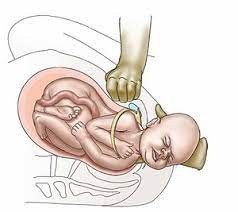
The nurse anticipates the vaginal delivery of a client who has been induced for macrosomia. The provider asks the nurse to apply suprapubic pressure. The nurse knows that suprapubic pressure is applied:
A. At the maternal umbilicus.
B. Over the symphysis pubis.
Suprapubic pressure aids in the delivery of the fetal shoulders, and delivery of the fetal head. to control postpartum hemorrhage and to assess uterine tone after delivery.
C. Lower left quadrant of the abdomen.
D. At the fundus of the uterus.
Full Explanation
Suprapubic pressure aids in the delivery of the fetal shoulders, and delivery of the fetal head. to control postpartum hemorrhage and to assess uterine tone after delivery.