Nursing practice questions with comprehensive rationales
NurseDive Free Nursing Practice Question
Which of the following patients is most at risk for uterine rupture?
A. A G3P2 whose youngest child is 3 years old.
B. A G2P1 who has had one prior lower transverse cesarean section.
C. A CS4 who has had three prior lower transverse cesarean sections.
A CS4 who has had three prior lower transverse cesarean sections is at the highest risk for uterine rupture. The risk of uterine rupture increases with each subsequent cesarean section, and a history of three or more prior lower transverse cesarean sections is considered a significant risk factor for uterine rupture.
D. AG4P3 whose last baby was born at term gestation.
This question is an excerpt from Nurse Dive's nursing test bank - Final Exam OB + Community Proctored Exam. Take the full exam now
Full Explanation
A CS4 who has had three prior lower transverse cesarean sections is at the highest risk for uterine rupture. The risk of uterine rupture increases with each subsequent cesarean section, and a history of three or more prior lower transverse cesarean sections is considered a significant risk factor for uterine rupture.
Similar Questions
The nurse anticipates the vaginal delivery of a client who has been induced for macrosomia. The provider asks the nurse to apply suprapubic pressure. The nurse knows that suprapubic pressure is applied:
A. At the maternal umbilicus.
B. Over the symphysis pubis.
Suprapubic pressure aids in the delivery of the fetal shoulders, and delivery of the fetal head. to control postpartum hemorrhage and to assess uterine tone after delivery.
C. Lower left quadrant of the abdomen.
D. At the fundus of the uterus.
Full Explanation
Suprapubic pressure aids in the delivery of the fetal shoulders, and delivery of the fetal head. to control postpartum hemorrhage and to assess uterine tone after delivery.
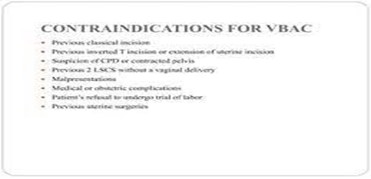
Which of the following women is the best candidate for vaginal birth after cesarean (VBAC)?
A. Client who had a breech presentation in her last pregnancy and this pregnancy is a vertex presentation.
B. Client who dilated to 6 cm in her last delivery and failed to progress beyond this point after more than 5 hours of labor.
C. Client who had an emergency cesarean section because of fetal distress with a classical incision.
D. Diabetic client whose last infant was over 10 lbs., and the provider suspects this infant is larger due to the current ultrasound result.
Full Explanation
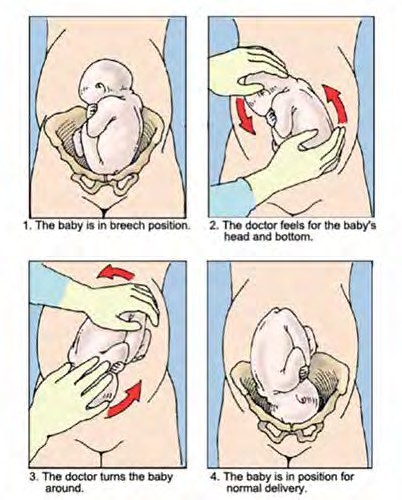
The nurse is caring for a term gestation pregnant patient who came into the office for an external cephalic version. Which of the following interventions would not be appropriate for this patient?
A. Verify the patient's blood type and prepare RhoGAM † necessary.
B. Have the patient ambulate before the procedure to see if the baby will turn.
The patient should not be ambulating before the procedure as this may cause fetal descent and prevent the success of the version. The other interventions listed are appropriate and important for the safety and well-being of the patient and the fetus during the procedure.
C. Have the patient empty her bladder before the procedure.
D. Assess for contractions and fetal heart rate pattern before the procedure.
Full Explanation
The patient should not be ambulating before the procedure as this may cause fetal descent and prevent the success of the version. The other interventions listed are appropriate and important for the safety and well-being of the patient and the fetus during the procedure.