
Nursing practice questions with comprehensive rationales
NurseDive Free Nursing Practice Question
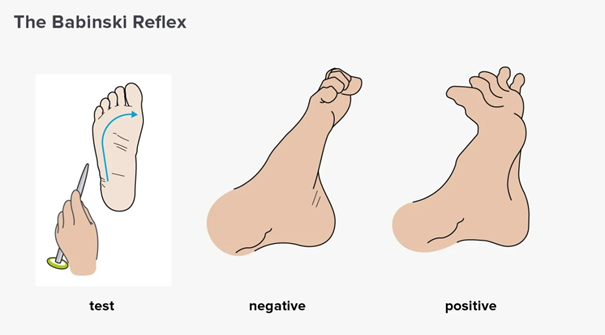
The nurse documents an abnormal finding from the Babinski reflex as a (the):
A. toes turning up and spreading
Toes turning up and spreading:This description corresponds to the abnormal finding in the Babinski reflex. In a positive Babinski sign, the big toe (hallux) dorsiflexes (turns upward) and the other toes fan out. This response is abnormal in adults but normal in infants up to a certain age.
B. downward curl of the toes
Downward curl of the toes:This response is typical of the normal plantar reflex, where the toes curl downward (plantar flexion) in response to stimulation of the sole of the foot. It is not indicative of the Babinski reflex.
C. pain in the big toe
Pain in the big toe: Pain in the big toe is not a characteristic finding of the Babinski reflex. The Babinski sign is assessed by observing the movement pattern of the toes in response to stimulation, rather than eliciting pain.
D. big toe bending upward
Big toe bending upward:The big toe bending upward, or dorsiflexion of the big toe, is a specific component of the positive Babinski sign. However, it is typically accompanied by spreading of the other toes, which is the hallmark feature of the Babinski reflex.
This question is an excerpt from Nurse Dive's nursing test bank - Ati Lpn Med Surg Neuro Test 2024 Proctored Exam. Take the full exam now
Full Explanation
A. Toes turning up and spreading:
This description corresponds to the abnormal finding in the Babinski reflex. In a positive Babinski sign, the big toe (hallux) dorsiflexes (turns upward) and the other toes fan out. This response is abnormal in adults but normal in infants up to a certain age.
B. Downward curl of the toes:
This response is typical of the normal plantar reflex, where the toes curl downward (plantar flexion) in response to stimulation of the sole of the foot. It is not indicative of the Babinski reflex.
C. Pain in the big toe:
Pain in the big toe is not a characteristic finding of the Babinski reflex. The Babinski sign is assessed by observing the movement pattern of the toes in response to stimulation, rather than eliciting pain.
D. Big toe bending upward:
The big toe bending upward, or dorsiflexion of the big toe, is a specific component of the positive Babinski sign. However, it is typically accompanied by spreading of the other toes, which is the hallmark feature of the Babinski reflex.
Similar Questions
A nurse is preparing to administer valproic acid 500 mg PO. Available is valproic acid oral solution 250 mg/5 mL. How many mL should the nurse administer? (Round the answer to the nearest whole number. Use a leading zero if it applies. Do not use a trailing zero.)
Full Explanation
To calculate the dose of valproic acid oral solution, the nurse should use the following formula:
Dose (mL) = Ordered dose (mg) / Concentration (mg/mL) x Volume (mL)
Plugging in the values from the question, we get:
Dose (mL) = 500 mg / (250 mg / 5 mL) x 5 mL
Simplifying, we get:
Dose (mL) = 500 mg / 50 mg x 5 mL
Dose (mL) = 10 mL
Therefore, the nurse should administer 10 of valproic acid oral solution to the patient.
A nurse is preparing to administer phenytoin 75 mg PO. Available is phenytoin suspension 25 mg/5 mL. How many mL should the nurse administer? (Round the answer to the nearest whole number. Use a leading zero if it applies. Do not use a trailing zero.)
Full Explanation
To calculate the dose of phenytoin suspension, the nurse should use the following formula:
Dose (mL) = Desired dose (mg) / Concentration (mg/mL) x Volume (mL)
Plugging in the values from the question, we get:
Dose (mL) = 75 mg / (25 mg/5 mL) x 5 mL
Dose (mL) = 15 mL
Therefore, the nurse should administer 15 mL of phenytoin suspension to the patient
A patient with Parkinson's disease asks the nurse why anticholinergics are used in the treatment. Which response by the nurse is most accurate?
A. "These drugs inhibit the action of acetylcholine
"These drugs inhibit the action of acetylcholine":This response is accurate. Anticholinergic medications work by blocking the action of acetylcholine, a neurotransmitter involved in various functions in the body, including muscle control. In Parkinson's disease, there is an imbalance between dopamine and acetylcholine, leading to motor symptoms such as tremors and rigidity. By inhibiting the action of acetylcholine, anticholinergic drugs help rebalance neurotransmitter activity and alleviate some of the motor symptoms associated with Parkinson's disease.
B. "These drugs help you urinate."
"These drugs help you urinate":This statement is not directly related to the use of anticholinergic medications in Parkinson's disease. While some anticholinergic drugs can indeed relax the smooth muscle of the bladder and improve urinary symptoms, this is not the primary indication for their use in Parkinson's disease.
C. "These drugs will decrease your eye pressure."
"These drugs will decrease your eye pressure": While anticholinergic medications can be used to dilate the pupils and decrease intraocular pressure, this is not typically the reason for their use in Parkinson's disease. While some anticholinergic medications may have ocular effects, they are primarily used to address motor symptoms associated with Parkinson's disease.
D. "These drugs will assist in lowering your heart rate."
"These drugs will assist in lowering your heart rate":While some anticholinergic medications may have effects on heart rate by blocking parasympathetic nervous system activity, this is not the primary indication for their use in Parkinson's disease. The focus of anticholinergic therapy in Parkinson's disease is primarily on addressing motor symptoms rather than cardiovascular effects.
Full Explanation
A. "These drugs inhibit the action of acetylcholine":
This response is accurate. Anticholinergic medications work by blocking the action of acetylcholine, a neurotransmitter involved in various functions in the body, including muscle control. In Parkinson's disease, there is an imbalance between dopamine and acetylcholine, leading to motor symptoms such as tremors and rigidity. By inhibiting the action of acetylcholine, anticholinergic drugs help rebalance neurotransmitter activity and alleviate some of the motor symptoms associated with Parkinson's disease.
B. "These drugs help you urinate":
This statement is not directly related to the use of anticholinergic medications in Parkinson's disease. While some anticholinergic drugs can indeed relax the smooth muscle of the bladder and improve urinary symptoms, this is not the primary indication for their use in Parkinson's disease.
C. "These drugs will decrease your eye pressure":
While anticholinergic medications can be used to dilate the pupils and decrease intraocular pressure, this is not typically the reason for their use in Parkinson's disease. While some anticholinergic medications may have ocular effects, they are primarily used to address motor symptoms associated with Parkinson's disease.
D. "These drugs will assist in lowering your heart rate":
While some anticholinergic medications may have effects on heart rate by blocking parasympathetic nervous system activity, this is not the primary indication for their use in Parkinson's disease. The focus of anticholinergic therapy in Parkinson's disease is primarily on addressing motor symptoms rather than cardiovascular effects.